- KPI – June 2026: The Brief
- KPI – June 2026: State of Manufacturing
- KPI – June 2026: State of Business – Automotive Industry
- KPI – June 2026: State of the Economy
- KPI – June 2026: Recent Vehicle Recalls
Below is a synopsis of consumer sentiment, confidence, demand and income/spending trends.
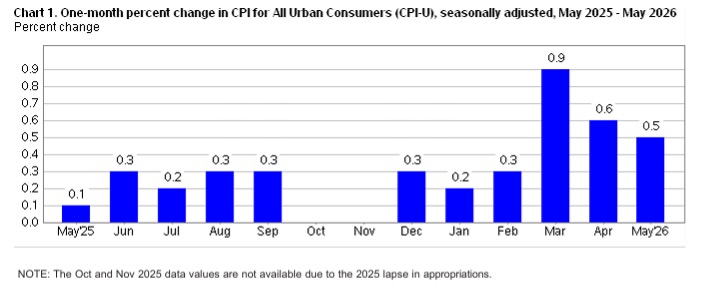
In May, the Consumer Price Index for All Urban Consumers (CPI-U) increased 0.5% on a seasonally-adjusted basis after rising 0.6% in April, according to the U.S. Bureau of Labor Statistics. Over the last 12 months, the all-items index increased 4.2% before seasonal adjustment.
Most recently, the energy index rose 3.9% in May, after rising 3.8% in April and 10.9% in March. The energy index accounted for over 60% of the monthly all-items increase. In addition, the index for shelter edged up month-over-month, up 0.3%. The food index increased 0.2%, as the food-at-home index rose 0.1% and the food-away-from-home index increased 0.3%.
The index for all-items-less-food-and-energy rose 0.2% in May. Indexes on the climb include communication, airline fares, medical care, personal care and recreation, while motor vehicle insurance, household furnishings and operations, as well as new vehicles decreased in May.
The all-items index rose 4.2% year-over-year, after rising 3.8% last month. The all-items-less-food-and-energy index rose 2.9% over the year, following a 2.8% increase over the 12 months ending April. The energy index increased 23.5%, while the food index increased 3.1% over the last year.
Sentiment
The University of Michigan Survey of Consumers — a survey consisting of approximately 50 core questions covering consumers’ assessments of their personal financial situation, buying attitudes and overall economic conditions — registered 44.8 in May and posted a preliminary reading of 48.9 in June.
“This month, consumer sentiment ticked up about four index points, or 9%, with consumers experiencing some relief due to the early-month easing in gasoline prices. This measured improvement in sentiment was widespread across age, education and political party. Lower-income consumers exhibited a particularly strong sentiment increase, consistent with the fact that gasoline comprises a larger share of their budgets,” according to Joanne Hsu, director at Survey of Consumers.
Overall, assessments and expectations of personal finances and business conditions all rose month-over-month. Even with June’s early gains, Hsu says views of the economy are still relatively dour.
“Sentiment is currently 13% below January 2026 and 19% below a year ago, as consumers remain focused on kitchen table issues,” she notes. “They feel burdened by the recent escalation in inflation and worry that higher inflation could remain stubborn going forward, particularly in the short run.”
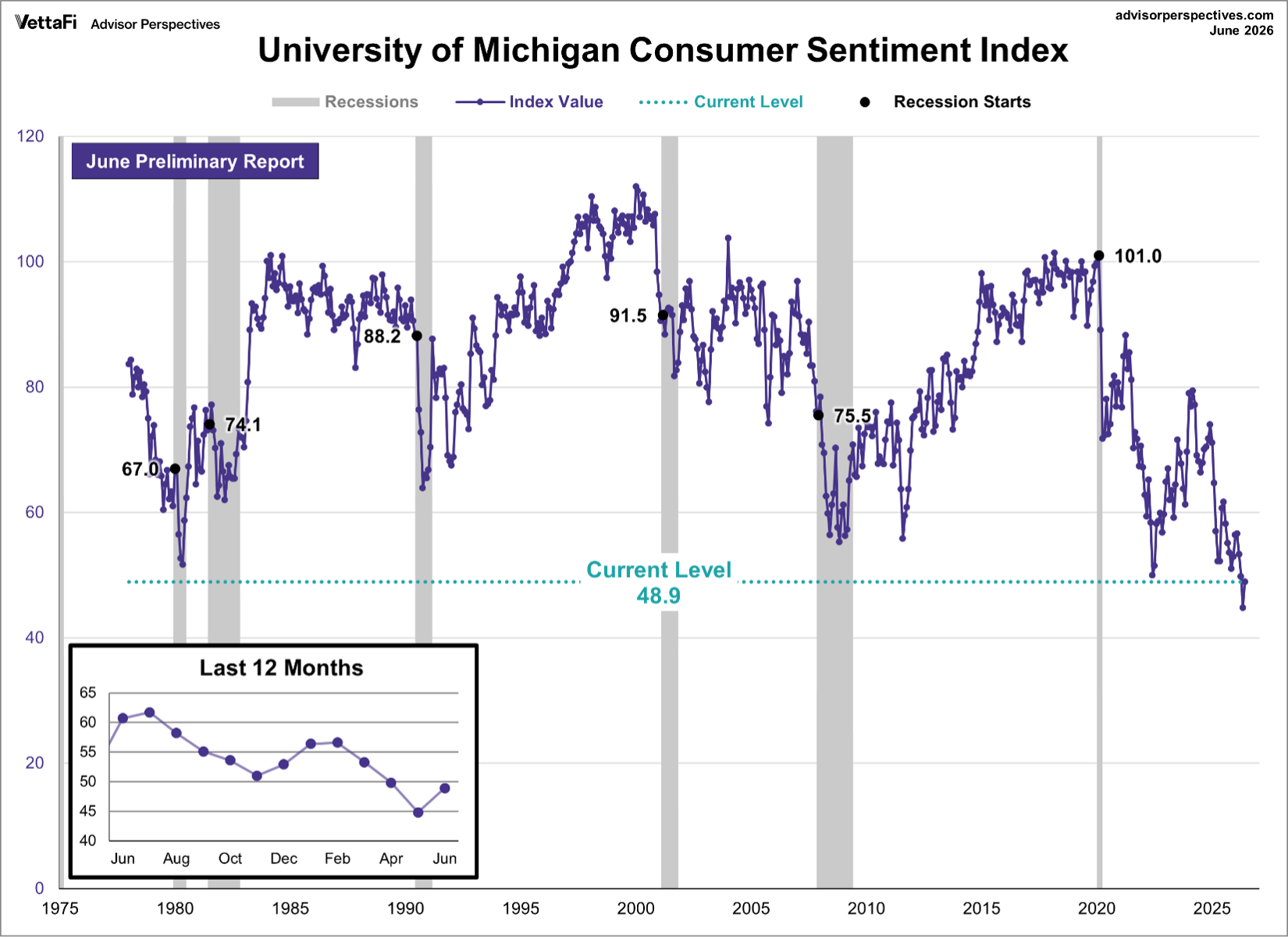 Caption: To put today’s report in historical context, consumer sentiment is currently 41.6% below its average reading of 83.8 (arithmetic mean) and 40.8% below its geometric mean of 82.5, based on data dating back to 1978.
Key Takeaways, Courtesy of Survey of Consumers:
- Year-ahead inflation expectations inched down from 4.8% in May to a still-elevated 4.6% this month. The current reading substantially exceeds the 3.4% reading seen in February 2026, prior to the start of the Iran conflict, along with all 2024 readings.
- Long-run inflation expectations dropped from 3.9% last month to 3.4% in June, remaining notably higher than the 2.8% to 3.2% range seen in 2024.
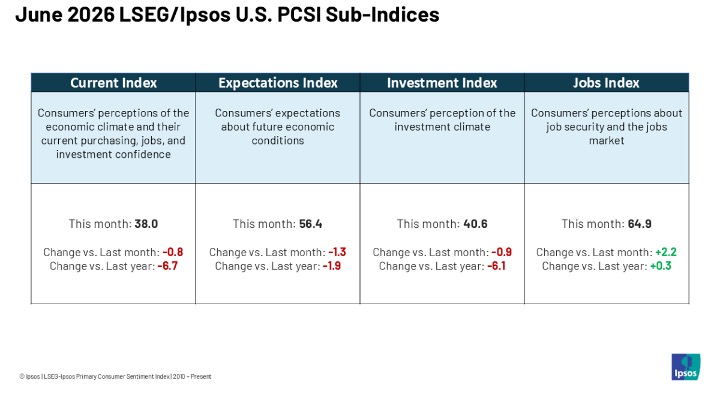 Caption: The LSEG/Ipsos Primary Consumer Sentiment Index for June 2026 is at 49.1. Fielded from May 22-29, 2026, the Index is down 0.5 points from last month.
Confidence
Editor’s note: The data for the Confidence section and the Key Takeaways below have not yet been released for June. The information below is from the May KPI report. We will update this section as soon as the data is available.
The Conference Board Consumer Confidence Index dipped 0.7 points to 93.1 (1985=100) in May, down from an upwardly revised 93.8 in April. The Present Situation Index—based on consumers’ assessment of current business and labor market conditions—retreated by 3.2 points to 121.2. The Expectations Index—based on consumers’ short-term outlook for income, business and labor market conditions—rose to 74.4.
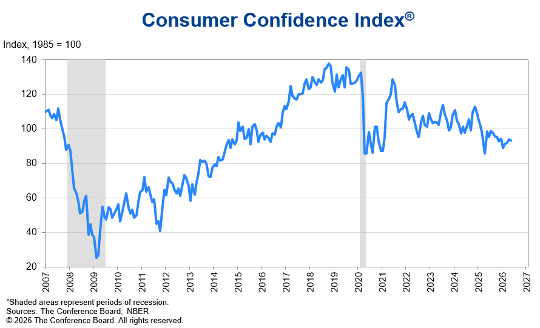
“Consumer confidence edged downward in May as the inflationary impacts of the war in the Middle East intensified. Consumer appraisals of current business conditions and the current labor market were moderately less positive compared to last month. This was somewhat offset by modest improvements in consumers’ expectations for business conditions and the labor market six months from now. Meanwhile, income expectations eased in May, as those anticipating less income rose,” says Dana M. Peterson, chief economist at The Conference Board.
Data shows confidence ticked up for consumers aged 35–54, but trended downward for older and younger consumers, both month-over-month and on a six-month moving average basis. Confidence among higher-income groups trended upward on a six-month moving average basis. By generation, confidence improved for the Silent Generation (the oldest group) but was little changed or lower among other generations. Republicans remained the most optimistic, while Independents were the only group that saw confidence tick up on a month-over-month basis.
Key Takeaways, Courtesy of The Conference Board
- Consumers’ net views of their Family’s Current Financial Situation and Family’s Future Financial Situation were both somewhat less positive in May.
- The share of consumers who said a U.S. recession is “very likely” and “somewhat likely” over the next 12 months increased. Those saying recession is “not likely” declined.
- Consumers’ average and median 12-month inflation expectations ticked downward but remained elevated. The percentage of consumers saying interest rates over the next 12 months will be higher on net stood at nearly 50% in May.
- The ongoing stock market rally—largely fueled by the tech sector and rising hopes for an end to the Middle East conflict—likely influenced consumer expectations of higher stock prices a year from now.
- Consumers’ plans to buy big-ticket items over the next six months continued to shift from “yes” to “no” in May. Nonetheless, the proportion saying “yes” remained well above the other responses. Buying plans for autos continued to rise on a six-month moving average basis, with used cars remaining the clear preference over new cars. Homebuying expectations inched higher, as plans to buy existing homes rose, offsetting a small dip in newly-built units. Spending plans for white goods, home furnishings and electronics eased a tad or were unchanged on a six-month moving average basis.
- Consumers planning more spending on services over the next six months shifted from “yes” and “maybe” to “no” in May. Future spending plans on services were mixed. Consumer spending trends in 2026 remained focused on “cheap thrills” and necessary services, but there was some increase in demand for discretionary services like personal travel, fitness, amusement parks and gambling. Among all service categories, restaurants/bars/take-out, streaming/internet/mobile services, as well as beauty and personal care, remained among the top three spending targets.
- Travel intentions for six months ahead ticked up in May, with consumers favoring domestic destinations over international travel. Overall expected spending on hotel/motel and airfare/trains for personal travel increased in May, correlating with an uptick in vacation plans.
“Consumers’ write-in responses on factors affecting the economy continued to skew towards pessimism. References to prices and oil and gas increased in frequency for a second consecutive month, while mentions of war, geopolitics and conflict remained elevated—likely signaling consumers’ underlying concerns about the inflationary impacts of the war in the Middle East on their wallets,” Peterson says.
Consumer Income & Spending
According to the U.S. Bureau of Economic Analysis (BEA), personal income, disposable income (DPI) and personal consumer expenditures (PCE) increased $181.6 billion (0.7% at a monthly rate), $164.9 billion (0.7%) and $156.1 billion (0.7%), respectively, in May.
Personal outlays — the sum of PCE, personal interest payments and personal current transfer payments — increased $159.9 billion. Personal saving was $704.2 billion, while the personal saving rate — personal saving as a percentage of DPI — registered 3%.
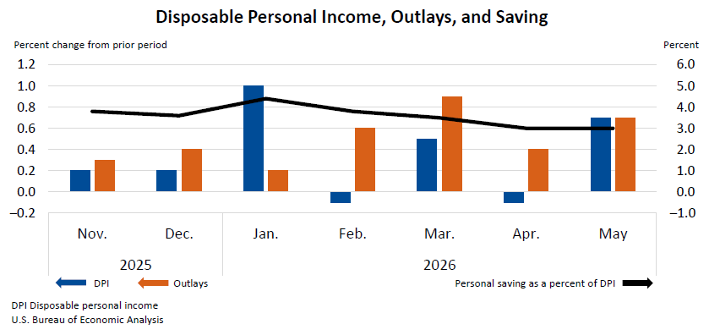
Key Takeaways, Courtesy of the U.S. Bureau of Economic Analysis:
- In May, the $156.1 billion increase in current-dollar PCE reflected increases of $94.3 billion in spending on services and $61.8 billion in spending on goods.
- Real PCE increased $43.8 billion (0.3% at a monthly rate), while the PCE price index increased 0.4%. Excluding food and energy, the PCE price index increased 0.3% since last month. The PCE price index increased 4.1% year-over-year. Excluding food and energy, it increased 3.4% from one year ago.