
- KPI – May 2026: The Brief
- KPI – May 2026: State of Business – Automotive Industry
- KPI – May 2026: State of Manufacturing
- KPI – May 2026: Consumer Trends
- KPI – May 2026: Recent Vehicle Recalls
Employment
Total nonfarm payroll employment edged up by 115,000 in April—down from the 185,000 created in March but outperforming the 55,000 forecast. Job gains occurred in health care, retail trade, as well as transportation and warehousing. Federal government employment continued to decline.
The report is “evidence of the underlying resilience of this economy and of this labor market, despite all of the slings and arrows of outrageous concerns about the Middle East and unemployment and inflation and the Fed,” says Scott Clemons, chief investment strategist at Brown Brothers Harriman.
He acknowledges new trends are not established in one month. There has been a lot of month-to-month volatility in the jobs market over the past year.
“I’m not sure that’s completely gone away. We get another two or three months of solid job gains, then I feel a little bit more comfortable,” he adds.
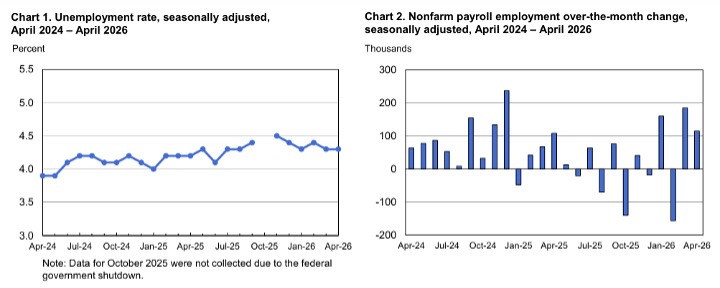
According to the U.S. Bureau of Labor Statistics, the unemployment rate and number of unemployed persons were relatively unchanged at 4.3% and 7.4 million, respectively. Data shows a broader measure that includes discouraged workers and those holding part-time jobs for economic reasons rose to 8.2%, up 0.2 percentage point.
“The household survey, which the bureau uses to calculate the unemployment rate, showed a decline of 226,000 workers as the participation rate declined to 61.8%, the lowest since October 2021,” according to recent reports.
In addition, wages rose less than expected, with average hourly earnings increasing 0.2% for the month and 3.6% on an annual basis. According to CNBC, economists predicted readings of 0.3% and 3.8%, respectively.
“[Overall,] more solid jobs data leaves the Fed where it’s been for a while—watching and waiting, focused on the inflation side of its mandate. Rate cuts still aren’t on the near-term horizon, but the absence of inflationary threats in today’s report should quiet some of the chatter about a potential hike,” says Ellen Zentner, chief economic strategist for Morgan Stanley Wealth Management.
Lindsay Rosner, head of multi-sector fixed income investing at Goldman Sachs asset management, notes the report does not make cutting more likely and that the Fed “will shift its focus to containing upside inflation risks now that the labor market appears back on track.”
“The FOMC could well feel compelled to remove the easing bias from its next post-meeting statement in June, which would suggest the hawks are gaining the upper hand on the committee for the time being. Strong data and inflation have likely put paid to any easing in the foreseeable future, though this could change depending on how energy prices and the situation in the Middle East develop,” Rosner adds.
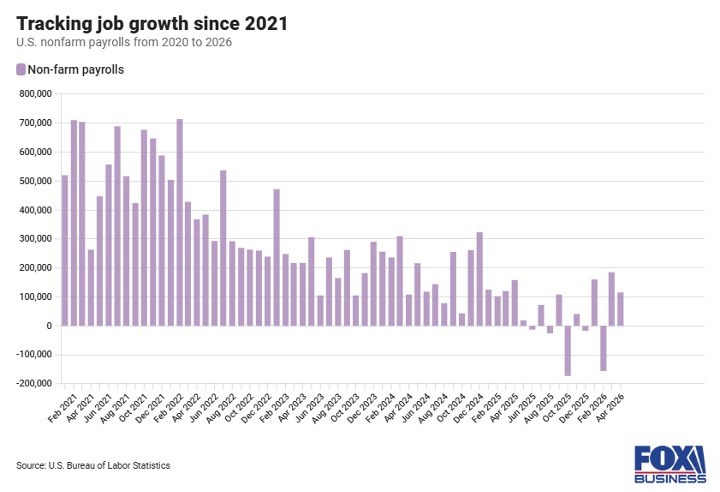 Caption: Wages rose less than expected. Average hourly earnings increased 0.2% for the month and 3.6% from a year ago, 0.1 and 0.2 percentage points, respectively, below forecast.
By Demographic
This month, unemployment among the major worker groups: adult women – 3.9%; adult men – 4%; teenagers – 14.4%; Asians – 3.3%; Whites – 3.7%; Hispanics – 5%; and Blacks – 7.3%.
Last month, unemployment among the major worker groups: adult women – 4%; adult men – 3.8%; teenagers – 13.7%; Asians – 3.7%; Whites – 3.6%; Hispanics – 4.8%; and Blacks – 7.1%.
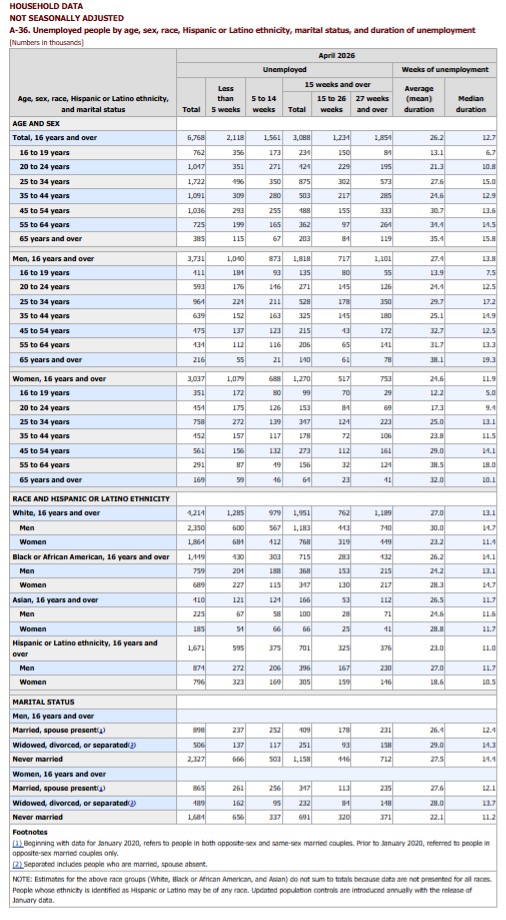 Image Source:
 By Industry
The Conference Board Employment Trends Index (ETI) increased to 105.77 in April, from a downwardly revised reading of 105.52 in March.
“The ETI rose in April on the back of a healthy Employment Report,” says Mitchell Barnes, economist at The Conference Board. “The index’s recent stability is a notable break from the ETI’s downward drift throughout 2025. The private sector has gained momentum, while federal government jobs continue to decline.”
April’s increase in the Employment Trends Index was a result of positive contributions from seven of its eight components: the Percentage of Respondents Who Say They Find Jobs Hard to Get, the Percentage of Firms with Positions Not Able to Fill Right Now, Job Openings, Initial Claims for Unemployment Insurance, Real Manufacturing and Trade Sales, the Number of Employees Hired by the Temporary-Help Industry and Industrial Production. One component contributed negatively: the Ratio of Involuntarily Part-time to All Part-time Workers.
“This month’s increase in the ETI was broad-based with positive contributions from 7 of its 8 components, which underscored the labor market’s continued resilience,” Barnes says. “However, challenges to the outlook include potential economic disruptions from geopolitical tensions as well as AI-driven layoff announcements.”
Key Takeaways, Courtesy of ETI
- The share of consumers who report “jobs are hard to get”—an ETI component from the Consumer Confidence Survey—declined 1.5 percentage points to 19.8% in April, the lowest since the beginning of the year.
- The share of small firms reporting that jobs are “not able to be filled right now” increased from 32% to 34%, rising to its highest level since June 2025.
- Initial claims for unemployment insurance declined to 203,300, continuing to fall from 2025 levels and reaching a near-historic low at the end of April.
- Employment in the temporary help services industry rose this month, now contributing positively to the ETI for four consecutive months.
- Both industrial production and real manufacturing and trade sales increased slightly in April.
- The only negative contribution came from the share of involuntary part-time workers, which rose to 17.9%, slightly above the 2025 average of 17.5%.
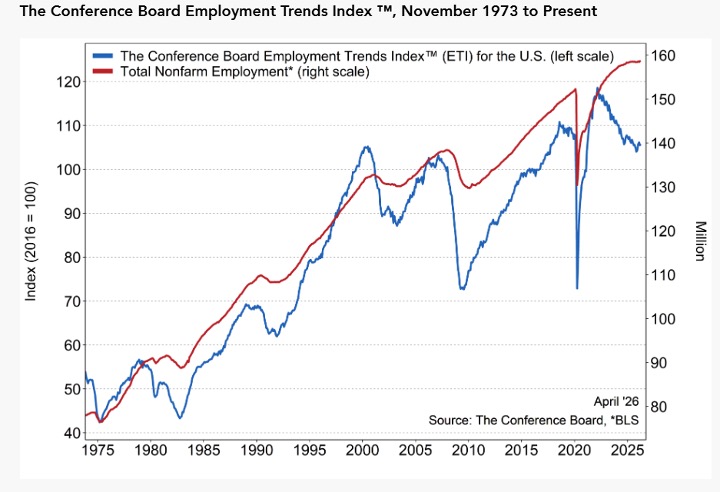 Caption: The Employment Trends Index is a leading composite index for payroll employment. When the Index increases, employment is likely to grow as well, and vice versa. Turning points in the Index indicate that a change in the trend of job gains or losses is about to occur in the coming months.
Click here to view more detailed information by industry.