
KPI – March 2026: The Brief
KPI – March 2026: State of Business – Automotive Industry
KPI – March 2026: State of Manufacturing
KPI – March 2026: Consumer Trends
KPI – March 2026: Recent Vehicle Recalls
Employment
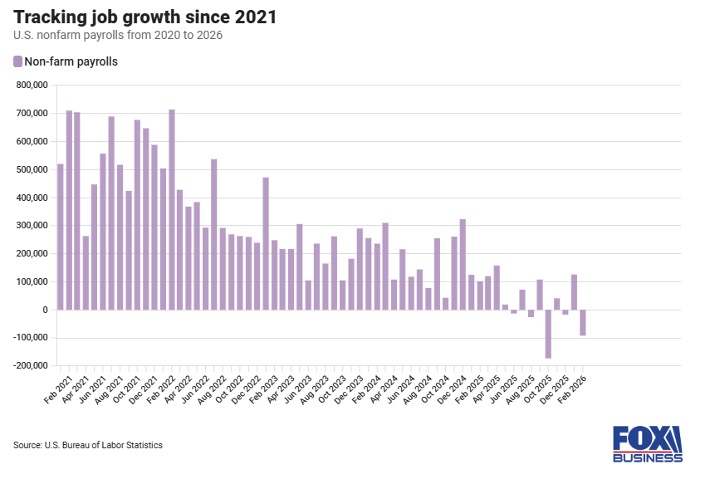
Total nonfarm payroll employment edged down by 92,000 in February—compared with an estimate of 50,000 and below the downwardly revised January total of 126,000. Employment trended down in various sectors, including information, federal government and health care.
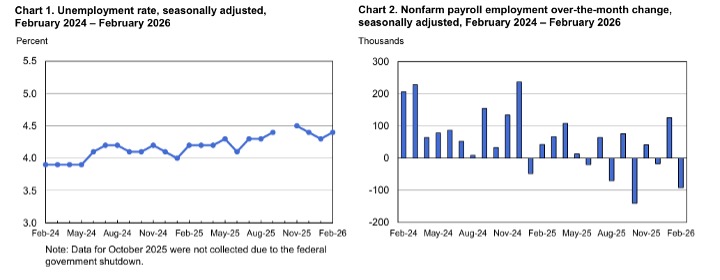
According to the U.S. Bureau of Labor Statistics, the unemployment rate and number of unemployed persons edged up to 4.4% and 7.6 million, respectively. A broader measure of unemployment includes discouraged workers and those holding part-time positions for economic reasons. In February, the stats dipped to 7.9%, or 0.2 percentage points below the January level. In addition, the labor force participation and long-term unemployed (those jobless for 27 weeks or more) rates registered 62% and 25.3%, respectively.
“I think it just tells us hopes that the labor market was steadying, maybe that was too much,” says Mary Daly, president of the Federal Reserve Bank of San Francisco. “We also have inflation printing above target and oil prices rising. How long they last, we don’t know, but both of our goals are risks now, and we have to keep our eyes on both.”
According to Elyse Ausenbaugh, head of investment strategy at JPMorgan Wealth Management, the answer is more complex. She states there are “a handful of things” that may have distorted February’s data, including winter storms possibly impacting a weakness in construction, as well as nursing strikes in health care. Still, she agrees the pace of job gains over the last few months is dramatically slower than it was in 2024 and much of 2025.
“This is going to make it harder for the Fed to sell the labor market stabilization narrative that’s been used to justify patience on further rate cuts. Add higher oil prices given conflict in the Middle East and renewed tariff uncertainty to the convoluted jobs market story, and you have a tricky, stagflationary mix of risks in the backdrop for the Fed,” Ausenbaugh says.
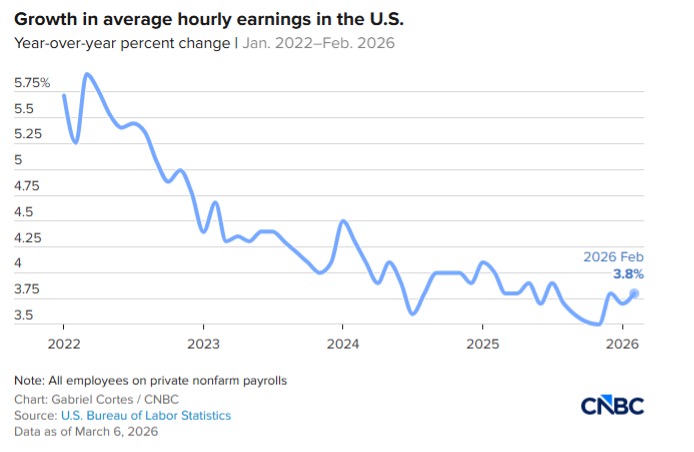
Caption: Wages rose more than expected. Average hourly earnings increased 0.4% for the month and 3.8% from a year ago, both 0.1 percentage points above forecast.
By Demographic
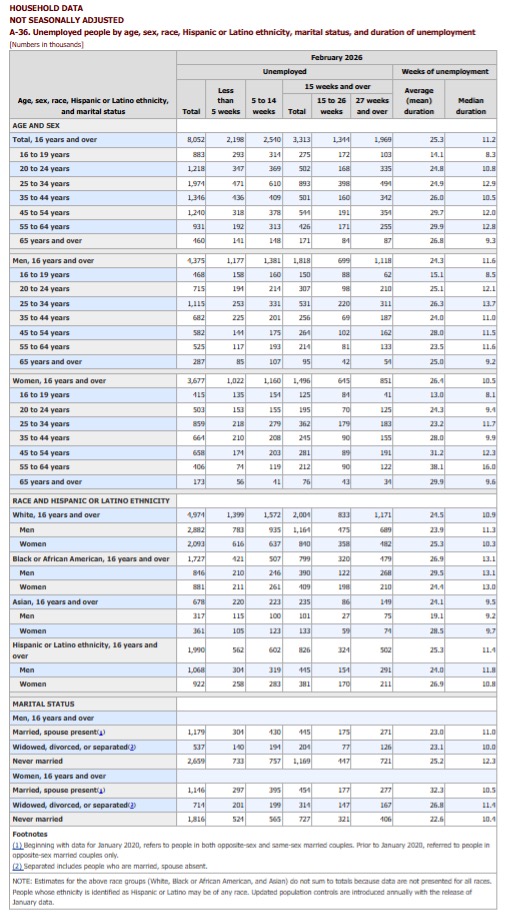
This month, unemployment among the major worker groups: adult women – 4.1%; adult men – 4%; teenagers – 13.9%; Asians – 4.8%; Whites – 3.7%; Hispanics – 5.2%; and Blacks – 7.7%.
Last month, unemployment among the major worker groups: adult women – 4.0%; adult men – 3.8%; teenagers – 13.6%; Asians – 4.1%; Whites – 3.7%; Hispanics – 4.7%; and Blacks – 7.2%.
By Industry
The Conference Board Employment Trends Index (ETI) rose marginally from an upwardly revised 105.18 in January to 105.37 in February.
“Despite a weak February Jobs Report, the ETI continued to show some resilience,” says Mitchell Barnes, economist at The Conference Board. “February’s 92,000 decline in BLS payrolls—while not a direct ETI input—were affected by temporary factors from weather and strikes. Overall, job creation is low, but the labor market remains roughly in-balance due to slower labor force growth.”
Data shows the share of involuntary part-time workers (an ETI component) declined to 16.2% in February and was the largest positive ETI contributor for the second consecutive month, with the ratio falling from 19.4% in December. In addition, the share of small firms reporting that jobs are “not able to be filled right now” improved to 33% after reaching a post-pandemic low of 31% in January.
“Six of the ETI’s eight components contributed negatively in February,” Barnes added. “That was a reversal from January, when seven components were positive. Mixed signals may persist as businesses and consumers wade through ongoing policy uncertainty.”
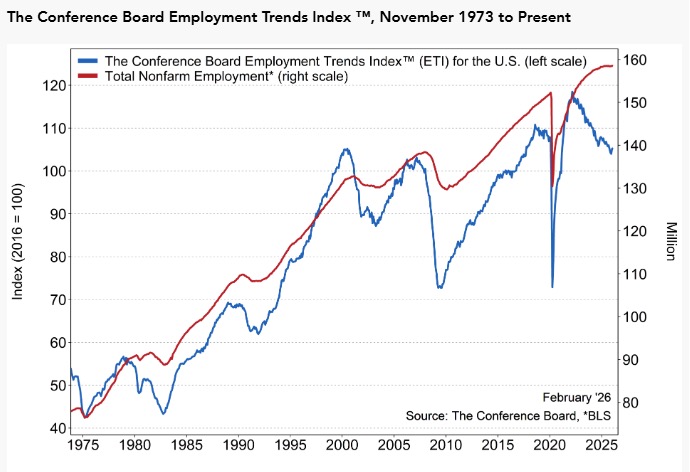
Caption: The Employment Trends Index is a leading composite index for payroll employment. When the Index increases, employment is likely to grow as well, and vice versa. Turning points in the Index indicate that a change in the trend of job gains or losses is about to occur in the coming months.
Key Takeaways, Courtesy of ETI:
- Consumers who report “jobs are hard to get”—an ETI component from the Consumer Confidence Survey—rose to 20.6% in February to reach the highest point since early 2021.
- Initial claims for unemployment insurance ticked up following a steady decline since September.
- Employment in the temporary help services industry declined in February after gains in two of the three prior months.
- Industrial production and real manufacturing and trade sales also ticked down.
Click here to view more detailed information by industry.