
- KPI – April 2026: The Brief
- KPI – April 2026: State of Business – Automotive Industry
- KPI – April 2026: State of Manufacturing
- KPI – April 2026: Consumer Trends
- KPI – April 2026: Recent Vehicle Recalls
Employment
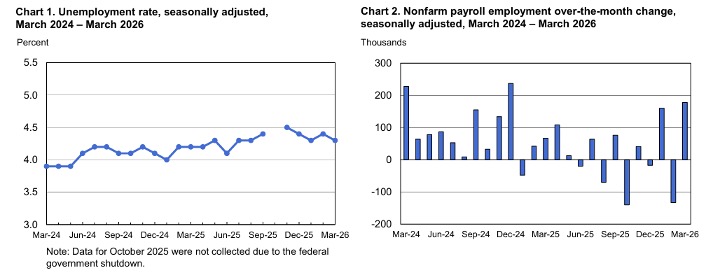
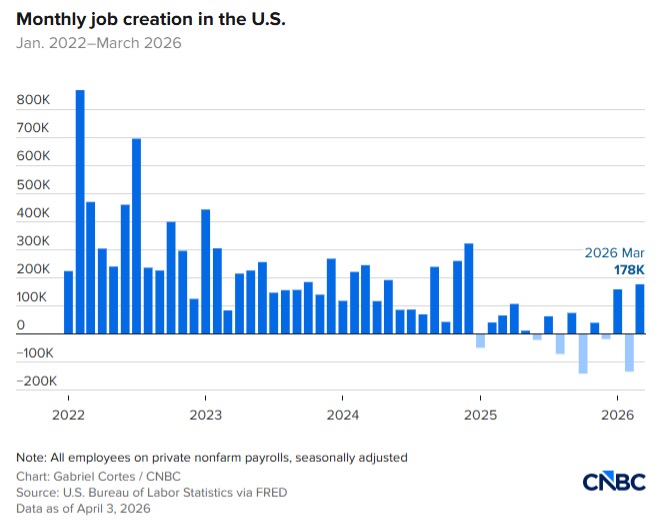
Total nonfarm payroll employment increased by 178,000 in March—a reversal from the 133,000-decrease in February and above the Dow Jones consensus estimate for 59,000. Job gains occurred in healthcare, construction, transportation and warehousing. Federal government employment continued to decline.
According to the U.S. Bureau of Labor Statistics, the unemployment rate and number of unemployed persons edged down to 4.3% and 7.2 million, respectively. The survey of households, which is used to compute the unemployment rate, showed 64,000 fewer people holding jobs. An alternative unemployment figure that counts discouraged workers and those holding part-time jobs for economic reasons edged up to 8%. In addition, the labor force participation and long-term unemployed (those jobless for 27 weeks or more) rates registered 61.9% and 25.4%, respectively—the latter of which is elevated.
Data also shows wages rose less than expected, with average hourly earnings up just 0.2% for the month and 3.5% from a year ago. According to CNBC reports, economists expected respective readings of 0.3% and 3.7%. The annual increase was the lowest since May 2021. Hours worked declined 34.2, down one-tenth from February.
“The bottom line is March was somewhat encouraging, but it’s been a rocky year for the labor market with almost no hiring since last April,” says Heather Long, chief economist at Navy Federal Credit Union. “The March data will keep the Federal Reserve on hold, but no one is declaring victory yet. It’s likely to be a tough spring for job seekers.”
According to Laura Ullrich, hiring lab director of economic research at Indeed, the broader story of 2026 is one of recalibration rather than acceleration. “Slowing population growth, a steep drop in immigration and declining labor force participation mean the economy simply doesn’t need to produce the job gains of prior cycles to keep unemployment stable,” she says.
Artificial intelligence is impacting the job market as well—especially as it applies to low-skilled roles. “While this year most likely will be a year of shifting labor dynamics, there continues to be healthy job opportunities for workers with experience,” adds Jeffrey Roach, chief economist for LPL Financial.
 Caption: Wages rose less than expected. Average hourly earnings increased 0.2% for the month and 3.5% from a year ago, 0.1 and 0.2 percentage points, respectively, below forecast.
By Demographic
This month, unemployment among the major worker groups: adult women – 4%; adult men – 3.8%; teenagers – 13.7%; Asians – 3.7%; Whites – 3.6%; Hispanics – 4.8%; and Blacks – 7.1%.
Last month, unemployment among the major worker groups: adult women – 4.1%; adult men – 4%; teenagers – 13.9%; Asians – 4.8%; Whites – 3.7%; Hispanics – 5.2%; and Blacks – 7.7%.
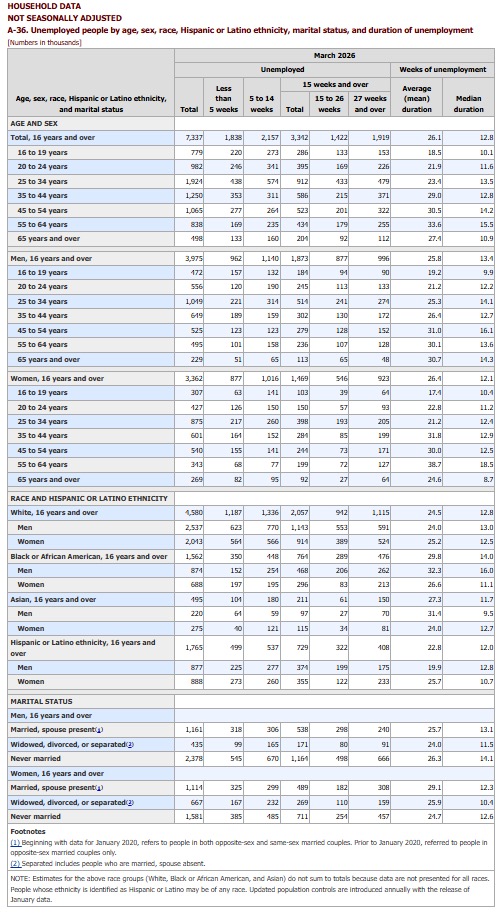 Image Source: A-36. Unemployed persons by age, sex, race, Hispanic or Latino ethnicity, marital status, and duration of unemployment (bls.gov).
By Industry
The Conference Board Employment Trends Index (ETI) declined from an upwardly revised 105.84 in February to 105.72 in March. The decrease in the Employment Trends Index was a result of negative contributions from five of its eight components: the Ratio of Involuntarily Part-time to All Part-time Workers, the Percentage of Firms with Positions Not Able to Fill Right Now, the Percentage of Respondents Who Say They Find “Jobs Hard to Get,” Industrial Production and Real Manufacturing and Trade Sales. Three components contributed positively: Initial Claims for Unemployment Insurance, Job Openings and the Number of Employees Hired by the Temporary-Help Industry.
“Job seekers continue to face a challenging market,” says Mitchell Barnes, economist at The Conference Board. “This is evident in the ETI, as several components moderated in March. Overall, the U.S. economy has remained surprisingly resilient, but rising geopolitical uncertainty may contribute to ongoing employer hesitancy to add more workers.”
Key Takeaways, Courtesy of ETI:
- Data shows the share of consumers who report “jobs are hard to get”—an ETI component from the Consumer Confidence Survey—climbed to 21.5% in March and reflects a 5-percentage point rise since March 2025.
- The share of small firms reporting jobs are “not able to be filled right now” declined by 1 percentage point in March to reach 32%.
- The share of involuntary part-time workers increased to 16.5% in March, but that measure declined from 19.4% in December.
- Initial claims for unemployment insurance decreased to 207,800, reflecting a steady decline in jobless claims from the 2025 average of 226,450.
- Employment in the temporary help services industry rose marginally in March and in three of the last five months.
- Industrial production and real manufacturing and trade sales were also steady in their most recent data releases.
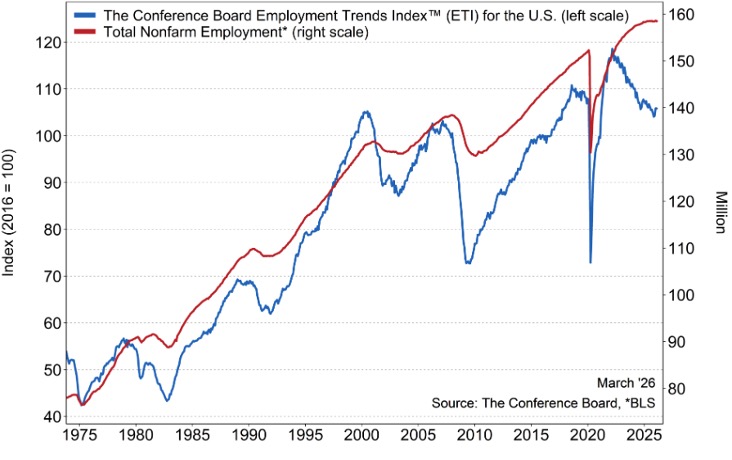 Caption: The Employment Trends Index is a leading composite index for payroll employment. When the Index increases, employment is likely to grow as well, and vice versa. Turning points in the Index indicate that a change in the trend of job gains or losses is about to occur in the coming months.
Click here to view more detailed information by industry.