- KPI – July 2026: State of Business – Automotive Industry
- KPI – July 2026: State of the Economy
- KPI – July 2026: Consumer Trends
- KPI – July 2026: Recent Vehicle Recalls
The Brief
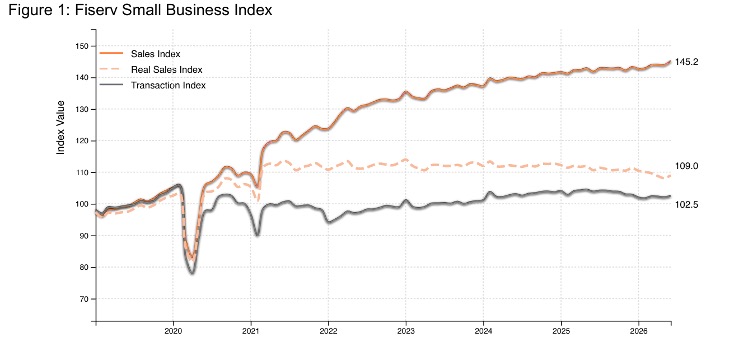
The national Fiserv Small Business Index reached 145.2 in June 2026, registering year-over-year and month-over-month sales growth of 2.4% and 0.8%, respectively. The Fiserv Small Business Transaction Index held steady at 102.5, with transactions dropping 1.3% year-over-year but up 0.5% month-over-month. According to the report, the data suggests steady consumer activity despite lower annual transaction numbers.
“We saw a continuation of recent trends in May: stable overall sales, rising average tickets and softer consumer activity as households adjust to increasing costs,” says Prasanna Dhore, chief data officer at Fiserv. “Services remained the strongest contributor to sales growth, full-service restaurants outperformed limited-service and higher fuel costs continued to impact many businesses.”
Key Takeaways, Courtesy of The Fiserv Small Business Sales Index:
- Overall, small business sales rose 2.4% year-over-year and 0.8% month-over-month. Growth remained driven by higher average tickets, which increased 3.7% year-over-year; although the pace for some categories—most notably retail—reflects a more balanced mix of pricing and activity compared with May. Transactions declined 1.3% year-over-year but improved 0.5% month-over-month, signaling some stabilization in consumer activity after several months of contraction.
- Restaurant sales edged up 0.2% year-over-year, an improvement from May’s -0.5%. This was driven by an average ticket increase of 3.3% year-over-year. Transactions remained under pressure (-3.1% YoY), though declines moderated some. Limited-Service Restaurants continued to lag, while Full-Service performance remained comparatively steady, supported by stable demand and pricing.
- Gasoline prices eased slightly in June but remained well above last year. Sales increased 15.3% year-over-year but declined 4.7% month-over-month. While still elevated (up 16.8% YoY), average tickets fell 3.2% compared to May. Still, transaction activity declined both month-over-month (-1.4%) and year-over-year (-1.5%). This pullback reflected slower demand in June.
- Retail bounced back on higher foot traffic in June. Total retail sales increased 3% year-over-year and 1.5% month-over-month, an improvement from May’s softer performance. Growth was supported by both transactions (+2.7% YoY) and modest price gains, indicating more balanced demand. Food and Beverage Retailers stabilized after prior declines, while other retail categories such as Sporting Goods, Clothing and Health and Personal Care showed improvements, driven primarily by increased foot traffic.
- For the past 18 months, Essentials sales growth outperformed Discretionary categories. That gap has narrowed recently, which may be supporting a return to goods spending. In June, Goods sales (largely discretionary-driven) rose 3.0% year-over-year on 2.5% year-over-year transaction growth. Average tickets increased just 0.5% year-over-year, suggesting consumers are finding value through product selection and price comparison. By contrast, Services (which leans toward Essential) grew 2.1% year-over-year, but transactions declined 2.7% year-over-year on higher average tickets (+4.8% YoY), suggesting that growth still depends on pricing, with fewer low-priced options to choose from.
In June, the NFIB Small Business Optimism Index rose 2.1 points to 97.4—nearing its 52-year average of 98.0. Expectations for better business conditions and real sales expectations improved substantially and primarily drove the rise in the Index. The Uncertainty Index fell two points month-over-month to 89, remaining well above its historical average of 68.
“Current economic conditions present small business owners with both encouraging developments and ongoing challenges,” says NFIB Chief Economist Bill Dunkelberg. “Lower fuel costs provide welcome relief for businesses as well as consumers, with firms anticipating improved operating conditions over the next six months. While there have been improvements in the overall environment, high interest rates and modest economic growth are causing owners to approach hiring and capital spending with caution.”
Important Takeaways, Courtesy of NFIB:
- Job openings and hiring plans rebounded in June. Thirty-two percent (seasonally adjusted) of all owners reported job openings they could not fill during the current period (up three points) and a seasonally adjusted net 11% of owners plan to create new jobs in the next three months (up two points). The improvement can be seen as a correction from May’s decline.
- Twenty-one percent of business owners cited inflation as their single most important business problem, up three points from May and marking the highest reading since October 2024. Inflation ranks as the top problem.
- The net percent of owners raising average selling prices rose two points from May to a net 38% (seasonally adjusted). This is the fourth consecutive month that actual price increases have risen, marking the highest level since January 2023.
- Looking forward to the next three months, a net 32% (seasonally adjusted) plan to increase prices, down two points from May’s highest reading since July 2022.
- The net percent of owners expecting better business conditions in the next six months rose 10 points in June to a net 13% (seasonally adjusted), improving for the first time this year.
- The net percent of owners expecting higher real sales volumes over the next quarter rose eight points from May to a net 9% (seasonally adjusted).
- Twenty percent (seasonally adjusted) of small business owners plan to make capital outlays in the next six months, up four points from May and the highest reading of the year.
- The average interest rate paid on short-maturity loans was 7.4%, down 0.4 points from May and the lowest level since October 2022.
- Twenty-two percent of all owners reported borrowing regularly, down five points from May. June’s reading is 12 points below the historical average of 34%.
Key Performance Indicator Report Overview
Professionals in the automotive, RV and powersports industries remain steadfast in their efforts to evolve their business models and grow their brands in the face of adversity. As such, the monthly Key Performance Indicator Report serves as an objective wellness check on the overall health of our nation, from the state of manufacturing and vehicle sales to current economic conditions and consumer trends. Below are a few key data points explained in further detail throughout the report.
Key Data Points:
- Economic activity in the manufacturing sector expanded in May for the fifth consecutive month, according to the nation’s supply executives in the latest ISM Manufacturing PMI Report. The Manufacturing PMI registered 54% in May, 1.3 percentage points higher than in April and its highest reading since May 2022 (55.9%). The overall economy continued in expansion for the 19th month in a row.
- In June, global light vehicle sales were estimated at 7.9 million units. The forecast for total global sales in 2026 was revised down to 90.5 million units, a projected 1.9% year-over-year decline.
- Total new vehicle sales for June 2026, including retail and non-retail transactions, are projected to reach 1,363,800—a 3.6% increase year-over-year, according to a joint forecast from JD Power and GlobalData.
- The Manheim Used Vehicle Value Index (MUVVI) fell to 211.5, reflecting a 0.6% decrease in wholesale used-vehicle prices (adjusted for mix, mileage and seasonality) during the first 15 days of July. Wholesale values are now higher by 2% year-over-year, even as depreciation has been elevated—normalizing the run rate from a strong start.
- Powersports Business says dealers across the country reported a slight incline of 0.2% in combined same-store sales compared to the same month last year, according to composite data from more than 1,700 dealerships in the U.S. that utilize CDK Lightspeed DMS. On average, dealerships were up 0.5% in major units and 0.3% in service, but down 3% in the parts department.