- KPI – July 2026: The Brief
- KPI – July 2026: State of the Economy
- KPI – July 2026: Consumer Trends
- KPI – July 2026: Recent Vehicle Recalls
Global Light Vehicle Sales
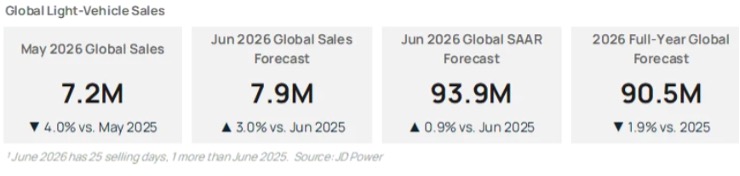
In June, global light vehicle sales were estimated at 7.9 million units. This translates to a seasonally-adjusted annual rate (SAAR) of 93.9 million units per year, a slight 0.9% increase year-over-year.
According to GlobalData, China faced significant headwinds. Its domestic market weakness continues to weigh heavily on global activity, with volumes down 22%. The losses in China were partially offset by double-digit growth in India and South America, alongside further growth in Japan, Brazil and North America. The U.S. light-vehicle market, in particular, posted June sales of approximately 1.35-1.4 million units, with a SAAR in the mid-16-million-unit range. Hybrids surged, capturing 14% of the market.
“Our forecast for total global sales in 2026 has been revised down to 90.5 million units, compared to an outlook of 91.1 million units a month ago. This forecast would represent a 1.9% year-over-year decline, as relative weakness in China, along with headwinds from economic and trade factors, drag down the global industry,” says David Oakley, manager of Americas vehicle sales forecasts at GlobalData.
U.S. New Vehicle Market
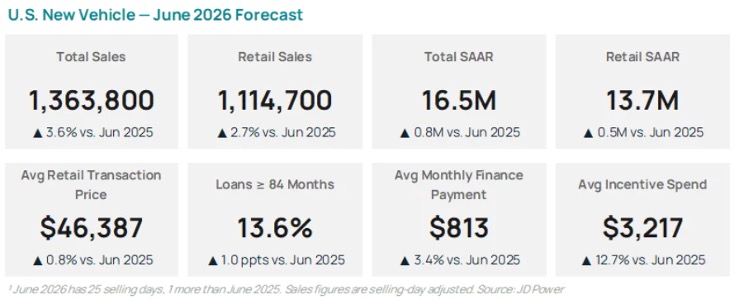
Total new vehicle sales for June 2026, including retail and non-retail transactions, are projected to reach 1,363,800—a 3.6% increase year-over-year, according to a joint forecast from JD Power and GlobalData.
While demand for new vehicles is holding firm as the first half of the year wraps up, evaluating year-over-year results requires broader consideration.
“Last year, consumers were reacting to the perceived risk of higher prices from vehicle tariffs, and the resulting volatility makes simple year-over-year comparisons murky,” explains Thomas King, president of the data and analytics division at J.D. Power.
Sales in March and April of 2025 were inflated as consumers rushed to showrooms and pulled ahead their purchases due to anticipated tariffs. By the following month, he notes the pull-ahead reversed into payback with an estimated 63,000 sales pulled out of May and an additional 12,000 sales pulled out of June and into the preceding months.
“On a full-year basis, the 4.1% decline in retail sales, more than offset by rising sales to fleets, is notable, but not alarming. Supply constraints on several of the best-selling vehicles in the market account for most of the decline,” King says. “That said, macroeconomic uncertainty, higher fuel prices and persistent affordability challenges present headwinds to new vehicle demand.”
Key Takeaways, Courtesy of J.D. Power:
- The SAAR is forecasted to hit 16.5 million, up 5.1% year-over-year.
- Total new vehicle sales in Q2 2026 are projected to reach 4,226,600 units, an increase of 0.7% year-over-year. Total new vehicle sales for the first half of 2026 are projected to reach 8,245,700 units, an increase of 1.2% from the first half of 2025.
- Average incentive spending per vehicle is trending toward $3,217, a 12.7% increase from a year ago.
- The average transaction price of a new vehicle has increased to $46,387, an increase of 0.8% from a year ago.
- Retail sales volume growth with slightly higher transaction prices means that total retail consumer expenditure is projected to rise to $49.4 billion, an increase of $4.2 billion from June 2025.
- The average interest rate on new vehicle loans is expected to fall 0.35 percentage points to 6.6%, the lowest June reading since 2022. However, average monthly finance payments have climbed 3.4% to $813, the highest ever for the month of June.
U.S. Used Market
The Manheim Used Vehicle Value Index (MUVVI) fell to 211.5, reflecting a 0.6% decrease in wholesale used-vehicle prices (adjusted for mix, mileage and seasonality) during the first 15 days of July. Wholesale values are now higher by 2% year-over-year, even as depreciation has been elevated—normalizing the run rate from a strong start.
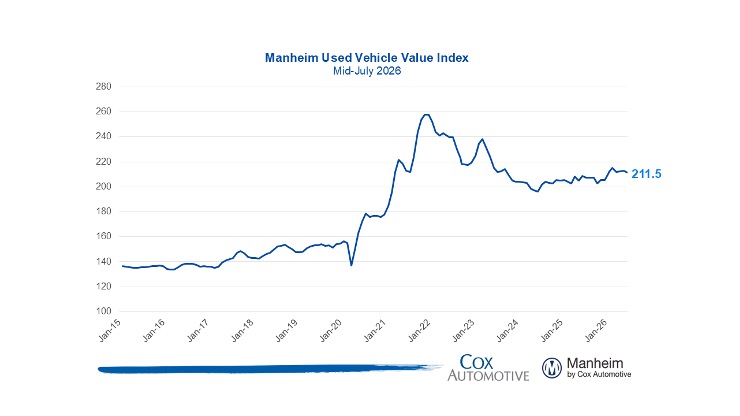
“Wholesale values have been on the decline in the summer after seeing a strong and prolonged Spring Bounce earlier in the year. While depreciation trends are currently running a bit higher than usual, it’s a sign of the market correcting itself back to normal as the MUVVI remains 2% higher against last year’s level. Under the surface, we’ve continued to observe stronger pricing trends in older ‘more affordable’ units as strapped consumers look to offset higher prices in the rest of the economy by shopping for cheaper used vehicles. At the same time, there’s more interest in used electric vehicles, with the segment rising to over 4% of all units driving the Manheim Index value—a level never seen before,” says Jeremy Robb, chief economist at Cox Automotive.
“New vehicle sales have been stronger thus far this summer, as the wealth effect from strong equity markets fuels demand, while used retail sales have stayed flat against the stronger levels from last year. And wholesale inventory is getting a bit of a boost with higher off-lease maturities hitting the market—a good trend for dealers needing to source popular late model product,” Robb continues.
Despite the normalization in wholesale valuations, he says the market is fairly balanced and set up to support dealers as we move into the second half of the year.
“With gas prices once again on the rise, we expect interest to remain steady for fuel-efficient vehicles as consumers look for anything that can provide relief for stretched budgets,” Robb says.
Click here to view results by segment.