Shell Triple 10 Challenge Concept Car Targets Sub-10-Minute EV Charging
Shell's concept car uses dielectric thermal fluid to achieve sub-10-minute charging, 16 miles/kWh efficiency & a 50% reduction in lifecycle emissions vs. typical BEVs...
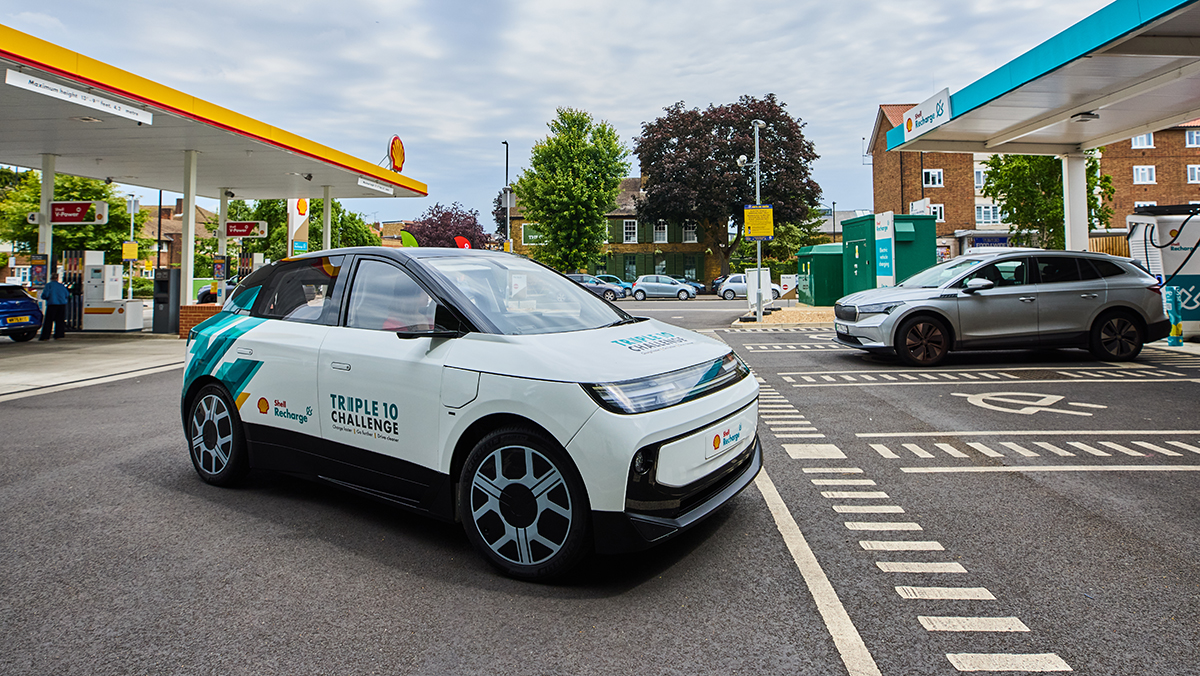
Shell has unveiled its Triple 10 Challenge concept car, a ground-breaking proof-of-concept vehicle designed to inspire a new design philosophy for the next generation of battery electric vehicles (BEVs), company officials stated in a press release.
This compact, mass-market EV demonstrates next-generation electric vehicle capability and offers the industry an alternative to the current reliance on ever-larger batteries by reimagining the fundamentals of thermal management.
A New Benchmark for Efficiency
The vehicle meets three ambitious goals that Shell believes can help drive the future of mass-market electric mobility:
- Charge Faster — a sub-10-minute charge time
- Go Further — 10 km/kWh (approximately 16 miles/kWh) economy
- Drive Cleaner — a lifecycle 10-tonne CO2e footprint
The Triple 10 Challenge is the first road-worthy vehicle to have successfully demonstrated the potential of a simplified, single-circuit cooling architecture to efficiently manage the thermal load of the car’s entire powertrain, even under the most extreme fast-charging scenario in real-world conditions, noted the release.
Cara Tredget, VP Mobility & Lubricants Technology for Shell, said, “With the Triple 10 Challenge concept car, we have unlocked the potential for faster charging, lighter systems and improved lifecycle efficiency by using our advanced thermal fluids. Together with our co-engineering partners, we are proud to develop alternative options for sustainable EV development, leveraging technologies that are available today and are scalable to support customers into the future.”
The Shell Triple 10 Challenge Concept car has been designed to achieve 10 km/kWh (approximately 16 miles/kWh) in driving economy with a smaller, more efficient battery system. It adds more than 30% improvement in overall energy efficiency compared to many current-generation EVs, enabled by Shell’s advanced thermal fluids that provide optimal thermal management, the company said.
The Triple 10 Challenge vehicle can charge the battery from 10% to 80% in 9 minutes 54 seconds, without compromise to thermal stability or lifespan. While some EVs in the market today can charge in under 10 minutes, this requires using an ultra-fast charger in excess of 300kW, which is uncommon on the public charging network. According to the press release, however, the Triple 10 Challenge vehicle can attain this on the existing charging network infrastructure using a standard 175kW charger, adding 24 km/minute (approximately 15 miles/minute) range, compared to typical BEVs that average a 13 km/minute (approximately 8 miles/minute) range on the same charger—equivalent to almost 90% more range added per minute of charge.
The Triple 10 Challenge concept car is estimated to have a lifecycle carbon footprint of approximately 10 tonnes CO2e. Enabled by its lightweight design, optimized battery capacity, low-carbon and recyclable materials, together with 100% renewable electricity for vehicle charging, Shell estimates this represents around a 50% reduction in lifecycle emissions compared to typical battery electric vehicles in the European market.
The Technology: Immersive Thermal Management
The key to the Triple 10 Challenge car’s performance is Shell Recharge thermal fluid. Unlike traditional cooling systems that use water-glycol, Shell’s dielectric fluid allows for direct immersion cooling of the battery and powertrain components, including the motor and power electronics. By redefining heat management across the battery and powertrain, the team has unlocked the potential for faster charging, lighter systems and improved lifecycle efficiency using technologies that exist and can scale today.
Unveiled at HORIBA MIRA’s proving ground, the concept car is the culmination of Shell’s Triple 10 Challenge. By incorporating a more compact and efficient battery pack design with fewer modules and using Shell’s advanced thermal fluid, enabling a simplified housing architecture, these improvements contribute to about a 25% reduction in overall battery pack cost compared to a conventional EV, the company said.
Shell also announced its full EV capabilities have been integrated under Shell Recharge—from charging and fluids to battery solutions—to create a stronger, single end-to-end offer for both B2B and B2C EV customers. As part of this, the Shell EV-Plus brand will be retired.