Carb Tuning: Restoring Vintage Carbureted Engine Performance, Part II
Carburetor-equipped engines run best when the carb supplies the engine with the correct amount of fuel...
Article & Photos by Henry Olsen
Editor’s note: This is the second installment of a two-part series addressing carb tuning issues in vintage vehicles using today’s unleaded gasoline blends. Part I appeared in the April 2026 issue of THE SHOP.
FINE-TUNING THE FUEL SYSTEM
In Part I of this article on tuning a carburetor-equipped engine for today’s gasoline, we covered how we set the spark advance systems so the engine can properly burn the fuel. A properly tuned carburetor-equipped engine should perform just as well as—or maybe even better than—the day it was driven off the new car dealer’s lot, even with today’s unleaded reformulated gasoline.
The proper tuning of an engine’s ignition spark advance and air/fuel mixture(s) can make the difference between a strong-performing engine and one that runs and sounds like it needs a tuneup.
A carburetor-equipped engine can only be expected to run its best when the carburetor supplies the engine with the correct amount of fuel. Proper idle, cruise and power air/fuel mixtures allow the engine to supply the driver with the best performance while getting as many miles as possible from a tank of fuel.
An overly lean air/fuel mixture (too little fuel for the amount of air in the cylinder) will cause a rough idle and a surge while cruising and will feel as if the vehicle lacks power. It may also cause the engine to run too hot.
Meanwhile, an overly rich air/fuel mixture (too much fuel for the amount of air in the cylinder) will cause an engine to “load-up” at idle, foul the spark plugs and reduce performance.
The misfires that result from an overly lean or overly rich air/fuel mixture (seen on an exhaust gas analyzer as HC/hydrocarbons) will cause the engine’s exhaust to be unpleasant to breathe and make your eyes water.
Engines can be tuned to run as well as, or even better than, they did when they were new by using modern tools such as an exhaust gas analyzer and/or a digital air/fuel meter for tuning.
Today’s best and most accurate method to determine if the engine’s air/fuel mixture is correct for its needs is analyzing or “reading” the content of the engine’s exhaust gases. New advances in infrared exhaust gas analysis and wide-band oxygen sensor-based digital air/fuel meter technology have made it possible to “read” and/or record the actual air/fuel mixture under almost any driving condition.

READING THE AIR/FUEL MIXTURE
There are two modern methods in common use to read the air/fuel mixture:
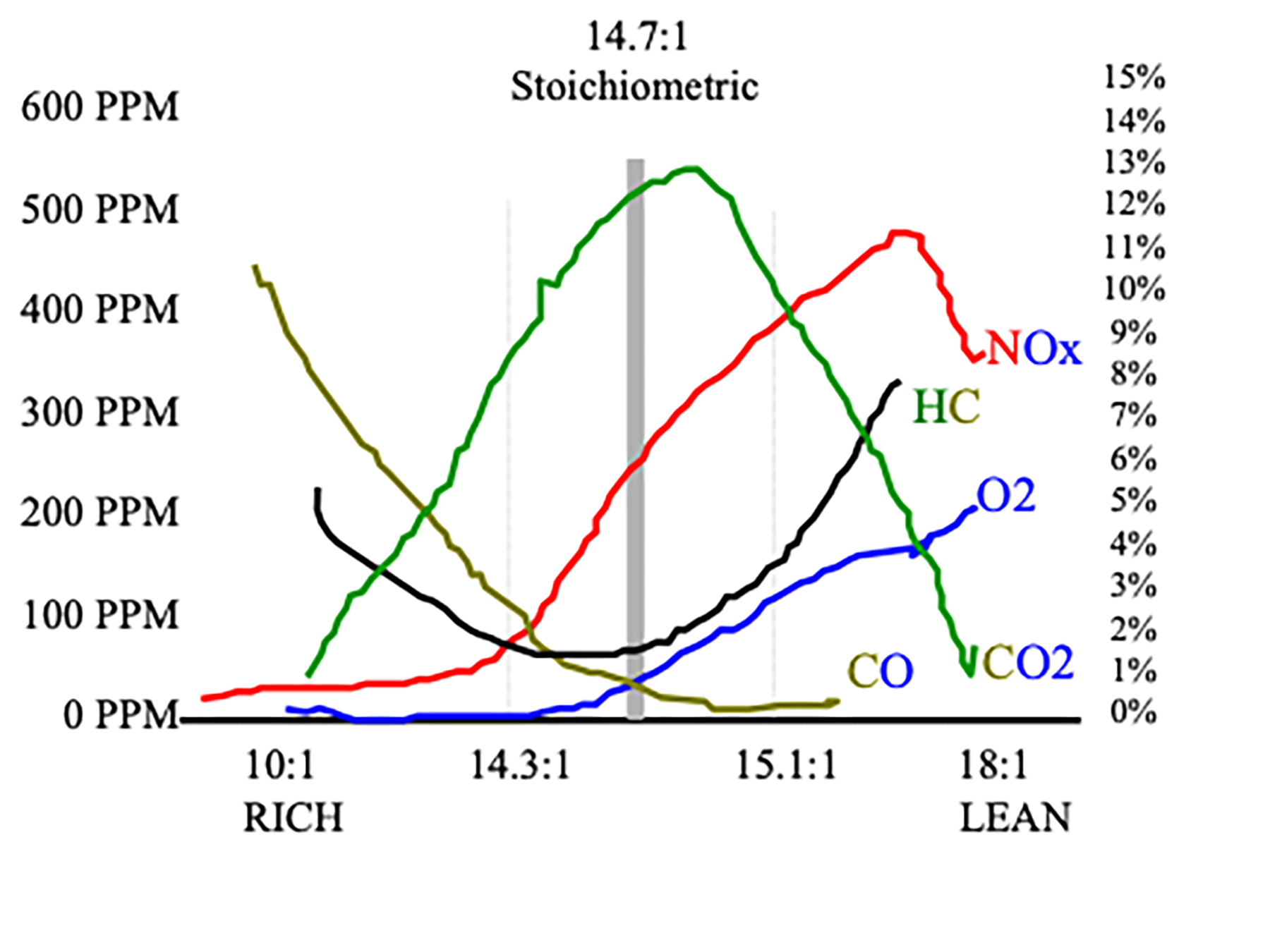
- The easiest and most accurate method we’ve found to read the air/fuel mixture is by using an infrared exhaust gas analyzer. This method has you place the sample probe into the tailpipe, where the analyzer samples and analyzes the content. The CO (carbon monoxide) reading is used to observe the air/fuel mixture, and the HC (unburned hydrocarbons) is an indicator of engine misfire. The CO2 and NOx readings from the exhaust gas analyzer can be used as a method to determine if the ignition timing is what the engine needs for maximum power and efficiency.
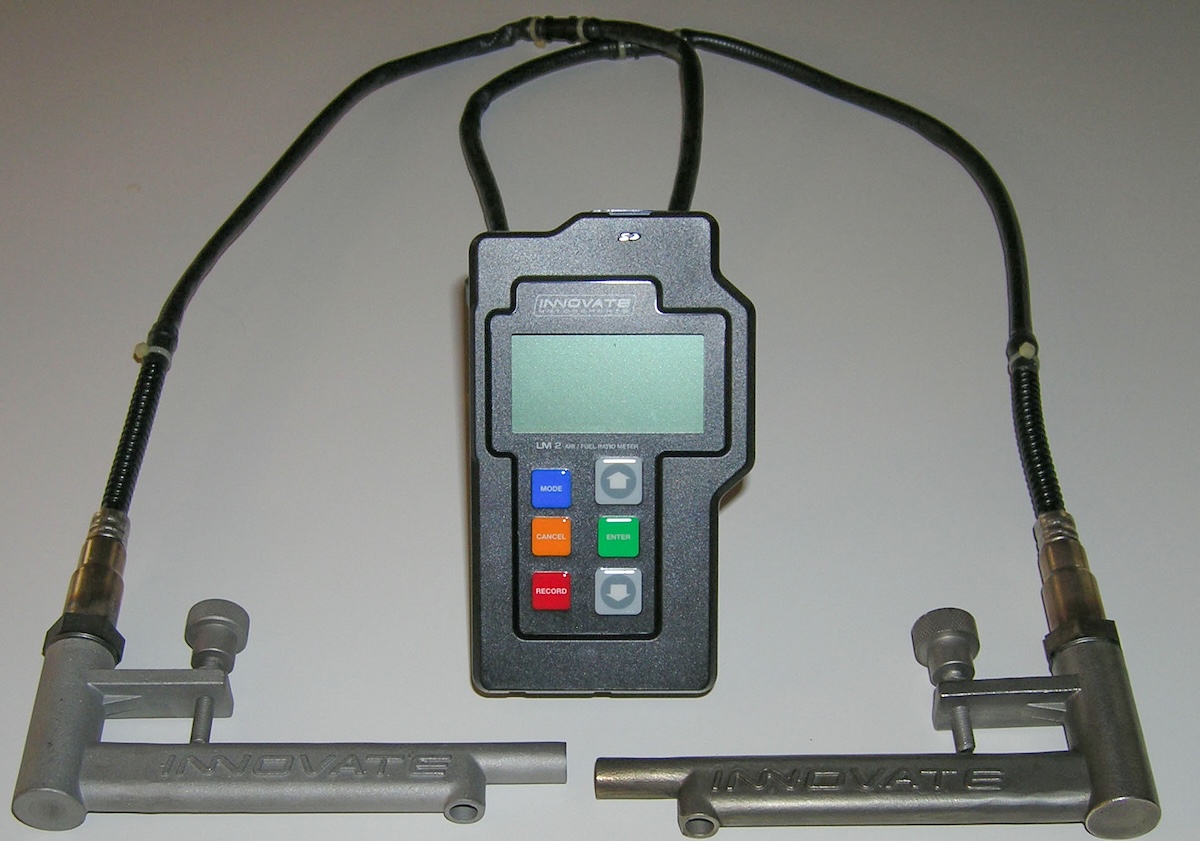
- The second method involves using a wideband oxygen sensor installed into the exhaust header or exhaust pipe with a tailpipe probe (we use one from Innovate Motorsports). The oxygen sensor is then “read” by a digital air/fuel meter. This method determines the air/fuel mixture by looking at the oxygen/unburned combustibles content of the engine’s exhaust. These readings can be very accurate, but false lean readings can be created by an exhaust leak, engine misfire or a high-overlap cam at lower rpms (these false lean readings are caused by the oxygen sensor misreading the extra oxygen in the exhaust from the misfire, exhaust leak or high-overlap cam).
The digital air/fuel meter method requires installing a bung in the exhaust system to mount the wideband oxygen sensor within about 40 inches of the closest exhaust valve for the most accurate readings. Or Innovate Motorsports offers a tailpipe probe to allow temporary mounting of the oxygen sensor in the exhaust system.
The infrared exhaust gas analyzer and/or the digital air/fuel meter method allows a partial-throttle air/fuel mixture to be checked, which otherwise is almost impossible. The readings from either method can be read in real time or recorded and later played back. It is important to note that any changes other than jet swaps and other basic adjustments should be done by a proficient carburetor “expert.”
A good starting point for the air/fuel mixtures for most carburetor equipped engines is:
- Idle: 1% to 3% CO or a 14.1- to 13.4-to-1 air/fuel mixture.
- Cruise rpm: 1% to 3% CO or a 14.1- to 13.4-to-1 air/fuel mixture.
- Power mixture and acceleration: 6% CO or 12.25-to-1 air/fuel mixture.
USING AN INFRARED EXHAUST GAS ANALYZER
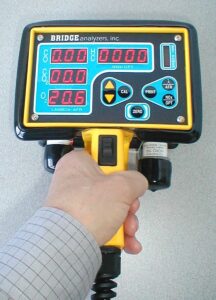
The reading from an infrared exhaust gas analyzer will indicate air/fuel ratio, engine misfire, engine combustion efficiency and excessive combustion chamber heat (detonation) by looking at the following exhaust gases:
- CO (carbon monoxide): The reading from an infrared gas analyzer is the reading that we use to determine the air-to-fuel ratio (note: CO is partially burned fuel).
- HC (hydrocarbons): The amount of unburned fuel or an indicator of an engine misfire, the best mixture gives you the lowest HC.
- CO2 (carbon dioxide): A product of complete combustion, the best air/fuel mixture along with the best ignition spark timing will give you the highest CO2 reading.
- O2 (oxygen): A high O2 reading indicates a lean mixture, an exhaust leak or that the engine has a “hot” cam. Note: if O2 is above 2% to 3%, the CO readings may not be accurate.
- NOx (oxides of nitrogen): A gas created by excessive combustion chamber heat. In many cases, a high reading may be related to excessive ignition timing creating detonation that can result in engine damage.
TUNING WITH A DIGITAL AIR/FUEL METER
A digital air/fuel meter uses a wideband oxygen sensor to supply the user with an air/fuel mixture reading. While this method requires you to know what air/fuel mixture your engine needs for each driving condition, this data should be available from your engine manufacturer, or you can use an infrared exhaust gas analyzer to help you determine what air/fuel mixture your engine needs to run its best.
The digital air/fuel meter method uses a wideband oxygen sensor to determine the fuel mixture by analyzing the unburned combustibles in the exhaust gas. An extended-range oxygen sensor can read air/fuel mixtures as rich as 9-to-1 or as lean as 19-to-1 or leaner (a standard oxygen sensor is only accurate at an air/fuel mixture at or near 14.7-to-1).
This method has the advantage of extremely fast reaction times for the readings, but false lean readings can be caused by engine misfires or anything that exposes the sensor to outside oxygen such as an exhaust leak. The wideband oxygen sensor-based air/fuel meter that we use is the LM-2 Digital Air/Fuel Meter from Innovate Motorsports.
The use of an infrared exhaust gas analyzer, while slower in reaction time, has the advantage of not only reading the oxygen/unburned combustibles content of the exhaust, but also allowing users to determine the air/fuel mixture by observing the CO reading (carbon monoxide); the engine’s rate of misfire by observing the HC reading (hydrocarbon); engine efficiency by observing the CO2 reading (carbon dioxide); and detonation caused by overly advanced ignition timing by observing the NOx reading (oxides of nitrogen).
READING THE AIR/FUEL MIXTURE
The first step in achieving a proper reading of the air/fuel mixture of an engine is to confirm the basic engine condition is good and a proper tuneup has been performed (new, properly gapped spark plugs; clean air filter; proper fuel pressure and volume; proper ignition timing curve). The next step is using a tool such as an exhaust gas analyzer to read the air/fuel mixture at 250-rpm intervals from idle through 3,000 rpm.
If the 2,500-3,000-rpm cruise mixture is off, first change the jets in order to get the air/fuel mixture correct at the 2,500-3,000 cruise rpm range. Once the 2,500-3,000 rpm cruise mixture is correct, check and reset the idle mixture.
If the air/fuel mixture is too lean at idle or partial throttle and the idle mixture screws do not provide enough adjustment, the correction may involve enlarging the idle jet. Once the idle mixture is correct and if the mixture is still lean at 1,000-1,800 rpm, the idle channel restriction/economizer restriction on a carburetor such as a Rochester Quadrajet or Carter AFB/AVS (also the Edelbrock Performer or Thunder series) may have to be slightly enlarged to allow more fuel to be delivered at partial throttle.
This lean condition at partial throttle will cause the engine to miss or stumble on light acceleration and at 25-35-mph light cruising speeds. This lean-off-idle problem is also very common on many of the replacement and performance carburetors sold today.
If the air/fuel mixture is too rich at idle and/or partial throttle, the idle jet or partial throttle idle restriction may be too big and need to be replaced with a smaller one.
Once you have the idle, partial throttle and cruise air/fuel mixture curves correct, the next step is a road test. A road test using a portable infrared exhaust gas analyzer and/or a wideband oxygen sensor will allow you to check the cruise speed air/fuel mixture, followed by a check of the power air/fuel mixture under load.
This type of test allows you to see what the air/fuel mixture is when the vehicle is driven at cruise or wide-open driving conditions. If the air/fuel mixture readings show an air/fuel mixture reading that goes lean at wide-open throttle (WOT), make sure the fuel pressure stays above 5 pounds before increasing the jet size.
If the fuel pressure drops, the fuel pump may not be producing enough volume for the engine’s demands, or the fuel tank vent system and vented gas cap may not be letting enough air into the tank to replace the fuel that is being pumped out of the gas tank.
TUNING THE CARBURETOR
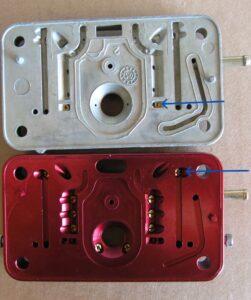
Carburetors have an accelerator pump, idle, main jets and, in most cases, a power system that is designed to supply the correct air/fuel mixture for the engine’s demands. An idle system will have an idle jet/restriction that must be changed to supply the desired fuel mixture for idle and off-idle engine demands.
The main jet size is what determines what air/fuel mixture is delivered to the engine at light load/cruise speeds (1,500 rpm and up) and the power valve restriction (under the power valve) is the determining factor in what the air/fuel mixture the carburetor will supply when the power valve is open.
A 6.5-inch power valve will be open and supplying the richer air/fuel mixture needed under high power demands anytime the vacuum is below its 6.5 opening point. If the carburetor uses metering rods in the primary jets—such as a Rochester Quadrajet or a Carter AFB (sold today by Edelbrock today as the Performer and Thunder Series)—they are there to change the air/fuel ratio for both the power and cruise mixture demands of the engine.
The accelerator pump system adds fuel as the throttle valves are opened, tuning the accelerator pump squirter volume and duration. Its tuning is mainly done by trial and error in order to obtain the best throttle response, but a 12.5-to-1 air/fuel mixture is a good place to start.
The problem we most often see with a Holley 4-barrel carburetor-equipped engine is hesitation on quick acceleration. The cure for this is to change the accelerator pump squirter size to 0.031-inch, along with a No. 330 “pink” pump cam.
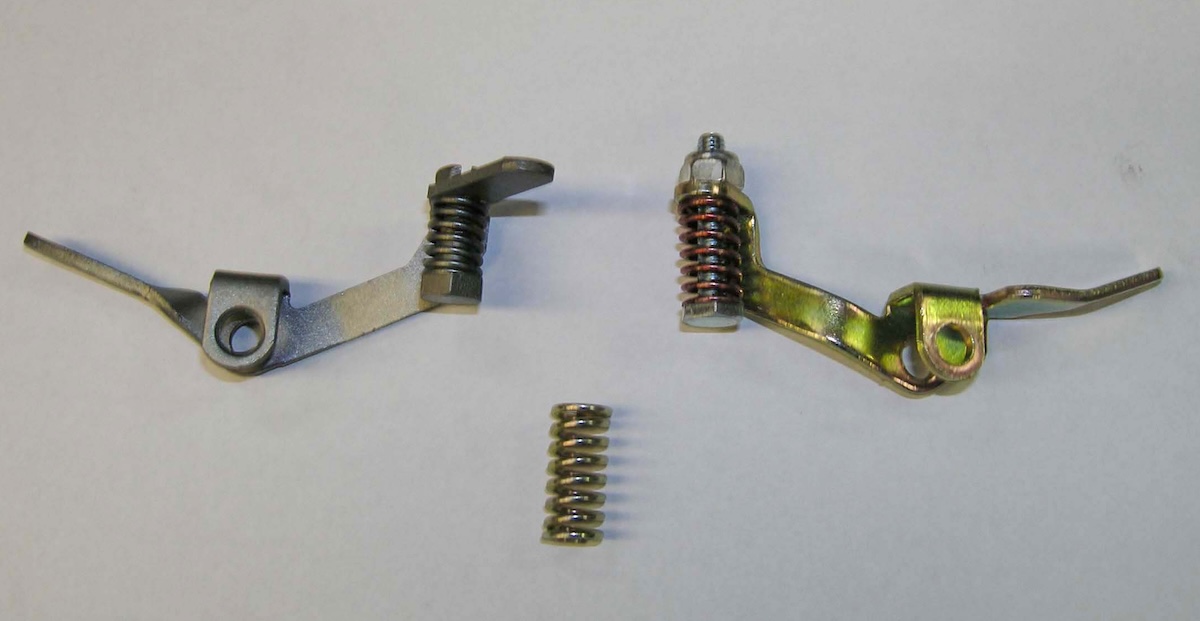
My shop also uses an upgraded accelerator pump arm duration spring that is stiffer than the stock “red” spring found on most Holley-style carburetors. In many cases this stock “red” spring compresses too easily when the throttle is opened quickly—thus, the pump squirt is not as lazy, resulting in a hesitation on rapid acceleration.
The spring upgrade was something that engineers at Barry Grant/Demon carburetor company came up with several years ago and is still available through Allstate Carburetor Co. We use a stronger accelerator duration spring we source from Lee Spring (part No. 485269) on the Carter/Edelbrock AFB/AVS carburetors we tune.
Many of the carburetors that came on vehicles sold in the smog era (1960 or later) are calibrated on the lean side. If you observe a lean or rich air/fuel mixture reading with either an exhaust gas analyzer or digital air/fuel meter at partial throttle that is not corrected with jets and/or metering rods, you may need to modify some of the internal passages inside the carburetor.
When we are tuning a Quadrajet carburetor designed for an engine built after 1969 that is running lean at partial throttle, we often refer to the book “How to Rebuild & Modify Rochester Quadrajet Carburetors” by Cliff Ruggles, because these carburetors are designed for the smog emission rules of the day. The first and second tuning recipes he mentions in the book show how to modify the air-bleed and jetting package most post-1970 carburetors came with, so it can supply the engine with the ideal air/fuel mixtures with today’s reformulated gasoline.
Ruggles also sells accelerator pumps with stronger duration springs and ethanol-resistant pump cups, thus helping avoid any hesitation problems.
BACK TO OUR PROJECT
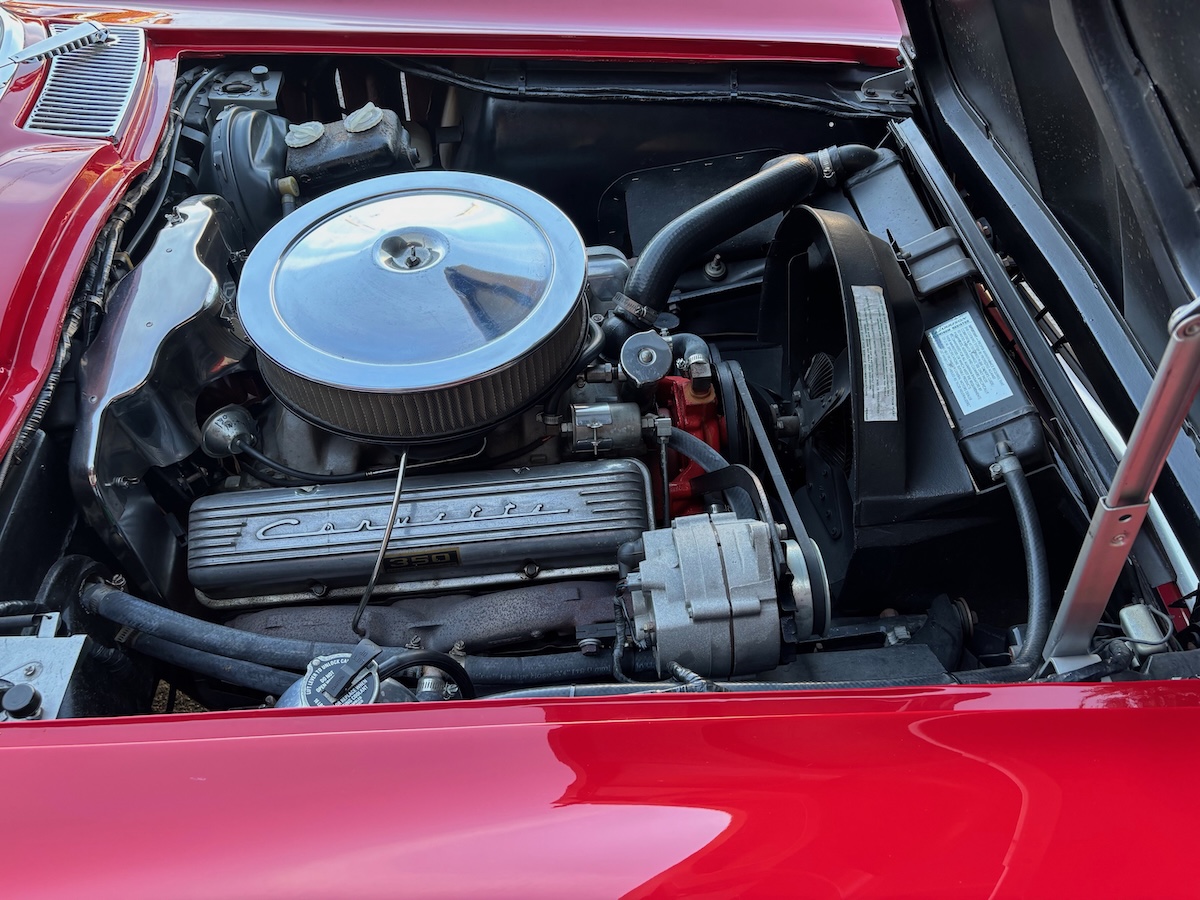
Since the carburetor on the 1965 Corvette we were working on had not been serviced in a long time, we chose to rebuild it. Since we already knew that the carb was rich at idle, lean off idle and that the owner was complaining about poor throttle response, we knew what changes we needed to do as we rebuilt the carburetor.
One of the first changes we made was to the accelerator pump system—the carburetor had a 0.025 pump squirter along with a weak pump duration spring and a pump cam that did not supply enough accelerator pump squirt. Our solution was a No. 330 “pink” pump cam along with a 0.031 squirter and a stiffer duration spring we got from Allstate carburetor company.
We also modified the idle well in the primary metering block in order to enrich the off-idle air/fuel mixture.
Once the carburetor was reinstalled on the engine, we adjusted the idle mixture using our 5-gas exhaust gas analyzer and checked the readings, which confirmed the air/fuel mixture was right where we wanted it to be and the HC (unburned hydrocarbons) readings were much lower than the were when we started working on this car.
Once the owner took her Corvette for a test drive, she could not stop talking about how much better it ran and how the car’s exhaust was no longer causing her eyes to burn. She also mentioned that she thought it ran as good or better than when she bought the car back in 1975.
PARTS & PARTNERS
Exhaust Gas Analyzers
Bridge Analyzers
Digital Air/Fuel Meters
Innovate Motorsports
Carburetor Parts & Quadrajet Tuning Book
Cliff Ruggles
Carburetor Parts
Allstate Carburetor
 Henry Olsen of Performance Motorsports in Millbrae, California, specializes in tuning vintage carburetor equipped engines for today’s reformulated gasoline. Reach him at [email protected].