Spyker C8 Preliator XXV Coupé Marks New Era for 146-Year-Old Marque
Limited to just 25 units, the company's new hand-built flagship hypercar pairs an 800-horsepower twin-turbo engine with a true manual gearbox…
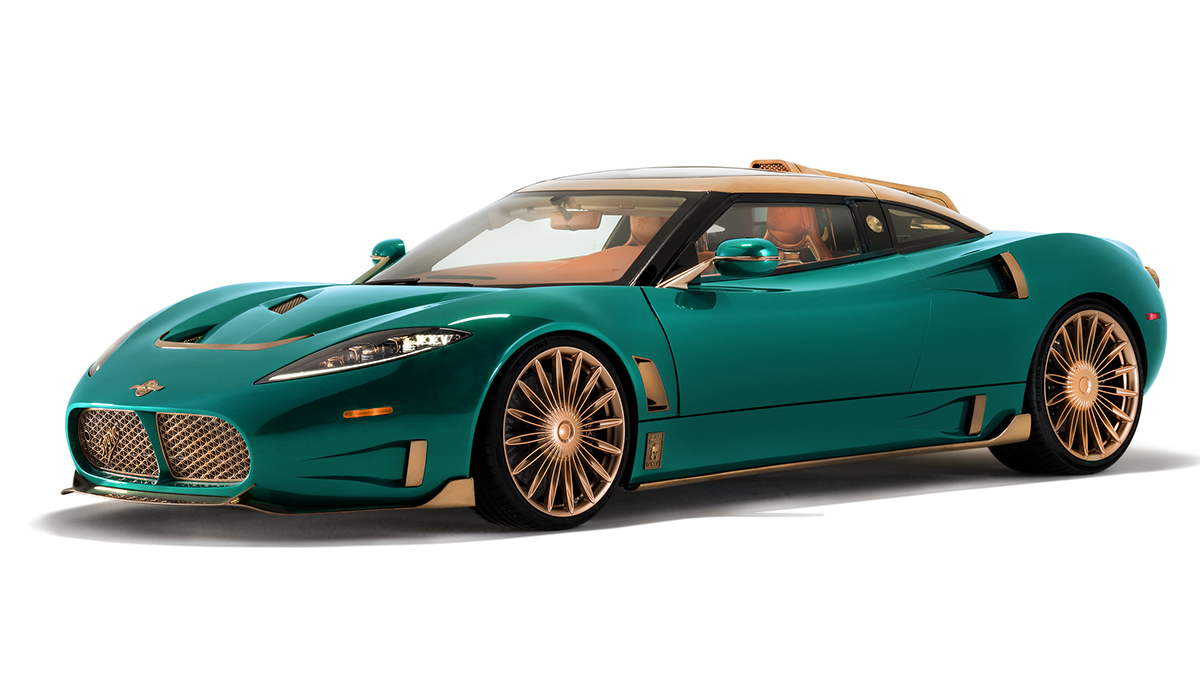
Spyker unveiled the Spyker C8 Preliator XXV Coupé at The Quail during Monterey Car Week. The hand-built flagship hypercar, chassis number 270, pairs an 800-horsepower twin-turbo engine with a true manual gearbox and a handmade aluminum body, continuing Spyker’s coachbuilding tradition, company officials stated in a press release. The name “Preliator” translates to “warrior” in Latin.
The Spyker C8 Preliator XXV Coupé is an entirely new automobile, combining craftsmanship, aviation-inspired engineering and modern performance while remaining faithful to the design philosophy that has defined Spyker since the beginning, when brothers Hendrik Jan and Jacobus Spijker founded the company in 1880 in the Netherlands, noted the release.
Aviation-Inspired Design
Aviation has been part of Spyker’s DNA since the company merged with the Dutch Aircraft Factory in 1914, influencing generations of its design and engineering. These roots have taken a different shape in each generation of Spyker’s modern era, which began with the company’s revival in 2000.
The Spyker C8 Preliator XXV Coupé has NACA ducts as air intakes, pushing the aviation concept further than previous models, and carries that evolution to its third generation, where the fin tail on the Spyker C8 Preliator XXV Coupé echoes the prominent fin tail of the original 1919 Spyker C1 Aerocoque. The Spyker C8 Preliator XXV Coupé headlights carry the model’s own name, XXV, and its rear lights are shaped like fighter jet afterburners.

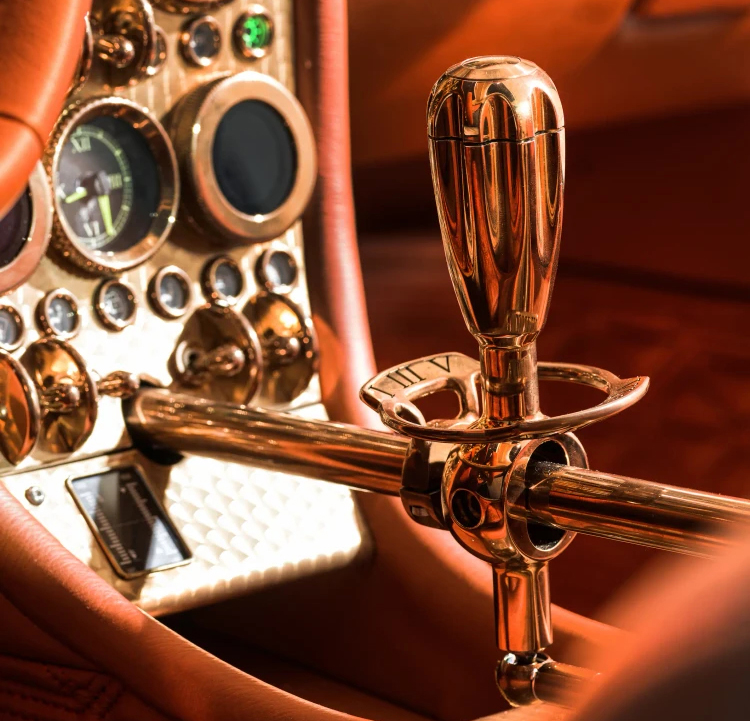
An isogrid lattice of interlocking triangles, developed to make rocket structures lighter while making them even stronger, appears in the car’s grilles, vents, pedals, exhaust mesh and seat upholstery. The exposed gear linkage continues as a signature Spyker design element present since the beginning of the company.
Built by Hand
The body is hand-built in aluminum, on a spaceframe engineered entirely in-house and completely redesigned for this car, continuing Spyker’s long partnership with Coventry Prototype Panels in England, where every exterior panel was newly shaped for the Spyker C8 Preliator XXV Coupé.
A Spyker takes roughly 2,100 hours to build this way, according to the company. The steering wheel is stitched with two needles at once, by one craftsman, over four hours. The dashboard in turned aluminum is a nod to the pre-1925 Spykers, milled by a workshop that has finished automotive parts since the same decade Spyker was founded in 1880. Even the screw heads inside the cabin are aligned by hand to face the same direction.
Each chassis number is stamped by hand into the aluminum space frame, so that no two impressions are quite alike. The car that was on display at The Quail is chassis number 270, the last of 255 Spykers built since 2000. The car is finished in a vivid metallic Quail Green with subtle rose gold flakes, its brightwork finished in rose gold throughout, and its interior trimmed in an orange-brown leather the company calls “Tuscan Saddle.”
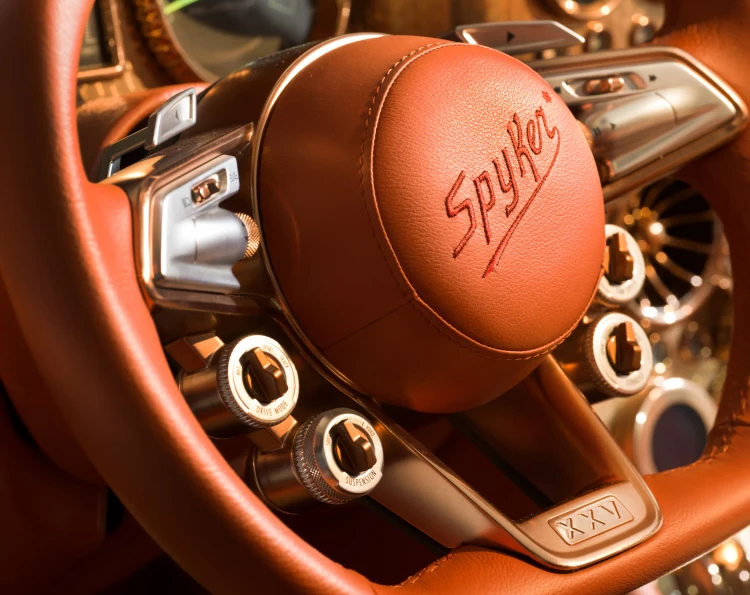
In an industry where carbon fiber has become the default, Spyker says that it deliberately continues to work in aluminum because aluminum can be shaped, worked and polished by hand, giving every car an individuality that cannot be replicated by an automated production process.
“While carbon fiber is rightfully celebrated for its technical virtues, we have always preferred aluminum, a living metal that can be shaped by the hand of an experienced craftsman, polished to perfection, its beauty only deepening with age, like a fine Cabernet,” said Spyker founder and CEO Victor Muller. “For Spyker, this is what modern ultra-luxury should feel like: rare, personal and made by human hands.”
Under the Hood
At the heart of the C8 Preliator XXV Coupé is a 4.0-liter twin-turbo V-8 producing 800 horsepower and 1,000 Nm of torque, with a top speed exceeding 217 mph. It is equipped with a true manual gearbox, so there are no shift paddles or automated substitutes. Every gear change remains a direct, mechanical interaction between driver and car.
“We deliberately chose a real manual transmission, not an automated imitation,” added Muller. “You decide when to shift. You feel every gear change in your hand. And if you make a mistake, well, you bear the consequences. That is what driving a sports car should be, at least according to Spyker.”
In the cockpit, digital interfaces are kept to a minimum, with a head-up display as the only screen. Everything else remains analog, tactile and designed to be operated rather than watched.
Underneath, the fuel tank has been moved from the sills to a trapezoidal space behind the seats and ahead of the engine, a placement long used on Spyker’s Le Mans race cars. The rear boot has been moved entirely to the front. In its place, the so-called butterfly mode, the entire car opens at the push of a button, as the earliest Spykers did, which means the engine bay itself had to be designed to the same standard as the rest of the car, a detail the company has compared to the movement of a fine Swiss Watch.
Production of the C8 Preliator XXV Coupé will be limited to just 25 hand-built hypercars. Each will be individually commissioned, making every C8 Preliator XXV Coupé a personal expression of its owner.
Looking Toward the Future
The debut of the C8 Preliator XXV Coupé marks the beginning of a new era for Spyker following Volodymyr Nosov’s investment and his becoming co-owner of the marque. Nosov is also the founder and president of W Group, a major European fintech group specializing in blockchain technology and digital infrastructure, which has also strategically partnered with Spyker.
“The launch of this new hypercar marks a new era for Spyker. The partnership with Volodymyr Nosov underlines the long-term ambitions of the brand and its shareholders. We are building on everything that has made Spyker distinctive for 146 years while creating the foundation for what comes next. Spyker’s future has never looked brighter, and I am immensely proud of the employees, partners and suppliers who put their faith in us,” said Muller.
“We are bringing together more than a century of Spyker’s automotive heritage with W Group’s technological expertise, ambition and forward-looking mindset,” said Nosov. “Our goal was never simply to bring a legendary name back. We want to build the next era of Spyker, preserving everything that makes the marque iconic while opening it to new technologies, new experiences and a new generation of clients. The C8 Preliator XXV Coupé is the first statement of that ambition. And this is only the beginning.”