Genesis Magma Racing Unveils GMR-001 Hypercar for 2026 FIA WEC Season
The hypercars that will take on the FIA WEC season are the product of an extensive testing plan, completed during a tightly packed development schedule...

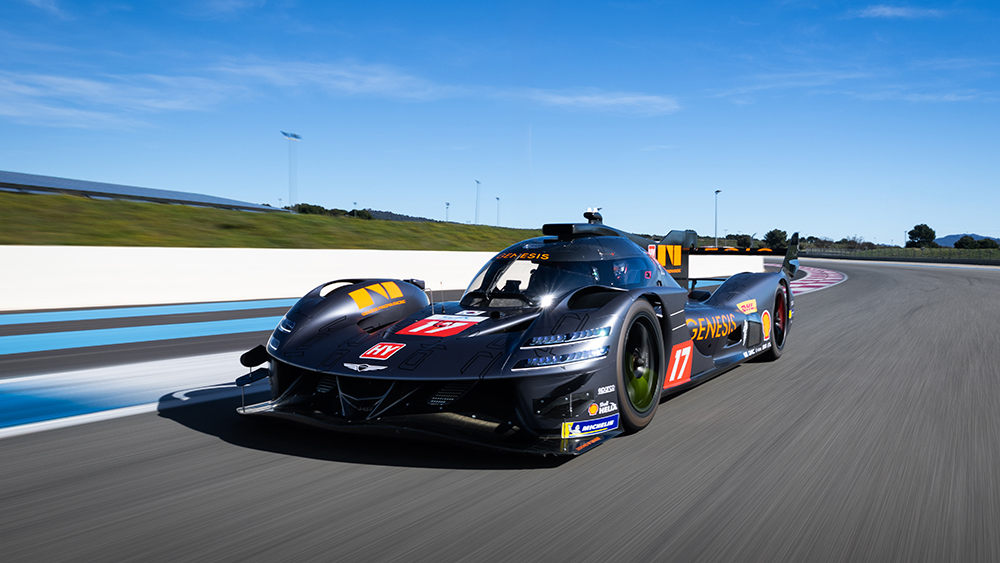
In April of last year, Genesis Magma Racing revealed a full-scale prototype of its GMR-001 Hypercar. The team has now unveiled the final version of the GMR-001 Hypercar that will represent the manufacturer in its first season of motorsport, competing in the FIA World Endurance Championship (WEC). The car is the product of a tightly packed schedule of design, building and development, company officials stated in a press release.
The GMR-001 Hypercar is the result of cooperation between Genesis’ own design center and chassis partner ORECA. The aerodynamic requirements provoke long, simple, flowing lines interrupted only where necessary. It features Two-Line headlamps similar to those found on Genesis road cars. These were specially designed for the race car, a risk given the importance of good lighting in WEC competition, but their performance was validated during the first endurance test of the car, which took drivers through the night at the Circuit Internacional do Algarve in Portugal in September.
Genesis Magma Racing Met Every Milestone on Tight Timeline
Despite the tight time frame dictated by a 2026 debut, the Genesis Magma Racing team says that it reached every milestone on schedule. The first Genesis G8MR 3.2l Turbo V-8, based on Hyundai Motorsport’s in-line 4-cylinder engine from the FIA World Rally Championship (WRC), was fired up as planned in February 2025.
While testing of the first power plants was underway, adding further powertrain components as the work progressed, the first GMR-001 Hypercar chassis were built to the LMDh technical regulations by chassis partners ORECA, close to Genesis Magma Racing’s own base at Le Castellet. Chassis and powertrain were united for the first time in August 2025, and testing began later that month.
“From the start, we wanted to be working with the best partners and resources we could,” said Genesis Magma Racing Team principal Cyril Abiteboul. “Working with ORECA and the experience they have was a natural choice, while using the base Hyundai Motorsport’s WRC engine gave us a strong, proven high-performance engine. These choices were very important in the early development to help us meet the deadlines we had set ourselves.”
GMR-001 Hypercar Completed 15,500 Miles of Testing
The first running took place at Circuit Paul Ricard to allow ORECA technicians and Genesis Magma Racing’s own engineers to quickly find solutions to any issues that arose during the first runs. Over the course of track testing, the GMR-001 Hypercar completed nearly 25,000 kilometers (over 15,500 miles) on circuits representative of those on the WEC calendar, with one engine completing nearly 9,000 kilometers (nearly 6,000 miles), which was a vital target for the team.

“We set some high mileage targets for various components, and we achieved most of them, but more importantly, the mileage has been productive,” said Genesis Magma Racing chief engineer Justin Taylor. “As well as endurance, we also focused on making sure we could run consistently to our full potential within the WEC technical regulations.”
Good progress on those targets during early testing allowed the team to increasingly hone the performance of the car, including simulating the demands of WEC events and runs in different conditions, including on a wet Magny-Cours circuit in October, noted the release.
“Our first target this season is to finish races,” said Taylor, looking ahead to the start of the 2026 season. “No problems. No penalties. Then we can start to look to move forward in the Hypercar class, step-by-step, Hyperpole appearances, achieving finishes on the lead lap, challenging for top fives on pace.”
Korean Heritage Takes Center Stage in Livery Design
The two GMR-001 Hypercars that will take to the track for the start of the FIA World Endurance Championship season will carry the Korean flag, announcing Genesis as the first Korean manufacturer to enter the series. As well as the national flag, the car livery also features the traditional Korean hangul lettering for “Magma,” which translates to “마그마.” The characters are central to Genesis Magma Racing’s identity, with its consonants “ㅁ,” “ㄱ,” and “ㅁ” inspiring the geometric Genesis Magma Racing logo that will be carried in the team’s signature Magma color on the engine cover of both GMR-001 Hypercars.

Hyundai Motor Group president and chief creative officer Luc Donckerwolke said: “The design work started during the very first test at Paul Ricard circuit in August, where we had a full naked carbon-fiber car as canvas. While applying our design philosophy principle, Athletic Elegance, to the livery, we focused on respecting the shapes of the GMR-001 Hypercar and its details, such as the Two-Line headlamps and the parabolic line in the body. As a Korean manufacturer, we also wanted to honor our roots and heritage by utilizing the word ‘Magma’ written in hangul, the Korean alphabet. Throughout the design evolution, this element became a strong graphic identifier that we decided to use not only for the GMR-001 Hypercar but also for our garage, structures and team uniforms.”