College Teams Compete in the 1,500-Mile Electrek American Solar Challenge
Appalachian State & KU Leuven topped a field of collegiate solar car teams from North America & Europe in a multiday, cross-country endurance competition…
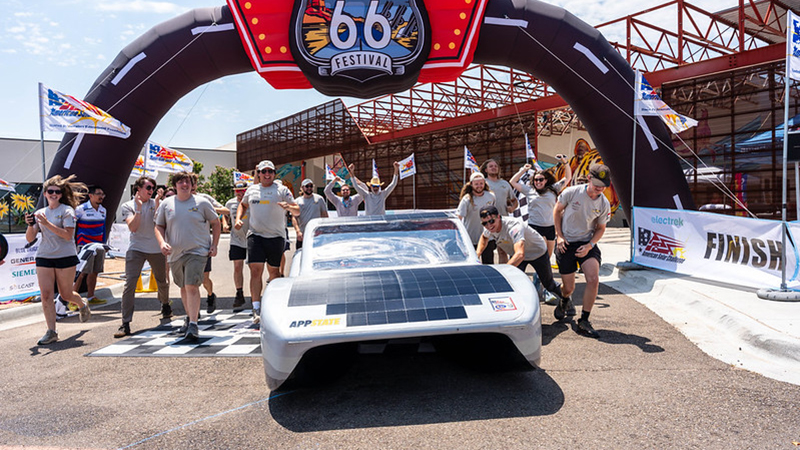
The Electrek American Solar Challenge, a collegiate challenge, sees teams attempt a public-road journey of more than 1,500 miles, testing student-designed and student-built solar vehicles against distance, weather and the limits of energy efficiency. Organized by the Innovators Educational Foundation (IEF), the event challenges teams to complete a fixed base route and a series of optional loops on the power of the sun alone—a test of engineering, energy strategy, and endurance that unfolds over four stages and hundreds of miles, event organizers stated in a press release. This year’s challenge concluded Saturday, Aug. 1, in Amarillo, Texas.
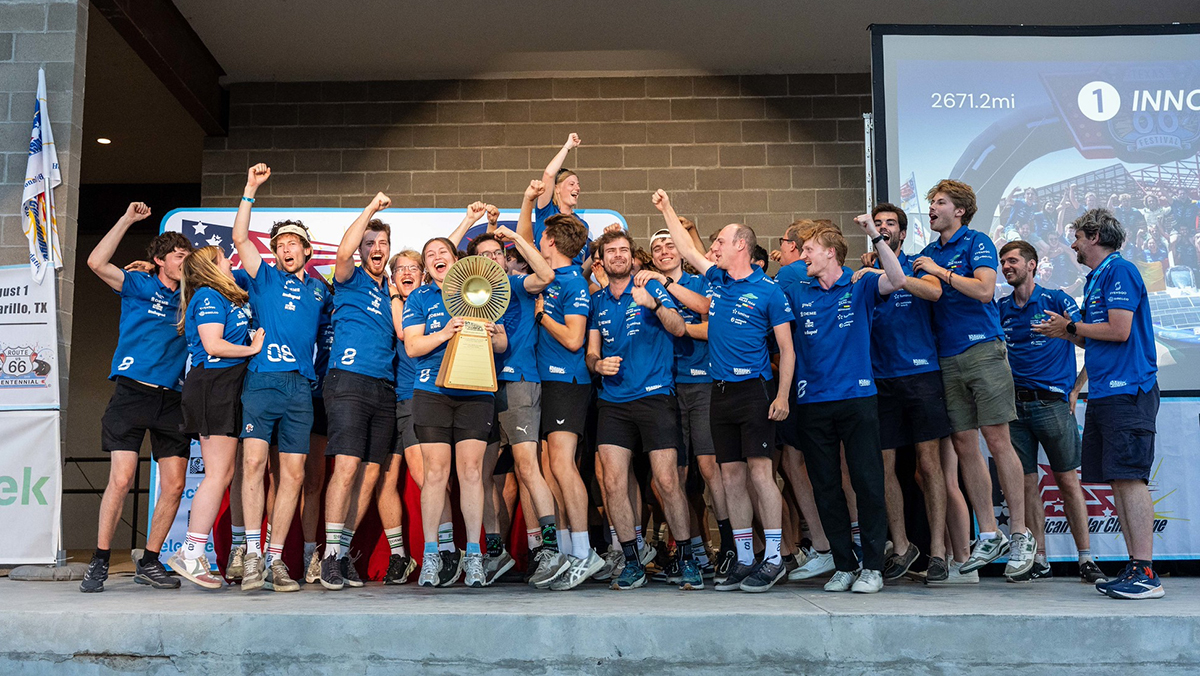
This year, that test came down to two champions: KU Leuven of Belgium (Car #8) claimed the Single-Occupant Vehicle (SOV) title, and Appalachian State University (Car #828) won the Multi-Occupant Vehicle (MOV) class. Seven teams completed the entire 1,547-mile base route. The full 2026 results are available at americansolarchallenge.org.
A Single-Occupant Finish Measured in Minutes
The SOV class produced one of the closest finishes in recent memory, noted the release. KU Leuven took the win with 2,671.2 official miles and an official time of 62:07:02, averaging 43.4 mph. TU Delft of the Netherlands (Car #30) matched KU Leuven’s 43.4 mph average and finished just under four minutes back with an official time of 62:11:01.
TU Delft actually completed a fraction more loop mileage, but the final margin came down to penalties. École de technologie supérieure (ÉTS) of Montréal (Car #92) rounded out the podium in third with 2,443.9 official miles and the class’s cleanest run, taking just 10 miles of deductions.
Single-Occupant Vehicle (SOV) Class Podium
- #8 KU Leuven (Belgium) — 2,671.2 official miles; 62:07:02; 43.4 mph average
- #30 TU Delft (Netherlands) — 2,535.5 official miles; 62:11:01; 43.4 mph average
- #92 ÉTS – Montréal — 2,443.9 official miles; 60:54:06; 40.3 mph average
Appalachian State Wins the Multi-Occupant Class
The MOV class rewards more than distance, organizers said. Teams are scored on a formula that weighs distance completed (40%), an optimization score based on person-miles carried per unit of external energy charged (40%), and a practicality score judged in Minneapolis (20%).
Appalachian State took first with a class-leading score of 92.7, edging out Polytechnique Montréal (Car #55) at 88.8, even though Poly Montréal actually covered the most ground in the class at 1,983.6 miles. Appalachian State’s combination of energy efficiency and a top practicality score carried the day. Georgia Tech (Car #49) finished third at 87.2, posting the highest passenger occupancy in the field.
Multi-Occupant Vehicle (MOV) Class Podium
- #828 Appalachian State — score 92.7 (1,829.6 miles logged)
- #55 Polytechnique Montréal — score 88.8 (1,983.6 miles logged)
- #49 Georgia Tech — score 87.2 (1,622.4 miles logged)
The Journey to the Finish Line
This year’s route carried the field south from the Minneapolis area, where teams first earned their place on the road at the Electrek Formula Sun Grand Prix, a closed-track qualifying event, before setting out cross-country. Over four stages, the caravan traveled through the Midwest and traced stretches of historic Route 66 through Oklahoma and Texas, converging on the finish line in Amarillo. Along the way, teams navigated checkpoints, optional challenge loops, and the day-to-day strategy of managing battery, weather and sunlight over hundreds of miles.
The Challenge closed with an awards ceremony at Arts in the Sunset in Amarillo, honoring the winning teams and the students who spent an average of two years designing and building their vehicles for the competition.
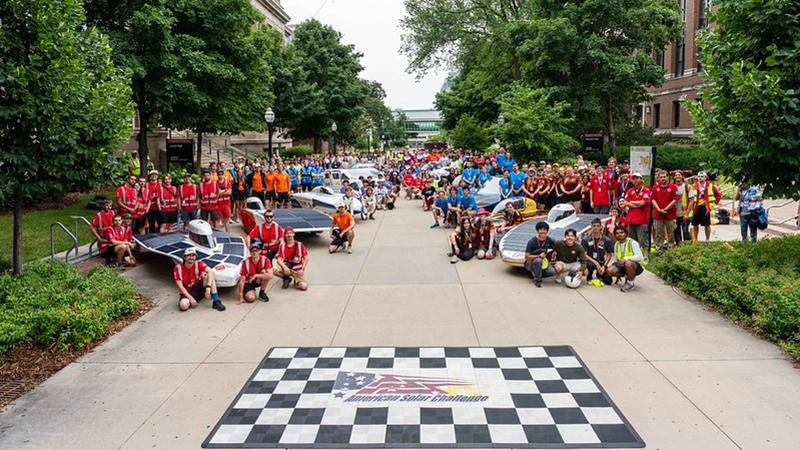
The IEF says the Electrek American Solar Challenge is fundamentally about what happens over the months and years before the cars ever reach the starting line. Each vehicle in this year’s field represents thousands of hours of student work—designing aerodynamic bodies, engineering battery and solar-array systems, and learning the energy strategy required to cross a continent on sunlight alone.