- KPI – September 2026: The Brief
- KPI – September 2026: State of Business – Automotive Industry
- KPI – September 2026: State of the Economy
- KPI – September 2026: Consumer Trends
- KPI – September 2026: Recent Vehicle Recalls
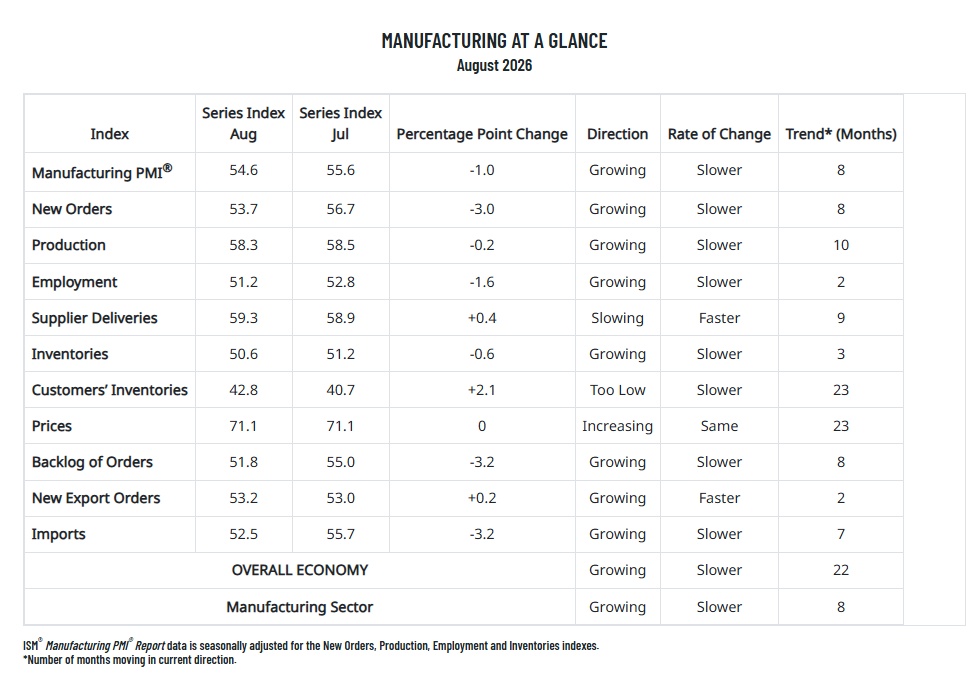
In August, economic activity in the manufacturing sector expanded for the eighth consecutive month, according to the nation’s supply executives in the latest ISM Manufacturing PMI Report. The Manufacturing PMI registered 54.6% in August, one percentage point below the July figure of 55.6%. The overall economy continued in expansion for the 22nd month in a row.
“U.S. manufacturing activity remained in expansion territory, though it has lost ground in a number of key measures—namely, the New Orders, Backlog and Imports indexes. Of the five subindexes that make up the PMI, the only one that grew faster than last month was Supplier Deliveries (up 0.4 percentage points), indicating a continuing slowdown of the supply chain,” says Susan Spence, chair of the Institute for Supply Management (ISM) Manufacturing Business Survey Committee.
Data shows 22% of the sector’s gross domestic product (GDP) contracted in August, compared to 20% in July. Likewise, 2% of manufacturing GDP was in strong contraction (defined as a composite PMI of 45% or lower), compared to zero percent in July.
“The share of sector GDP with a PMI at or below 45% is a good metric to gauge overall manufacturing weakness. Of the six largest manufacturing industries, five (Transportation Equipment, Petroleum & Coal Products, Computer & Electronic Products, Machinery, and Food, Beverage & Tobacco Products) expanded in August,” Spence says.
Important Takeaways, Courtesy of the Manufacturing ISM Report On Business:
- Three of four demand indicators (the New Orders, Backlog of Orders and New Export Orders indexes) remained in expansion, while the Customers’ Inventories Index remained in “too low” territory and contracted at a slower rate. A “too low” status for the Customers’ Inventories Index is usually considered positive for future production.
- Regarding output, the Production Index expanded for the 10th month in a row (though at a slower pace), with the positive-to-negative comment ratio dropping in August (2.2 positive comments for every negative one, versus a 3.3-to-1 ratio in July). The Employment Index remained in expansion but lost 1.6 percentage points. The positive-to-negative comments ratio on Employment also dropped (1.3-to-1, compared to 1.5-to-1 the previous month).
- Inputs—defined as supplier deliveries, inventories, prices and imports—were mixed. The Supplier Deliveries Index increased another 0.4 percentage points, while the Inventories Index declined 0.6 percentage points but remained in expansion. The Prices Index was relatively unchanged compared to July’s reading of 71.1%, but the Imports Index dropped 3.2 percentage points, from 55.7% in July to 52.5%.
What Respondents Are Saying:
- “The economy is annoying. It is getting in the way of otherwise good business. We are making great new products but struggling to compete when prices escalate due to things like tariffs and the conflict in the Strait of Hormuz. I fear that the inflation caused by these factors will lead to lower sales and lower spending power of our customers. Call it inflation! At some point, it leads to an economic downturn or at least an economic pain for many consumers. It’s an uncertain year, our second in a row.” [Chemical Products]
- “For our building products division, profitability is not far off from last year despite economic headwinds, as our specialty products have maintained their market share and sales. Specific to IT, the rising costs in component inputs have caused some budgetary constraints as we plan for the 2027 fiscal year. However, we have largely been able to keep costs close to historic consumer price index averages.” [Chemical Products]
- “The supply chain situation, especially in the electronics market, is going through another crisis even bigger and more complicated than during and post COVID-19. That’s mainly due to AI infrastructure and uncertainties in the global market (for oil and other critical supplies) due to war in the Middle East and more complication on trade rules.” [Computer & Electronic Products]
- “Supply markets are increasingly challenging due to inflation and supply availability. Each month has been more difficult than the previous one. Starting to resemble the post-COVID-19 disruptive period.” [Computer & Electronic Products]
- “Prices continue to rise on all goods. Suppliers are noting that energy, steel and labor costs are increasing very quickly. We continue to try to move products around to offset costs. We have moved more products to offshore sources to try to minimize cost impacts.” [Machinery]
- “Photonics, high-speed connectors, semiconductors and government orders are expanding significantly. Supply chains domestically and globally are difficult, with increases in lead times and cost.” [Machinery]
- “Commentary this month echoes that of recent months: (1) significant availability/price challenges in commodities heavily consumed by AI, (2) great uncertainty over when the Iran conflict will end and (3) another round of shifting U.S. tariff policy. Despite these tensions, we continue to focus on what we can control. The market for our products remains strong.” [Miscellaneous Manufacturing]
- “This month is a blur: Steel prices continue to climb as supply diminishes, aluminum is rising after dropping and there are many holes on the plate side. Demand seems to be a seesaw. Our prediction ability continues to diminish, with the exception that the year will remain difficult until the end.” [Primary Metals]
- “High steel and aluminum prices (due to Section 232 tariffs) continue to make profitability a challenge. Uncertainty over the U.S.-Mexico-Canada Agreement is at the forefront of many customer conversations. Our industry has also been hit with countervailing and anti-dumping penalties, further raising the cost of equipment.” [Transportation Equipment]
- “Volume is consistent. Our main customer is shifting production from U.S. plants to Mexico plants.” [Transportation Equipment]