KPI – September 2026: State of Business – Automotive Industry
Sponsored by Turn 14 Distribution
- KPI – September 2026: The Brief
- KPI – September 2026: State of Manufacturing
- KPI – September 2026: State of the Economy
- KPI – September 2026: Consumer Trends
- KPI – September 2026: Recent Vehicle Recalls
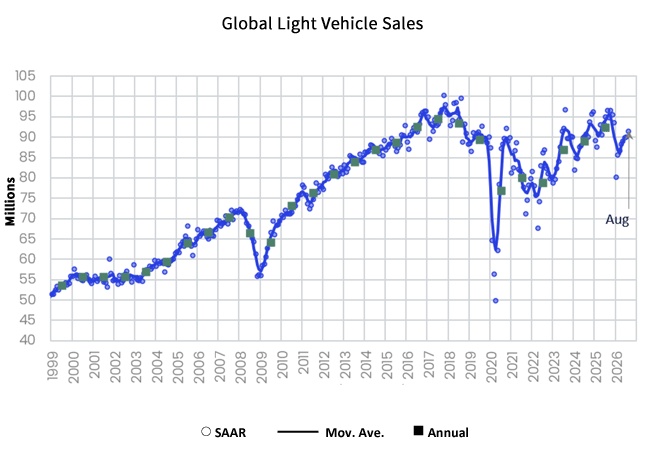
Global Light Vehicle Sales
In August, global light vehicle sales increased to over 91 million units per year. Year-to-date sales stand at 57 million units—down 4% compared to the first eight months of 2025. According to the GlobalData report, “the latest selling rate result is more in line with the 2025 full-year figure, though the strength of the market through H2 2025 suggests 2026 will remain in last year’s shadow.”
Looking ahead, September sales are expected to decline 4.7% year-over-year to 7.7 million units—translating to a selling rate of 89.3 million units, down by 5.8% year-over-year. Data shows a pivot away from policy support in China is leaving the domestic market exposed. Meanwhile, the U.S. market is facing cost-of-living pressures and dwindling support for EVs, but strong wealth metrics are offsetting some weakness. Elsewhere, consumers are benefiting from increasingly competitive markets despite economic headwinds.
“Once again, China is expected to be a drag on global volumes, while India is likely to see growth. European sales are forecast to be relatively flat year-over-year, while volumes are likely to decline in the Middle East, due in part to regional instability,” says David Oakley, manager of Americas vehicle sales forecasts at GlobalData.
The forecast for total global sales in 2026 was cut to 88.3 million units, compared to 89.7 million units a month ago. This forecast would represent a 4.3% year-over-year decline, with no major change in dynamics in the Chinese market expected until 2027.
The conflict in the Middle East is becoming “ever more protracted and complex,” Oakley says, noting the prospects of meaningful declines in energy prices are becoming more remote. This presents downside risks to global auto sales forecasts, as inflation increases and central banks respond by hiking interest rates.
U.S. New Vehicle Market
Total new-vehicle sales for September 2026, including retail and non-retail transactions, are projected to reach 1,330,100 units, a 2.6% increase year-over-year, according to a joint forecast from J.D. Power and GlobalData.
September results continue to demonstrate strong demand for new vehicles, with the annualized total selling rate reaching 16.1 million units. However, data shows year-over-year comparisons remain complicated by quirks in the industry sales reporting calendar and the ending of federal EV credits on Sept. 30, 2025.
For example, last year’s Labor Day holiday, which is one of the busiest shopping periods of the year, fell during the August sales reporting month. This year Labor Day was in September, making a favorable comparison to a year ago.
Conversely, data shows September sales were inflated a year ago by the announcement that federal EV credits of up to $7,500 would expire on Sept. 30, 2025, prompting many EV intenders to accelerate purchases in September 2025 that would otherwise have occurred later in the year.
“In totality, these dynamics are expected to result in 1,117,200 retail sales this month, a decrease of 0.2% on a selling-day-adjusted basis, but an increase of 4% on a non-selling-day-adjusted basis since September has an extra selling day this year,” says Thomas King, president of OEM solutions at J.D. Power.
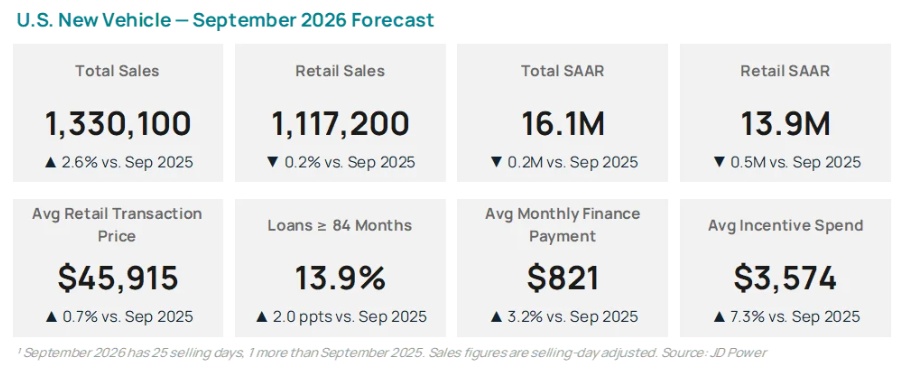
Key Takeaways, Courtesy of J.D. Power:
- September new vehicle total sales are on track for a 2.6% year-over-year increase, with a seasonally adjusted annualized rate (SAAR) of 16.1 million.
- The average transaction price of a new vehicle increased to $45,915, up 0.7% from a year ago.
- Average monthly payments are expected to rise 3.2% (or $821), while interest rates are projected to drop four basis points to 6.6%, the lowest September level since 2022.
- The increase in retail sales volume combined with the increase in transaction prices means the total retail consumer expenditure is projected to increase 6.6% to $48.7 billion, an increase of $3 billion from September 2025.
- Average incentive spending per vehicle is trending toward $3,574, a 7.3% increase from a year ago. Incentives as a percentage of MSRP are expected to hit 6.9% in September, up 0.4 percentage points from September 2025.
- EV share of retail sales fell 6.5 percentage points to 7.9% following the elimination of federal EV credits. However, elevated fuel prices and increased availability of vehicles with hybrid powertrains are driving a shift in powertrain sales mix. Hybrid share of retail sales is expected to reach 17%, up 3.5 percentage points from last year, despite ongoing tight inventory for some of the best-selling hybrid models on the market.
U.S. Used Market
The Manheim Used Vehicle Value Index (MUVVI) fell to 206.2, reflecting a 1% decrease in wholesale used-vehicle prices (adjusted for mix, mileage and seasonality) in the first 15 days of September compared to August. The Manheim index was down 0.4% compared to September 2025, “softening” from the elevated levels recorded in the first half of the year.
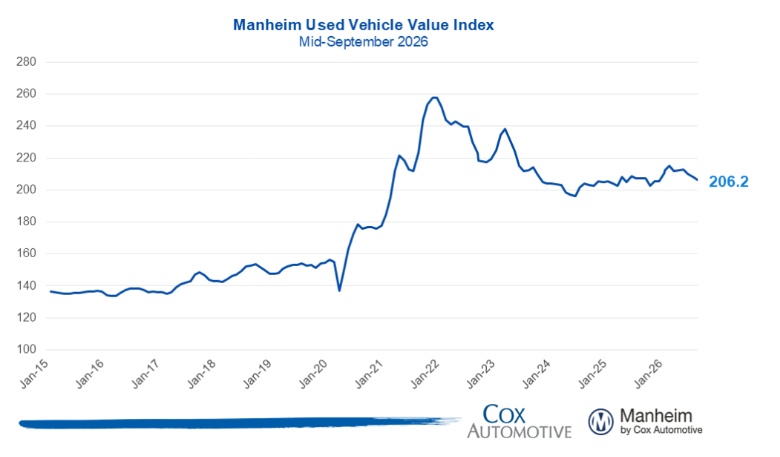
That decline is enough to tip the year-over-year comparison negative for the first time in 2026—down 0.4% against last September, after decelerating from a stronger-than-normal first half of the year. For Jonathan Gregory, senior director at Cox Automotive, “the market has fully given back the stronger pricing trend from the spring’s tax-refund bounce and is now tracking a touch below last year.”
Following a record-setting Labor Day, he says gas prices have continued to move higher amid renewed unrest in the Middle East. As of mid-month, Compact Cars and EVs were the only major segments with values above year-ago levels, potentially reflecting greater demand for fuel-efficient vehicles.
“The Federal Reserve’s first rate hike in more than three years adds another potential headwind. The direct impact on auto loans may be limited because those rates tend to track longer-term Treasury yields more closely than the federal funds rate. Still, higher borrowing costs and added pressure on household budgets will weigh on vehicle demand,” Gregory says.