
- KPI – July 2026: The Brief
- KPI – July 2026: State of Business – Automotive Industry
- KPI – July 2026: Consumer Trends
- KPI – July 2026: Recent Vehicle Recalls
Employment
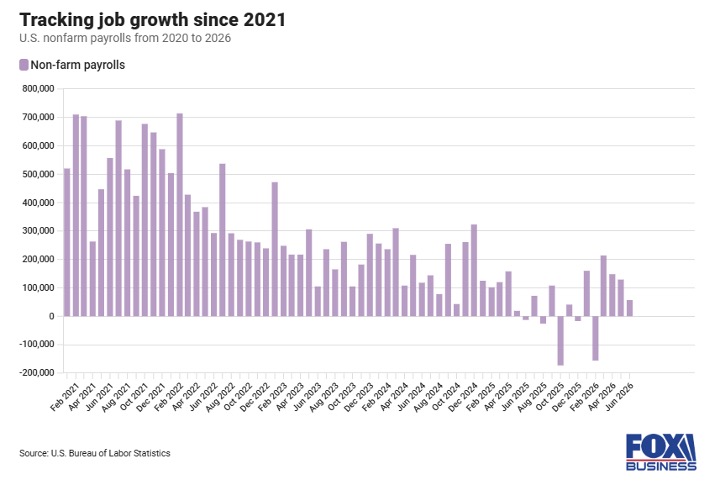
Total nonfarm payroll employment increased by 57,000 in June—below the Dow Jones forecast of 115,000. Employment continued to trend up in professional and business services, social assistance and health care but declined in leisure and hospitality.
According to the U.S. Bureau of Labor Statistics, the unemployment rate and number of unemployed persons remained relatively unchanged at 4.2% and 7.1 million, respectively. The labor force participation rate held steady at 61.5%, with long-term unemployment accounting for 27.3%. A broader unemployment measure that includes discouraged workers and those holding part-time jobs for economic reasons declined by 0.2 percentage point to 7.9%.
In addition, average hourly earnings rose 0.3% for the month and 3.5% from a year ago, both in line with the consensus forecasts.
Seema Shah, chief global strategist at Principal Asset Management, says that the June jobs report “paints a softer picture of the labor market than investors have become accustomed to, but it should ultimately be welcomed by markets.”
“The slowdown in payroll growth challenges the narrative of renewed labor market strength that has been building in recent months but, importantly, reinforces the view that the Federal Reserve is under little pressure to tighten policy,” Shah continues.
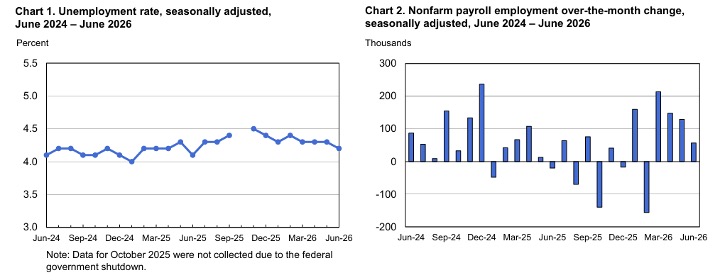
According to news reports, the above-consensus jobs numbers likely will deter the Federal Reserve from lowering interest rates anytime soon.
“For the Fed, this number is fine,” says Thomas Simons, senior economist at Jefferies. “The pace of job growth is plenty strong enough to maintain a steady unemployment rate and average hourly earnings are solid, but not accelerating. There is no imperative on their part to do anything with rates immediately, and the softening in the pace of job growth suggests that rate hikes are very unlikely to be necessary this year.”
By Demographic
This month, unemployment among the major worker groups: adult women – 3.7%; adult men – 3.9%; teenagers – 14.6%; Asians – 3.9%; Whites – 3.7%; Hispanics – 5.2%; and Blacks – 6.6%.
Last month, unemployment among the major worker groups: adult women – 3.8%; adult men – 4%; teenagers – 14.7%; Asians – 3.8%; Whites – 3.8%; Hispanics – 5%; and Blacks – 6.6%.
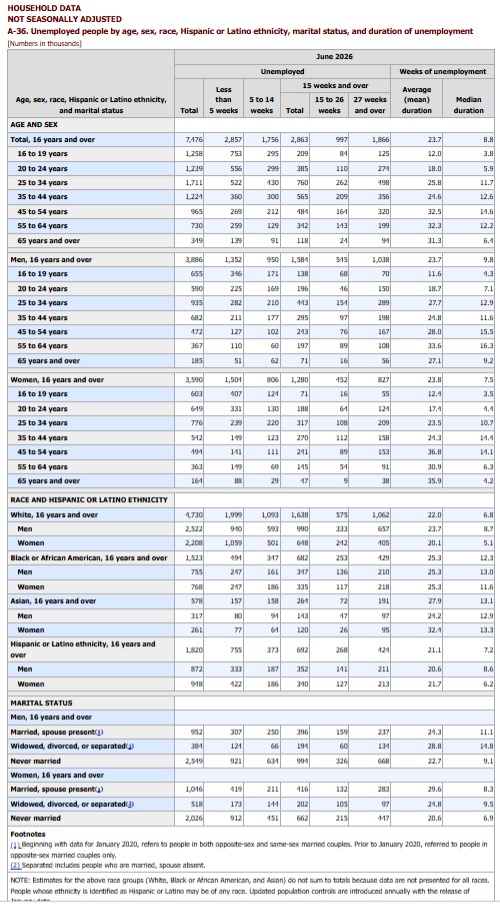 Image Source:
 By Industry
The Conference Board Employment Trends Index (ETI) decreased from a downwardly revised reading of 106.90 in May to 106.69 in June.
“The ETI declined a second consecutive month in June, suggesting slower payroll growth ahead,” says Jannik Schulz, economic research associate at The Conference Board. “However, recent data show persistent labor market resilience as firms continue to limit hiring and separations, while few workers are quitting.”
Three of the ETI’s eight components contributed negatively: The Percentage of Respondents Who Say They Find “Jobs Hard to Get,” Initial Claims for Unemployment Insurance and Real Manufacturing and Trade Sales. The following five components contributed positively: The Percentage of Firms with Positions Not Able to Fill Right Now, the Ratio of Involuntarily Part-time to All Part-time Workers, the Number of Employees Hired by the Temporary-Help Industry, Job Openings and Industrial Production.
“Consumers’ pessimistic hiring outlook fueled much of June’s weakness in the ETI,” Schulz says, “which is consistent with the prevailing ‘low hire, low fire’ labor market environment. Nonetheless, the number of people on non-farm payrolls remains elevated and has been ticking higher in recent months. Meanwhile, the number of initial jobless claims also increased in June. Although unemployment claims remain near historical lows, the ETI interprets the increase as a negative signal for the labor market ahead.”
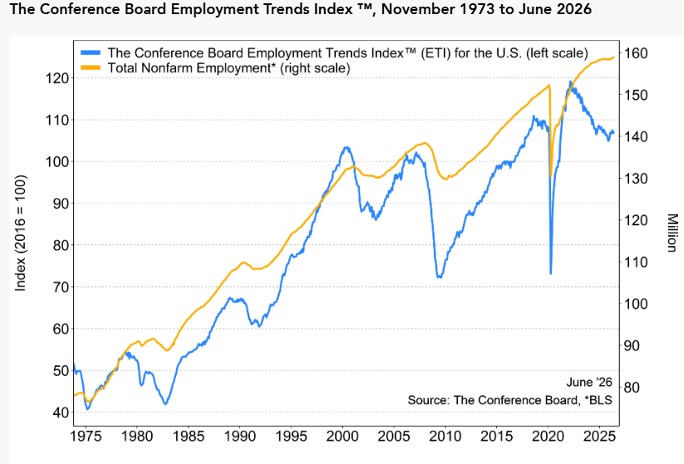 The Employment Trends Index is a leading composite index for payroll employment. When the Index increases, employment is likely to grow as well, and vice versa. Turning points in the Index indicate that a change in the trend of job gains or losses is about to occur in the coming months.
Click here to view more detailed information by industry.