Hot Rodders of Tomorrow: Still Building the Auto Aftermarket’s Future
The 18-year-old HROT engine building challenge continues to attract young talent to the industry...

This article on Hot Rodders of Tomorrow originally appeared in the June 2026 issue of THE SHOP magazine.
The automotive aftermarket has a people problem—and shop owners across the country are feeling it. As experienced technicians age out of the workforce and fewer young people enter the trades, the talent pipeline has thinned to a critical point.
As the owner of Winners Circle Speed and Custom in Joliet, Illinois, Jim Bingham understood firsthand how difficult it was becoming to find skilled, motivated employees. Instead of waiting for a solution, he set out to build one.
In 2008, alongside industry icon Vic Edelbrock Jr., Bingham launched Hot Rodders of Tomorrow (HROT). The high school engine-building competition is designed to introduce students to the fundamentals of the trade—and the opportunities within it.
“ These blue collar jobs are not going away,” says Rodney Bingham, HROT’s president and event coordinator and Jim’s son. “In fact, (trade workers) are actually getting paid more and more.”
What began as a local initiative rooted in the desire of two industry veterans to foster the next generation of automotive enthusiasts and professionals evolved into a national program that connects thousands of students with hands-on experience, industry mentors and career pathways. Today, HROT remains a grassroots answer to one of the aftermarket’s biggest challenges: developing talent.
“The engine is a tool to allow kids to learn teamwork, to learn fundamentals of the engine—and to earn a scholarship,” Rodneys Bingham says.
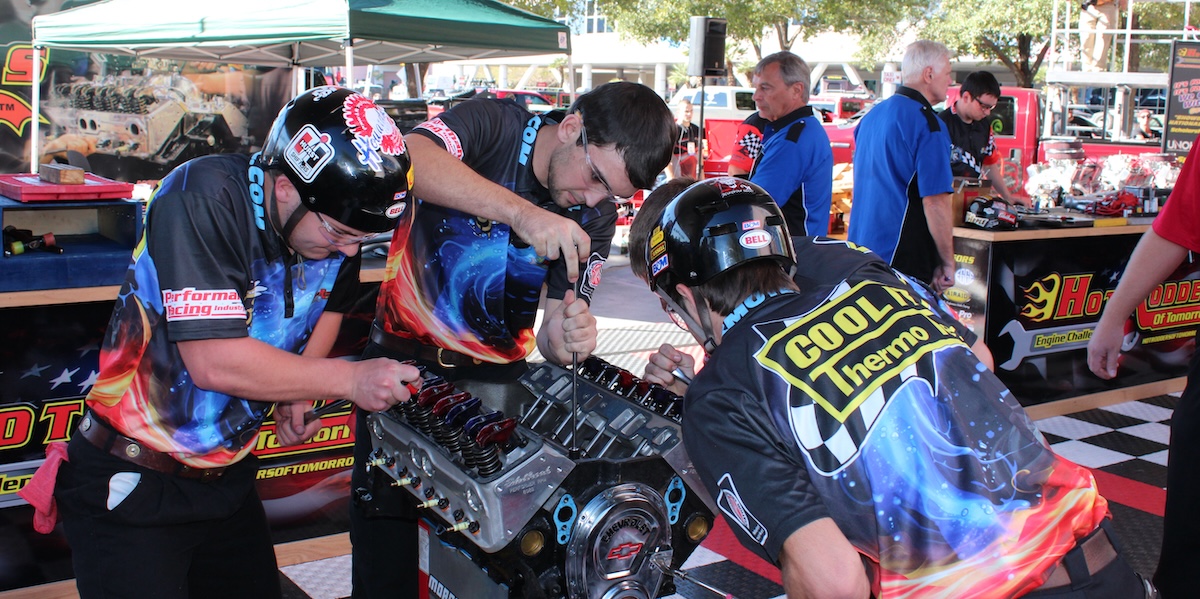
LOCAL COMPETITIONS, NATIONAL PIPELINE
Hot Rodders of Tomorrow’s signature Engine Challenge was inspired by a surprisingly modest setup—junkyard engines and a handful of high school and college teams competing inside a 10-by-20-foot booth that Vic Edelbrock Jr. discovered at the Race and Performance Expo trade show.
Seeing the potential, Edelbrock brought the idea to Jim Bingham, and the two set out to build something bigger. Jim acquired a truck and trailer, and together they rallied industry vendors to support a more structured, scalable version of the competition.
“All of the engines are from partnerships with all the sponsors, and then Begler’s machine shop here in Illinois did all the machining and got all the parts put together,” Rodney says.
HROT officially launched in 2008 with five high school teams and 35 students at the Race and Performance Expo. Within a year, it had expanded to 36 teams competing across three events.
Momentum continued to build as the program introduced significant scholarship opportunities, including $250,000 from Ohio Technical College (OTC) and the University of Northwestern Ohio (UNOH) at its first Showdown at the SEMA Show.
By the early 2010s, Hot Rodders of Tomorrow had expanded beyond its Midwest roots, establishing a footprint with events stretching from California to the East Coast. Along the way, the program also earned a place on some of the industry’s biggest stages. Students have the opportunity to compete at events like the SEMA Show and Performance Racing Industry (PRI) Show—where they can test their skills against top teams, compete in front of family and industry representatives and experience the automotive world firsthand.
Since its inception, HROT (hotroddersoftomorrow.com) has generated more than $50 million in scholarship opportunities through partnerships with schools and training institutions, including OTC, UNOH, the School of Automotive Machinists & Technology (SAM Tech) and Universal Technical Institute (UTI).
That growth, however, didn’t happen on infrastructure alone. At its core, Hot Rodders of Tomorrow has always been powered by people.
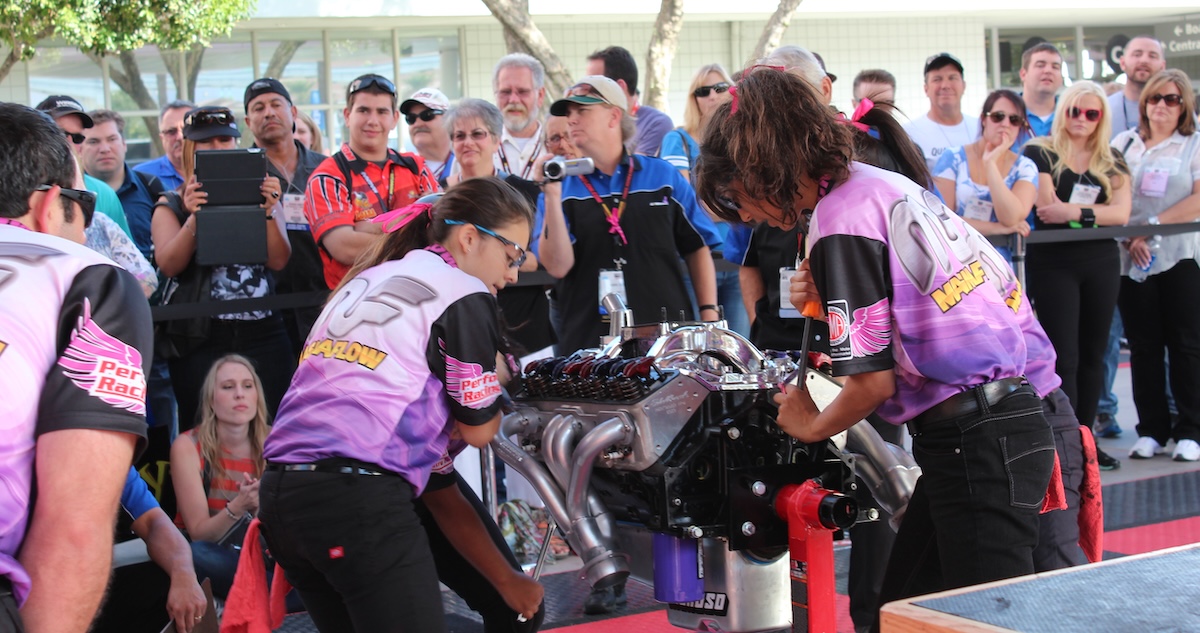
A VITAL COMMUNITY
While HROT has expanded across the country, its leadership remains rooted in the same family that started it. Rodney Bingham took over day-to-day operations in 2012 and carries forward the vision of his father, while adapting it for a new generation.
Today, he balances the demands of the program with his role at Winners Circle Speed and Custom (winnerscircle.com)—a business now in its 56th year and on its third generation.
But HROT’s reach extends far beyond the Bingham family. In many ways, its success hinges on instructors. Often volunteering their time outside the classroom, these educators are responsible for recruiting students, organizing teams and, in most cases, fundraising to get them to competitions.
“I always tell these students, ‘Thank your instructor as much as you thank us,’” Bingham says. “Ninety-nine percent of the instructors do not get paid to do the engine challenge here. It’s something they do out of the love of their part, not that they’re making extra money.”
Supporting HROT is a nationwide network of roughly 150 volunteers, many of whom are former competitors themselves. As alumni return to judge events, mentor students and help run events, the program has evolved into a self-sustaining pipeline.
Meanwhile, industry suppliers see the benefits of being involved as sponsors and advocates.
“The Hot Rodders of Tomorrow program continues to be one that we are happy to support,” says Rick Love from Vintage Air. “In addition to teaching students valuable engine-building skills, it also emphasizes the importance of teamwork and attention to detail—traits that will help students be successful in any future endeavor.”
Looking ahead, that same model may shape HROT’s future. As Bingham continues to guide the program forward, he acknowledges that one day, the torch will need to be passed again—likely to someone who once stood on the competition floor themselves.
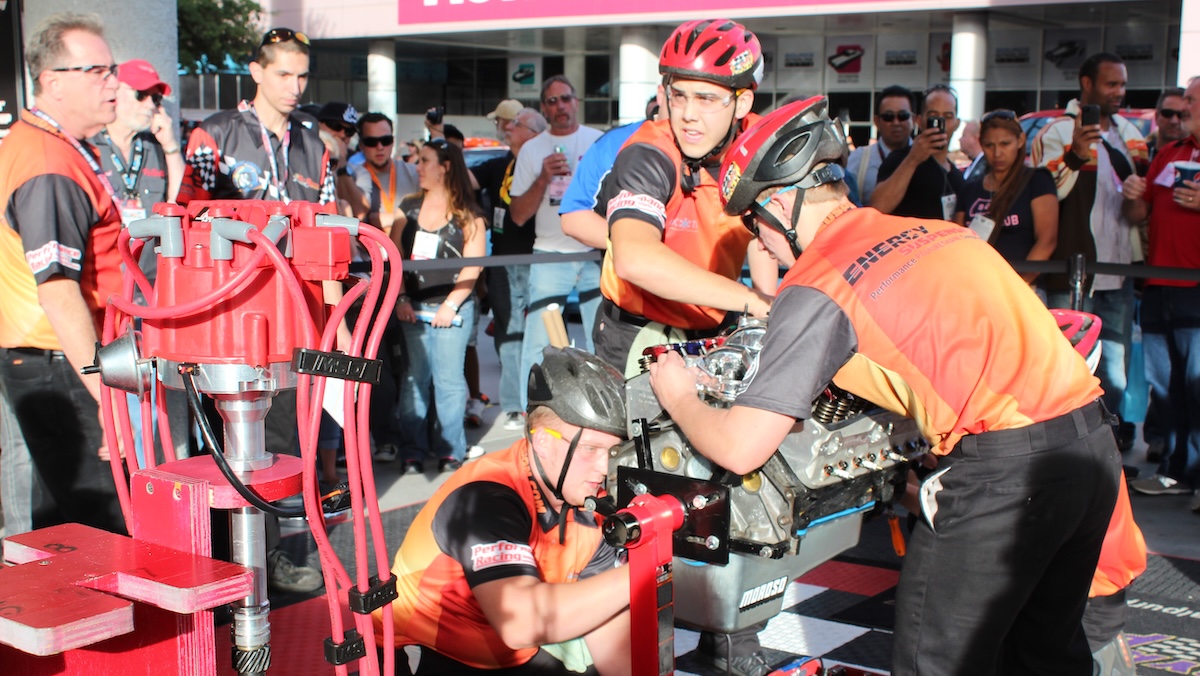
THE ROAD AHEAD
Even with that foundation in place, the road hasn’t been without challenges. Like many education-based initiatives, HROT felt the impact of the COVID-19 pandemic. Momentum stalled as schools shut down, hands-on programs were put on hold and some of the program’s most dedicated instructors chose to retire rather than navigate an uncertain teaching environment.
For a program built on consistency and in-person mentorship, the disruption was significant.
“COVID has been the biggest single challenge to the actual program,” Bingham says.
While he admits HROT almost shuttered permanently because of the pandemic, the pause turned into a reset.
In the years since, the program has restructured how it operates. Bingham leans more on host schools to run local events, which reduces the need to transport equipment across the country. The shift has allowed the program to rebuild more sustainably while still maintaining a national reach.
At the same time, Bingham is focused on lowering barriers to entry. One of the newest initiatives, the Spark Plug Challenge, simplifies the competition into an individual, entry-level format. That gives students a chance to participate without needing a full team or extensive resources.
As demand for skilled trades continues to rise, programs like HROT are increasingly relevant to the automotive aftermarket and the broader workforce. Bingham says the point of the program is more than simply attracting young people into the automotive industry.
In fact, its impact goes beyond the shop floor—alumni have gone on to careers across the spectrum, from NHRA and NASCAR to roles as welders, truck drivers and other in-demand trades
“As a country, we need welders; we need people to go into our military—so as long as they do something with their hands, then I’ve done my job,” he says.
Bingham recalls a former student from Virginia who stopped into his shop to share that he earned so much scholarship funding from participating in HROT and the workforce development program SkillsUSA that his schooling at Ohio Technical College was 100% paid for.
“He was super thankful to us for doing what we do,” Bingham says. “That’s what fuels me and fuels my volunteers.”