Virtually Race Against AI Drivers in the dSpace Booth at CES 2026
The company’s virtual reality racing simulator demo will offer a fully immersive human vs. machine experience…

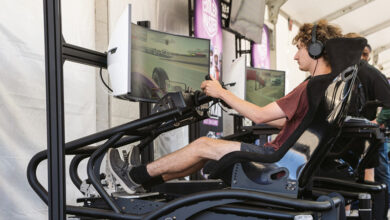
dSPACE, a provider of simulation and validation solutions, has invited Consumer Electronics Show (CES) visitors to race against the AI drivers of the Indy Autonomous Challenge (IAC) at its booth (#4500) in West Hall at the Las Vegas Convention Center. In a driving simulator, racing fans can compete on the virtualized Indianapolis Motor Speedway against driving stacks based on the driving algorithms of the world’s fastest autonomous racing cars, company officials stated in a press release.
The Indy Autonomous Challenge is an international competition for autonomous racing vehicles that brings together universities from around the world. dSPACE is a technology sponsor of the IAC and provides the student teams with simulation solutions such as the cloud-based test environment SIMPHERA and the central computer for the racing vehicles, noted the release.
dSpace Brings the IAC Into the Virtual World at Its Booth
In the last two years, the IAC has held racing competitions at the Las Vegas Motor Speedway during CES. This year, dSPACE is bringing the racing action into the virtual world and directly to its exhibition stand.
At CES 2026, dSPACE is presenting a comprehensive validation offering with AI-supported software-in-the-loop and hardware-in-the-loop solutions that enable vehicle manufacturers to master the increasing complexity in the development of software-defined vehicles, the company said. In addition, dSPACE is presenting a scalable cybersecurity test framework for vehicle development and a new hardware-in-the-loop system for the development and validation of common ECUs, especially for mechatronic applications in the automotive, agricultural machinery and construction machinery industries.
CES visitors can also discover how dSPACE integrates its HIL simulation tool chain with Qualcomm’s system-on-a-chip (SoC) platform to test AV algorithms based on synthetic data.