Self-Driving Volkswagen Part of Museum’s Declaration of Independence Celebration
“Stanley” is a modified 2004 blue VW Touareg that helped usher in the modern era of autonomous vehicles…
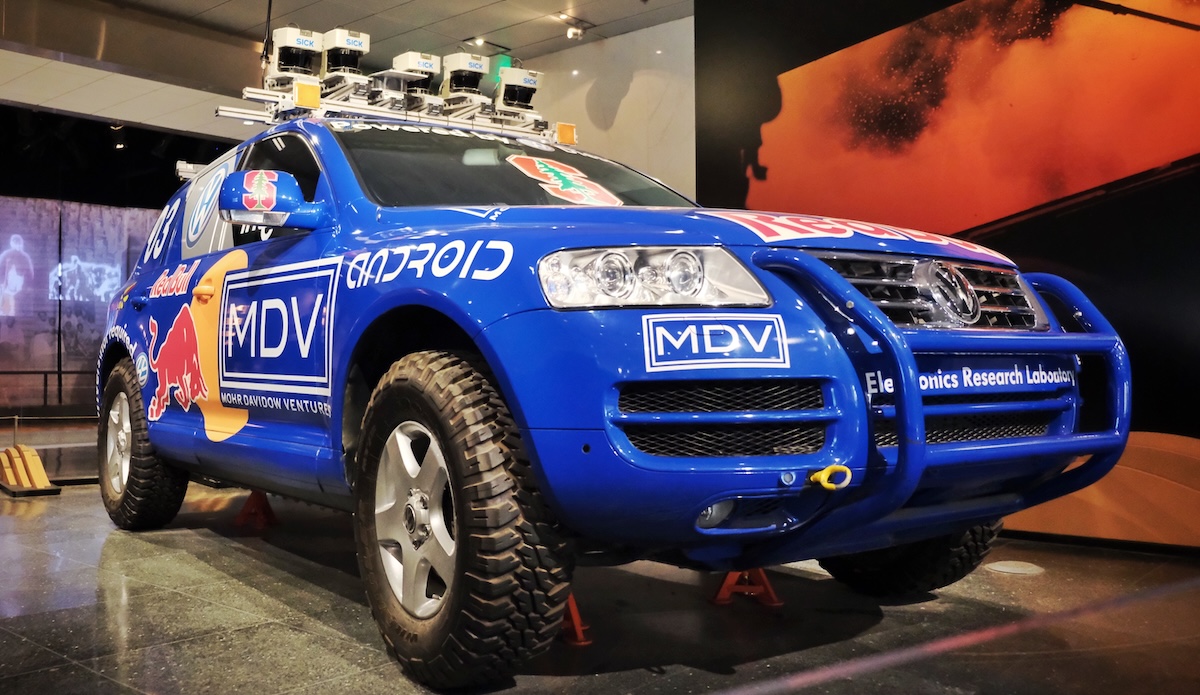
A history-making Volkswagen vehicle is included in the National Museum of American History’s sweeping museum-wide celebration of the 250th anniversary of the Declaration of Independence.
“Stanley,” a modified 2004 blue Volkswagen Touareg that helped usher in the modern era of autonomous vehicles, is one of the 250 objects highlighted in the exhibition, “In Pursuit of Life, Liberty & Happiness.”
“We’re incredibly proud to see a Volkswagen vehicle featured as a prominent moment in American history,” said Chuhee Lee, VP, mobility design & technology at Volkswagen Group of America. “‘Stanley’ is proof of what becomes possible when engineering ambition meets a bold vision for the future. That spirit lives on today in every Volkswagen vehicle we bring to American roads.”
The exhibition, which opened May 14 and runs through December in Washington, D.C., spans all three floors of the museum, covering approximately 250,000 square feet, according to a press release. It “connects America’s founding ideals with the ingenuity and innovation that have shaped the nation over the past 250 years.”
Visitors receive a commemorative guidebook featuring all 250 objects in the exhibition, along with activities, games and a full printed copy of the Declaration of Independence.
MAKING HISTORY ON ITS OWN
Before arriving at the museum, “Stanley “made history as a groundbreaking autonomous vehicle developed by Stanford University. On Oct. 8, 2005, Stanley—outfitted with an array of sensors and early machine learning—beat 22 competing robot vehicles to win the Defense Advanced Research Projects Agency (DARPA) Grand Challenge, a grueling 132-mile autonomous race across desert terrain near the California-Nevada state line.
The Stanford Racing Team, which built and operated the vehicle, claimed the $2 million prize with a time of 6 hours and 53 minutes. The technology that emerged from the DARPA challenge had an immediate and lasting civilian impact, the release noted, giving rise to the autonomous vehicle industry as it exists today.
Learn more about how to see “Stanley” on display at the National Museum of American History here.