Singer, Louis Vuitton Unveil Custom Porsche 911 Restomods
A rare collaboration blends high-end leatherwork & watchmaking with classic Porsche restoration craftsmanship to create a unique duo…
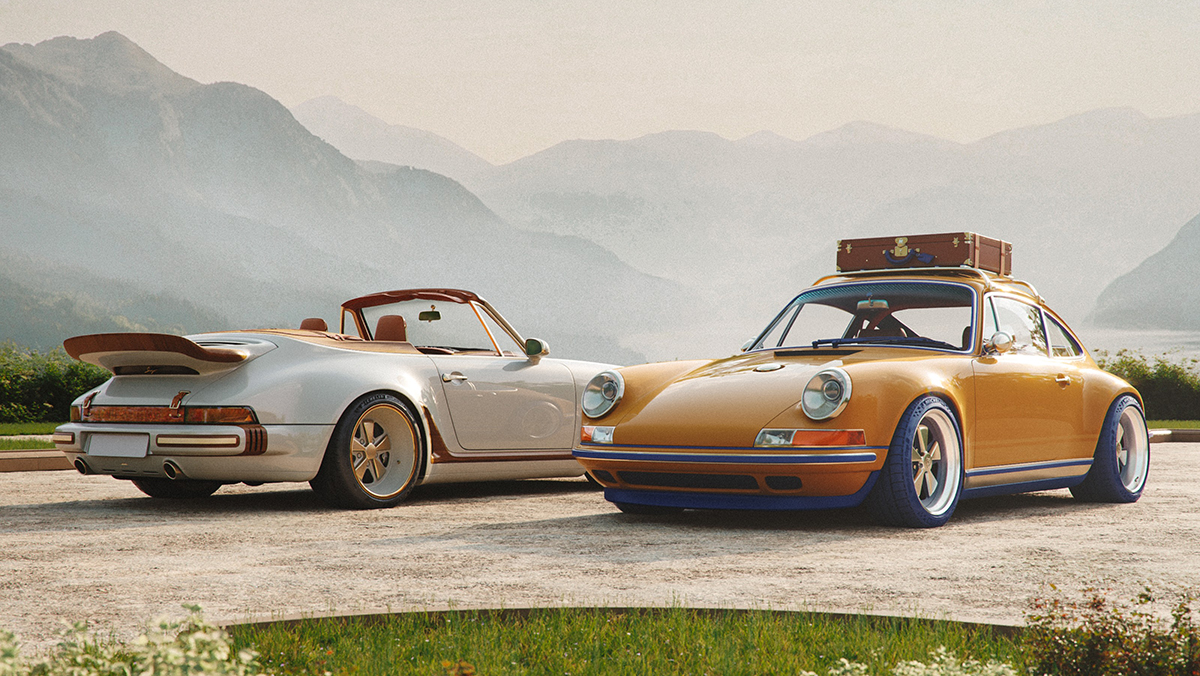
In a close collaboration, Louis Vuitton and Singer, the Californian atelier known for its highly personalized restorations of classic Porsche 911s, jointly revealed two builds. The first, a Porsche 911 Reimagined by Singer – Classic, showcases an exclusive livery in the House’s iconic colors—saffron, cobalt blue and yellow—specially crafted with and for Louis Vuitton.
Its counterpart, a Porsche 911 Reimagined by Singer – Classic Turbo, conceived by Louis Vuitton’s artistic director of women’s collections Nicolas Ghesquière, is a cabriolet finished in Calcaire Lutétien white and complemented by exquisite precious-wood trim. Both vehicles are enhanced with made-to-measure Louis Vuitton creations, transforming every journey into a true celebration of the art of living, company officials stated in a press release.
“This unique and remarkable adventure began with a request for a dashboard clock for a car reimagined by Singer,” shares Jean Arnault, Louis Vuitton watch director. “In addition to the design and production of this clock by La Fabrique du Temps Louis Vuitton workshops in Switzerland, it quickly became apparent to us that this collaboration with Singer could extend to the personalization of every functional element of the vehicle, enhancing them through our expertise in leather craftsmanship and watchmaking.”
“The specifications chosen by Louis Vuitton exposed us to techniques and methods developed over decades of experience,” explained Rob Dickinson, founder and executive chairman at Singer. “They trusted us with their esteemed brand, their traditions and their vision, and it was a joy to bring our two worlds together.”
At the heart of the project lies a detachable, mechanical timepiece, which can be converted into a desk clock, and whose design is inspired by the iconic Tambour watch, recognizable by its distinctive shape and its twelve polished and engraved letters forming the name of the House on the bezel, noted the release. To ensure coherence within the interior, the instrument display had to be redesigned, which required an entire year of relentless work.
Inspired by Louis Vuitton’s philosophy around the Art of Travel, the House’s designers reimagined every detail, including the speedometer, rev counter and gauges, to adopt the graphic codes of the Tambour line, particularly through their hands, terminations on the dials and index systems. The chosen design is a vivid cobalt blue hue accented with bright orange for the lettering. This unique creative partnership marks a historic first for both Louis Vuitton and Singer—creating a co-branded item.
“The aim was to create a true synthesis between Singer’s architectural and timeless language and the Louis Vuitton culture, characterized by refined materials, travel and expression of style,” said Octave Chany, project lead designer at Singer.
Louis Vuitton has chosen to express its vision in the form of a coupé reimagined through Singer’s Classic services, and a cabriolet reimagined through their Classic Turbo services, inspired by light and a nomadic spirit, the company said.
“This collaboration brought together two organizations with a shared belief that true luxury is defined by craftsmanship, authenticity and an uncompromising attention to detail,” explained Mazen Fawaz, chief strategy officer, Singer. “It has been a privilege for everyone at Singer to be trusted with Louis Vuitton’s remarkable 172 years of tradition and savoir-faire and to incorporate those techniques into our own work.
“Louis Vuitton brought an exceptionally bold and refined design vision focused on expressing the Art of Travel. Together, our teams combined that vision with Singer’s approach to engineering, craftsmanship and execution, challenging one another to achieve a level of precision worthy of both organizations. I couldn’t be prouder of how our mutual teams embraced that challenge. Along the way, what began as a creative partnership became a genuine friendship, both professionally and personally, built on mutual respect and a shared pursuit of excellence. These two automobiles are the result of that relationship, and neither could have been created without it.”
A Porsche 911 Reimagined by Singer – Classic: Louis Vuitton’s Most Contemporary Expression of the Art of Travel
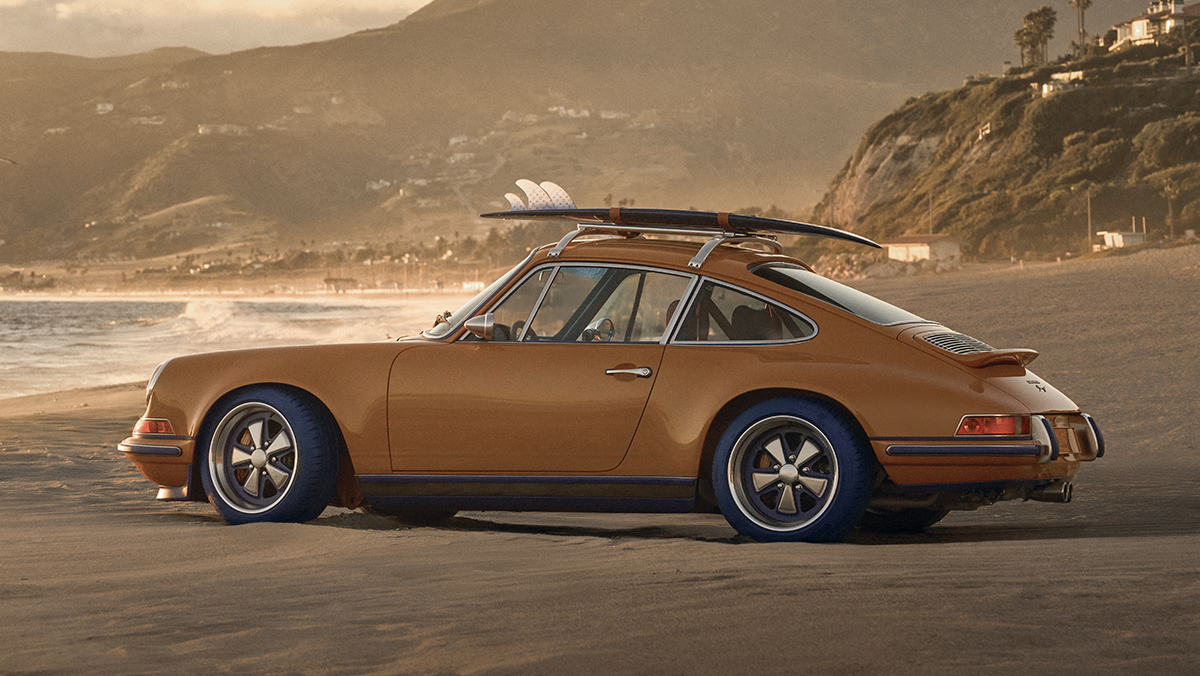
In its saffron and cobalt blue livery, fitted with a specially designed roof rack, which can accommodate a trunk, a surfboard or a pair of skis, this Porsche 911 was reimagined by Singer to the specification envisioned by Louis Vuitton.
The saffron shade, present in the House’s archives for over a century and a half and used across its packaging for more than 20 years, also resonates with Bahama Yellow, a hallmark hue closely associated with Singer’s earliest commissions. It has a particular connection with the automotive world, paying homage to the travel trunks designed for Citroën in 1924. These types of travel cases featured cobalt blue interior reinforcements. This two-tone color combination embodies Louis Vuitton’s identity, as does the bright yellow thread used for the saddle-stitch seams on the brand’s leather goods and trunks.
The classic car features distinctive cobalt blue demonstration tires, inspired by the handles and ribbons of the House’s packaging. This approach is echoed in the rear engine air intake grille, which discreetly incorporates a geometric motif formed by the initials L and V.
The cabin is entirely upholstered in leather with a natural hue inspired by VVT leather, one of the House’s most utilized leathers. Used for the handles, shoulder straps, edging, and labels of the brand’s luggage and on its coated canvas bags, the leather is one of Louis Vuitton’s most iconic signatures. Louis Vuitton’s expert artisans chose their preferred leather for the seats, selecting the appearance and color to complement the VVT-inspired leather trim that adorns the interior. The interior leatherworking was then executed by Singer’s team.
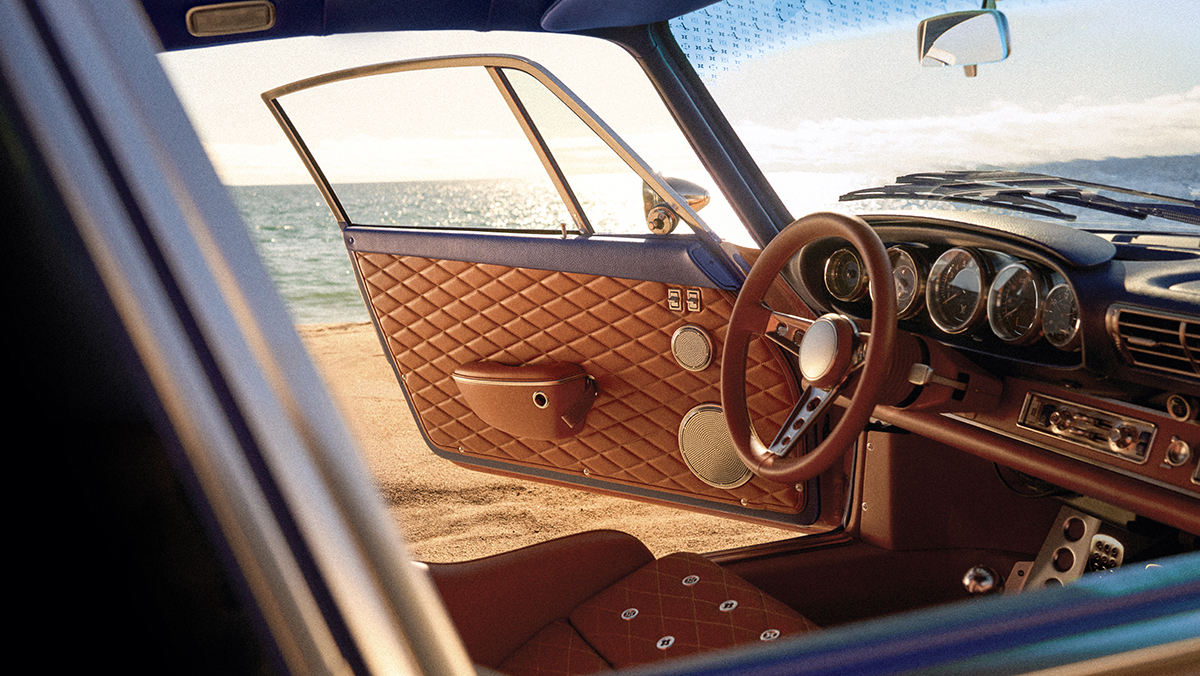
The edges of the door handles feature the same edge-dyeing technique used on Louis Vuitton bags, while the stitching is executed in yellow thread. The diamond-patterned embossing on the seats and the front boot trim, as well as the engine compartment at the rear, echoes the “malletage” motif characteristic of the inside of Louis Vuitton trunks. To ensure comfort for the driver and passenger, the seats are fitted with ventilation eyelets. Crafted and finished by hand, the seats also bear the iconic Louis Vuitton Monogram flower designs; a motif that also appears on the sun visor and headrests, echoing the windscreen.
Adjustment knobs, control switches, locks, pull-tabs and air vents have been crafted in metal, predominantly rhodium-plated, using traditional artisanal techniques. Each component has been individually hand-finished using techniques comparable to those employed in the creation of a fine timepiece. The tactile sensations, as well as aspects such as reflections and the play of light, have been carefully considered and adapted, drawing on watchmaking savoir-faire in polishing and satin-finishing. The specific colors have been achieved through anodizing or electroplating.
“What makes projects like this one particularly exciting is precisely the opportunity to challenge these constraints and explore new approaches to aesthetics, identity and craftsmanship within the realm of automotive engineering. Projects of this scale and exclusivity allow for a level of attention to detail that is unusual in the automotive world. Every transition between materials, every metallic reflection, every knurled surface, every mechanical interaction and every graphic element has been meticulously considered, often at an almost microscopic level,” explains Chany.
This attention to detail has been applied to the entire vehicle; for instance, the fuel and oil caps incorporate the distinctive typography used on Louis Vuitton watch components within their markings. Step by step, every element of the car has been meticulously designed and crafted to order, the company said.
“With the creation of both cars, Louis Vuitton has, for the first time, drawn upon the full breadth of its savoir-faire, bringing together the expertise of every House métier in a unique and exclusive automotive project,” said Arnault. “Every department at Louis Vuitton has contributed to this unprecedented cross-disciplinary endeavor, from trunk makers and leather goods artisans to the fashion and footwear teams, and even the watchmakers from La Fabrique du Temps Louis Vuitton.”
A Porsche 911 Reimagined by Singer – Classic Turbo: Where Fashion Meets Automotive Design
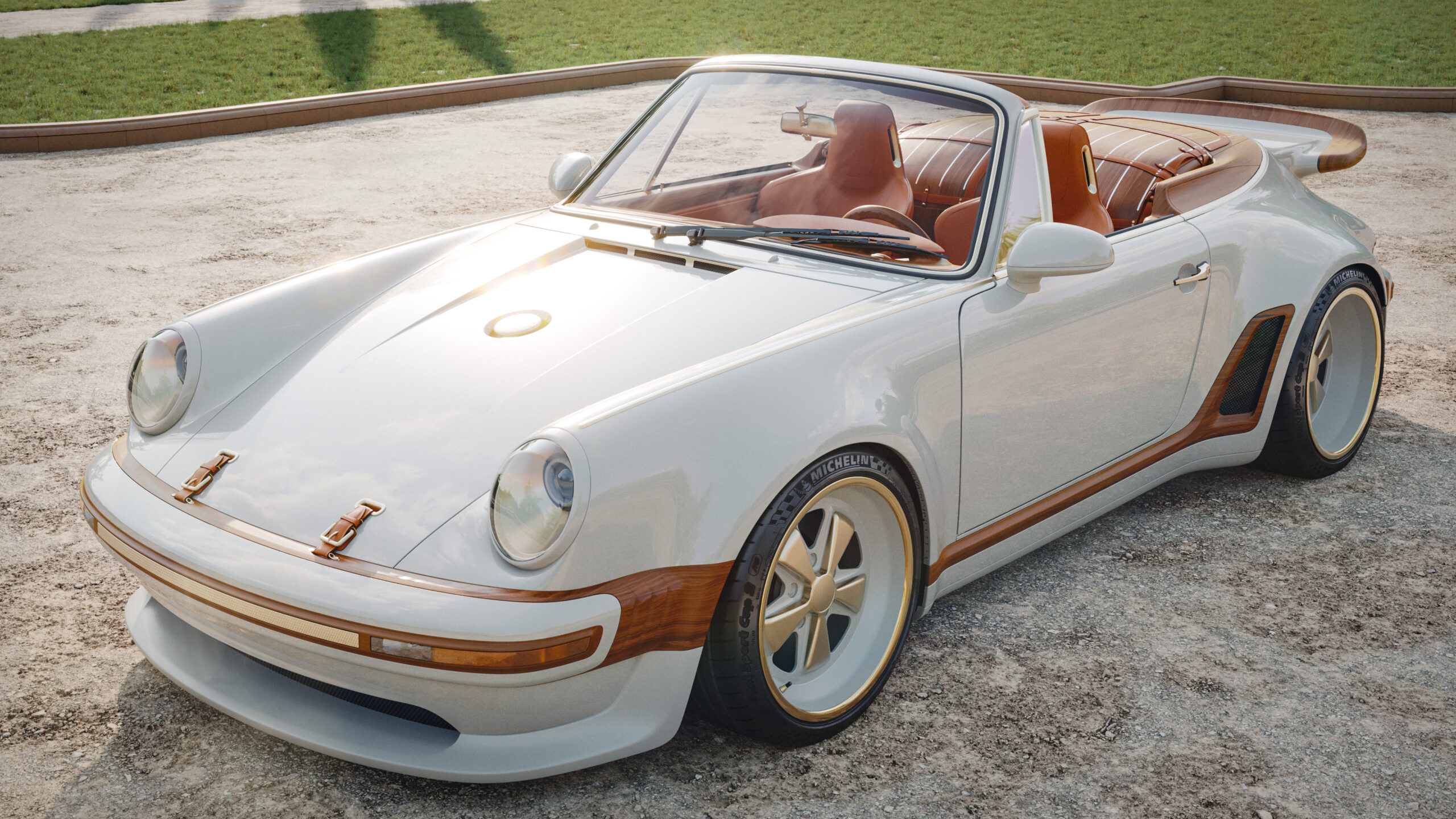
Once the design of the coupé was finalized, the creative collaboration continued with the development of a turbocharged cabriolet under the visionary leadership of Ghesquière. Featuring bodywork in white, subtly enhanced with touches of brown, it reveals an interior where leather and wood harmonize in a sophisticated tribute to the elegance of classic motorboats.
“Automotive design is a passion that has always lived within me. My collaboration with Singer has been a chance to reconnect with this fascinating world—a magnificent opportunity to explore truly exceptional automobiles,” highlights Ghesquière.
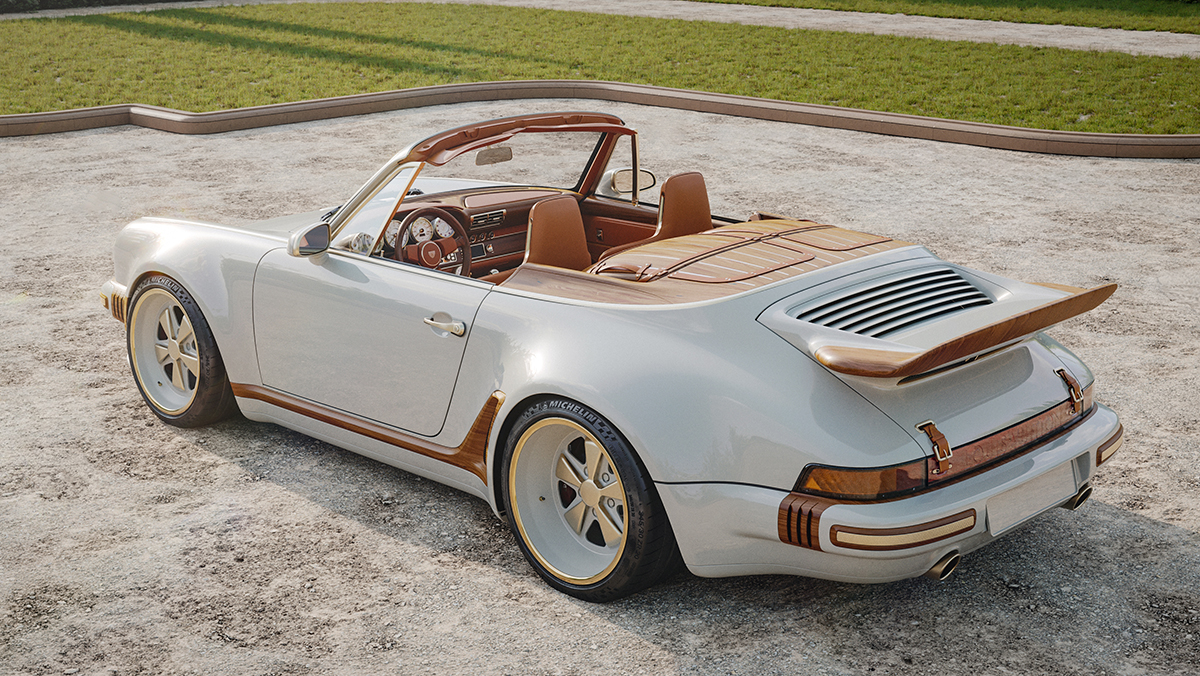
The choice of a cabriolet was an obvious one, combining sophisticated styling with exceptional prowess, the company said. While the large rear spoiler, typical of turbocharged models, underscores its capabilities, the rear-opening luggage compartment stands as an impressive feat of engineering, revealing a teak-inspired wooden deck. The color scheme combines an echo of Calcaire Lutétien with gold accents and the natural hues of the leather and wood.
As with the coupé, every element of the vehicle has been reimagined by the teams at Louis Vuitton and Singer, with the same attention to the finest details, materials, savoir-faire and finishes. Each component is unique, integrating various wooden features, including the bumpers, which presented an additional challenge for the designers and engineers involved in this project.
“The depth of dialog established between the worlds of automotive design, fine watchmaking and leatherwork makes these two cars particularly remarkable. The collaboration with Nicolas Ghesquière was just as fundamental to elevate the concept. Nicolas Ghesquière’s sensitivity to proportions, silhouettes and cultural expression has brought a perspective that has propelled the cars beyond traditional automotive design,” notes Chany.
The bespoke dashboard clock is not integrated into the instrumentation behind the steering wheel. Instead, it occupies the center of the console, upholstered in natural leather, where warm golden gauges, a dial finished in the exact shade of the exterior bodywork and a matching golden ignition key create a seamless connection between the interior and exterior.
The dashboard bears the Louis Vuitton signature, echoed within the Tail Lamps, while a distinctive leather patch on the steering wheel—one of Ghesquière’s signature details—subtly reinforces the House’s identity. All functional elements are crafted in metal, with the same attention to finishes and surface treatments as the Classic car, in harmony with the precision of fine watchmaking.
Behind the seats, upholstered in leather over a technical wooden shell, lies a luggage compartment developed specifically for the car’s unique form. It is crafted from varnished wood using the same technique employed for runabout decks. There is ample space for bespoke Louis Vuitton luggage fitted to the car, as well as for the lightweight soft top, which is itself inspired by the nautical world.
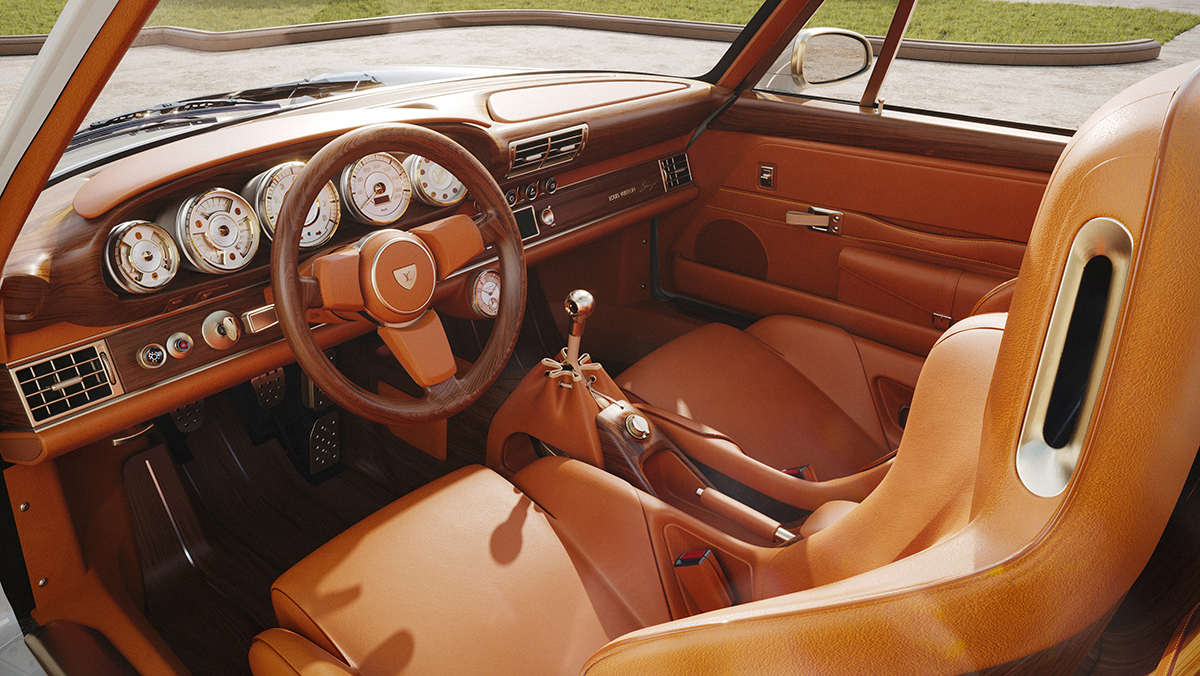
Wood paneling also lines the rear engine compartment and the front boot, which houses a bespoke trunk composed of three cases that slot together to form storage compartments. Leather fastening straps on the front and rear hoods, equipped with pin buckles, subtly recall references to motorsport, the traditions of trunk making and watch straps.
Specification Overview
Porsche 911 Reimagined by Singer – Classic
- Type 964 coupé chassis
- Lightweight carbon fiber bodywork in Saffron with speed-activated rear wing
- 4.0L, naturally aspirated, air-cooled flat-six
- Six-speed manual transmission
- Rear-wheel drive
- Carbon-ceramic braking system
Porsche 911 Reimagined by Singer – Classic Turbo
- Type 964 cabriolet chassis
- Lightweight carbon fiber bodywork in Calcaire Lutétien white with whale tail rear wing
- 3.8L, twin-turbocharged, flat-six with air-to-water intercooling
- Six-speed manual transmission and selectable drive modes
- Rear-wheel drive
- Carbon-ceramic braking system