
- KPI – October 2026: The Brief
- KPI – October 2026: State of Manufacturing
- KPI – October 2026: State of Business – Automotive Industry
- KPI – October 2026: Consumer Trends
- KPI – October 2026: Recent Vehicle Recalls
Employment
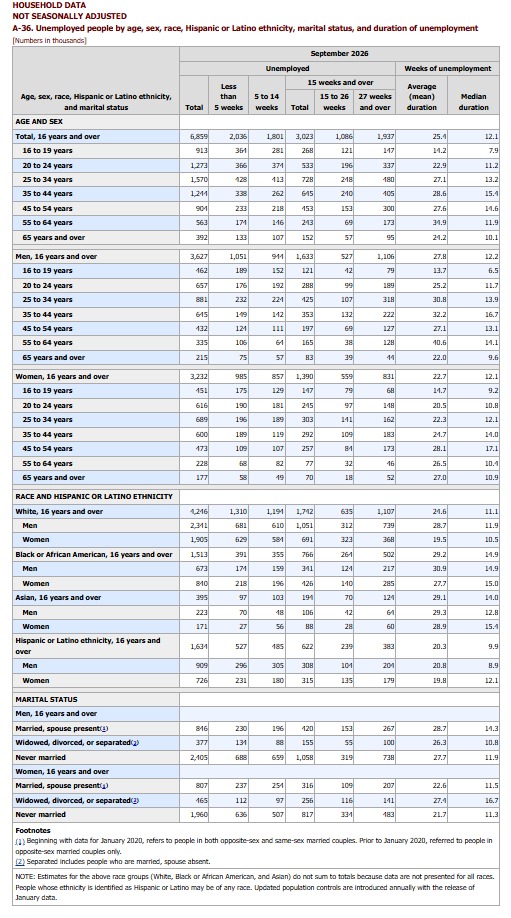
Total nonfarm payroll employment increased by 29,000 in September—below the Dow Jones estimate of 84,000. Employment across all major industries changed little over the month.
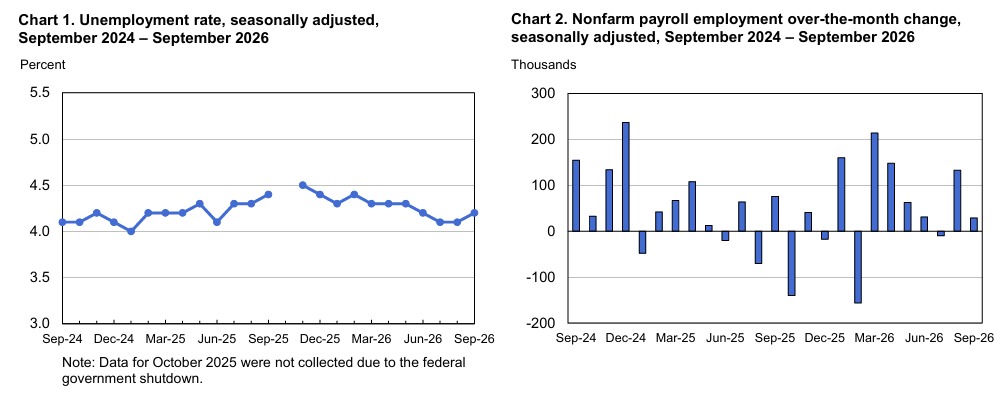 Caption: In addition, the August jobs count was revised lower to reflect a gain of 133,000, while July switched from a gain to a loss as payrolls fell by 10,000. The revisions in total showed 60,000 fewer jobs than previously reported.
While the labor market remains resilient, it is not accelerating. According to the U.S. Bureau of Labor Statistics, the unemployment rate and number of unemployed persons edged up slightly to 4.2% and 7.1 million, respectively. The labor force participation rate increased to 61.8%, with long-term unemployment accounting for 27.1%. Meanwhile, an alternative measure of unemployment, which includes discouraged workers and those holding part-time jobs for economic reasons, ticked down to 7.6%—the lowest reading since January 2025.
“Hiring is subdued, layoffs remain remarkably low and month-to-month payroll figures are likely to keep sending mixed signals. The underlying story is still a low-hire, low-fire labor market,” says Adam Schickling, senior economist at Vanguard, noting the report strengthens the case for the Federal Reserve to remain patient.
“The labor market has not deteriorated sharply, but there is also little evidence that it has meaningfully strengthened, giving policymakers reason to wait for additional data,” he adds.
Phil Camporeale, chief investment strategist at JPMorgan Wealth Management, believes the “combination of lower-than-expected jobs created, negative revisions to prior data and weaker wage growth are further evidence that the labor market is not a source of inflationary pressure.”
“Ultimately, today’s report is an ideal outcome for financial markets. Both the stock and bond markets should take solace from the Federal Reserve not needing to aggressively tighten financial conditions to slow down an overheating economy,” he adds.
Policymakers see inflation as a larger threat to the economy, which has held well above the Fed’s 2% target. According to CNBC journalist Jeff Cox, the most recent indicator of the central bank’s preferred gauge showed core inflation at a 3% annual rate. Americans continue to feel the burn, as wages “show signs of disinflation” alongside economic inflation. Average hourly earnings increased just 0.1% in September, putting the 12-month gain at 3%—the lowest since May 2021.
By Demographic
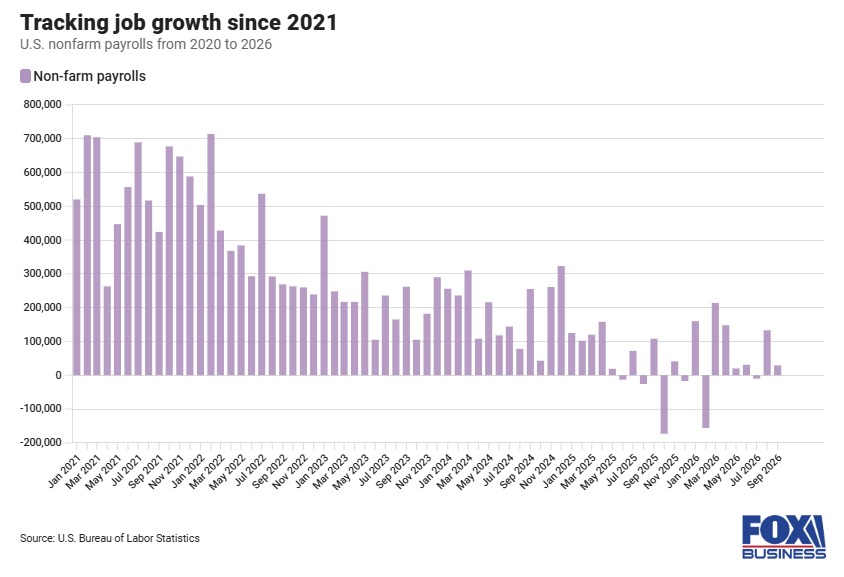
This month, unemployment among the major worker groups: adult women – 3.6%; adult men – 3.9%; teenagers – 14.5%; Asians – 2.9%; Whites – 3.6%; Hispanics – 4.7%; and Blacks – 7%.
Last month, unemployment among the major worker groups: adult women – 3.5%; adult men – 4%; teenagers – 14.1%; Asians – 3.2%; Whites – 3.7%; Hispanics – 4.8%; and Blacks – 6%.
By Industry
The Conference Board Employment Trends Index (ETI) fell to 107.56 in September, a 0.5% decline compared to a downwardly revised reading of 108.08 in August. Overall, four out of the ETI’s eight components contributed positively to the index in September: Initial Claims for Unemployment Insurance, Job Openings, Industrial Production, and Real Manufacturing and Trade Sales. On the contrary, four components contributed negatively to the Index in September, including the Percentage of Respondents Who Say They Find “Jobs Hard to Get,” Percentage of Firms with Positions Not Able to Fill Right Now, Ratio of Involuntarily Part-time to All Part-time Workers, and Number of Employees Hired by the Temporary-Help Industry.
“Despite partially reversing its recent gains, the ETI remains 1% above its level one year ago, suggesting moderate payroll employment growth ahead,” says Conrad Qi, economic data scientist associate at The Conference Board.
According to Qi, consumer and small-firm measures had the largest negative contributions on ETI data. The share of consumers reporting that jobs are “hard to get”—an ETI component from the Consumer Confidence Survey—rose from a revised 20.3% in August to 21.9% in September. Likewise, the share of small firms reporting positions they could not fill right now fell 3 percentage points (from 35% to 32%), alongside a decline in the share of owners hiring or trying to hire.
“Weaker perceptions of job availability and reduced small-business recruitment suggest a more difficult environment for jobseekers,” he says.
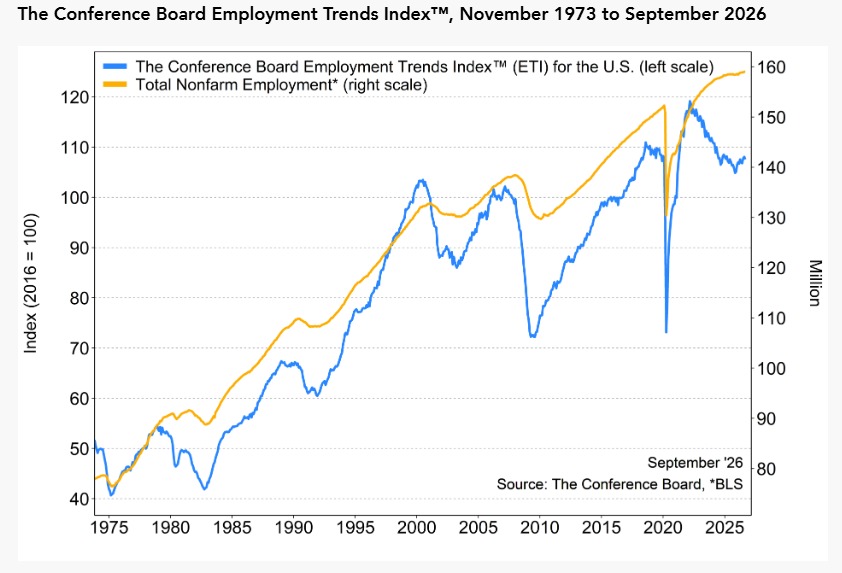 Caption: The Employment Trends Index is a leading composite index for payroll employment. When the Index increases, employment is likely to grow as well, and vice versa. Turning points in the Index indicate that a change in the trend of job gains or losses is about to occur in the coming months.
Key Takeaways from The Conference Board Employment Trends Index:
- The ratio of involuntarily part-time to all part-time workers also contributed negatively to the index, rising to 16.5% in September from 16.2% in August, indicating greater underemployment among part-time workers.
- Employment in temporary help services—an ETI component drawn from the payroll survey—fell by 10,900, even as total nonfarm payroll employment increased by 29,000 in September.
- Partially offsetting these negative contributions, initial claims for unemployment insurance fell in September, providing the month’s largest positive contribution to the ETI and signaling few layoffs.
- Job openings were estimated to have increased by 129,000 to 7.21 million in September. Estimated increases of 0.3% in industrial production and 0.1% in real manufacturing and trade sales also supported the index.
Click here to view more detailed information by industry.