KPI – October 2026: State of Business – Automotive Industry
Sponsored by Turn 14 Distribution
- KPI – October 2026: The Brief
- KPI – October 2026: State of Manufacturing
- KPI – October 2026: State of the Economy
- KPI – October 2026: Consumer Trends
- KPI – October 2026: Recent Vehicle Recalls
Global Light Vehicle Sales
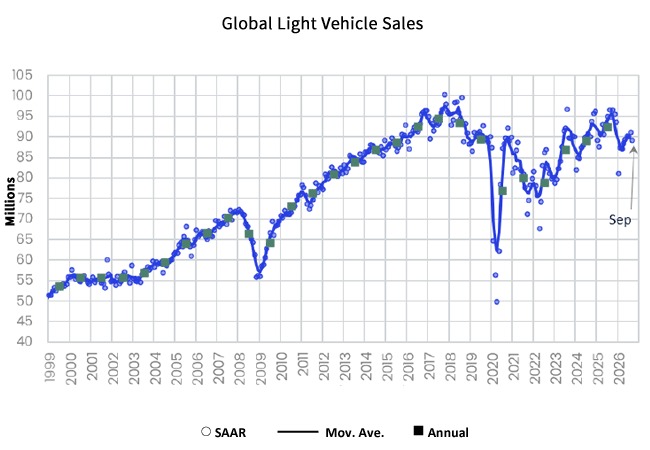
In September, the global Light Vehicle (LV) selling rate fell to 89 million units per year—bringing the year-to-date (YTD) average selling rate to 88 million units per year in 2026, 4.4% lower than the full-year 2025 result.
“As has been the case for much of the year, sales declined sharply year-over-year in China, dragging down the global market despite some bright spots elsewhere,” says David Oakley, manager of Americas vehicle sales forecasts at GlobalData.
According to the report, “weak economic fundamentals and lack of policy support” in China pose significant headwinds. On the contrary, the U.S. returned to year-over-year growth, although the selling rate eased and rising fuel costs are steering buyers toward hybrids. Western Europe continues to be supported by the electrification momentum, while India remains the key driver in Asia.
With one quarter of sales remaining, data shows it looks very likely that the market will not improve upon last year. YTD sales stand at 65 million units, down 4.3% compared to the first nine months of 2025.
“Our forecast for total global sales in 2026 now stands at 87.9 million units, compared to 88.3 million units a month ago. This forecast would represent a 4.8% year-over-year decrease, with the Chinese market expected to drag on sales until 2027,” Oakley says.
U.S. New Vehicle Market
Total new-vehicle sales for October 2026, including retail and non-retail transactions, are projected to reach 1,327,100—a 0.2% year-over-year increase, according to a joint forecast from J.D. Power and GlobalData.
“October results reflect the continued resilience of new-vehicle demand, with total sales on pace to rise 0.2% year over year, or 3.9% without adjusting for selling days. The year-over-year comparison to October 2025 is flattered by what happened a year ago, when the payback from September 2025’s EV tax-credit surge suppressed volumes,” says Thomas King, president of OEM solutions at J.D. Power.
Key Takeaways, Courtesy of J.D. Power:
- October new-vehicle total sales are on track for a seasonally-adjusted selling rate of 15.6 million.
- The average transaction price of a new vehicle is trending down slightly to $46,329; however, average monthly finance payments are forecasted to climb.
- Interest rates are projected to rise 19 basis points to 6.81%, the highest October level since 2023.
- Average monthly payments are expected to rise 2.6% to an October record of $823.
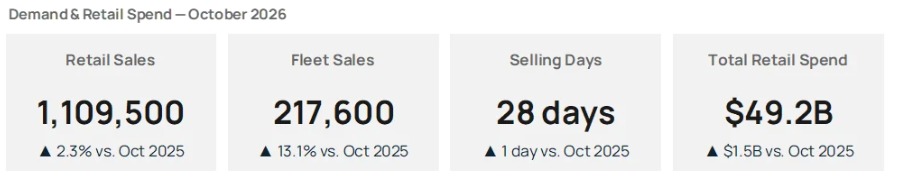
- Retail consumer expenditure on new vehicles is projected to increase 3.2% to $49.2 billion, an increase of $1.5 billion year-over-year, helped by the additional selling day and transaction prices just slightly below last year’s level.
- Average incentive spending per vehicle is trending toward $3,304, a 13.1% increase from a year ago and the largest increase in the past four months. Incentives as a percentage of MSRP are expected to hit 6.3% in October, up 0.7 percentage points from October 2025.
- Hybrid share of retail sales expected to reach 18.6%, up 4 percentage points.
U.S. Used Market
The Manheim Used Vehicle Value Index (MUVVI) rose to 207.4, reflecting a 0.7% increase in wholesale used-vehicle prices (adjusted for mix, mileage and seasonality) during the first 15 days of October compared to September. The Manheim index is now higher by 2.2% compared to October 2025, rebounding after the softening seen in the third quarter of the year.
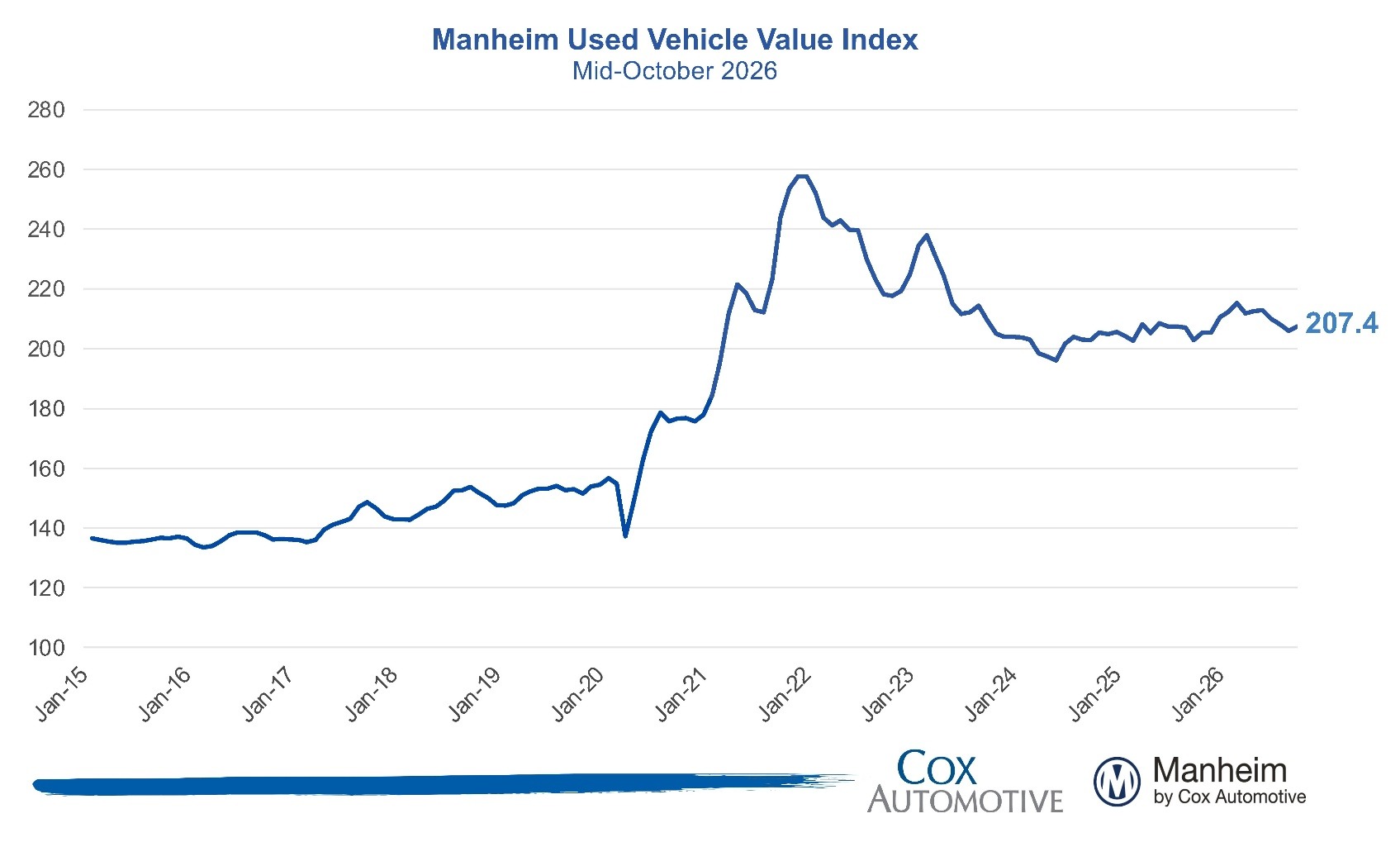
While September depreciated faster than normal, wholesale values firmed up in early October. According to Jonathan Gregory, senior director at Cox Automotive, supply—not demand—appears to be what slowed depreciation.
“Wholesale days’ supply fell from 28.7 to 28.2 days, and the gap compared to last year narrowed from 2.5 days to about one day. Dealer demand, meanwhile, is roughly flat: Sales conversion is only slightly above last year, and retention eased. The firmer values reflect leaner inventory rather than stronger buying, a more stable footing, but not a buyer-driven recovery,” Gregory explains.
Likewise, he notes the mix of what’s holding values up is shifting. EVs have outperformed all year on sustained demand for fuel-efficient vehicles; however, so far this month, non-EV values rose 0.7%, while EVs slipped 0.7%. EVs remain up 6.8% year-over-year, though momentum is fading as more off-lease EVs come to market. Data shows fuel efficiency and affordability continue to drive segment performance.
Compact cars are up 5.6% and midsize cars turned positive. Luxury is now slightly below last year after being a first-half leader, while pickups remain soft.
“This strong start to October cannot undo a soft third quarter. The trends we flagged in September haven’t gone away: higher rates and weaker sentiment. If anything, we might have seen some of the weakness we expect to see in October pulled ahead into September after a stronger-than-expected first half. October has started on steadier ground, but we will need the full month to know whether it will hold,” Gregory says.