Circle of Trust: California Custom Shop Keeps Classic Wheels Turning
Buchanan’s Spoke & Rim can repair & renew those complex-but-important wire wheels found on a variety of vintage vehicles...
This article on Classic Wheels originally appeared in the July 2026 issue of THE SHOP magazine.
As many old-timers in our industry age out, it’s becoming harder and harder to find people to tackle certain tasks. Even in Los Angeles, the birthplace of hot rodding, we recently struggled to find anybody to balance a 1964 Corvette flywheel—a job that should have been simple enough.
Meanwhile, around the same time, some friends had a 1950 straight-8 Buick engine in need of a rebuild. Unfortunately, the one company we found that would even look at it made a mess of it.
In some respects, the aging-out process opens doors of opportunity for entrepreneurs to start a business filling those niche needs. But it initiates the question: “Are there enough customers?”
I hang out at Mick’s Paint in Pomona, California, where they build, restore and paint everything from America’s Most Beautiful Roadster contenders to concours-quality Pebble Beach entries. Consequently, there isn’t a day that goes by that they aren’t looking for somebody to do some specialist work.
One day, they are looking for somebody to rebuild a Lucas fuel-injection system for a 1960s Maserati—there’s one guy in the world in Holland (Holland, the Netherlands, not Holland, Michigan) and he charges $20,000 minimum plus shipping both ways—and the next they’re looking for someone to rebuild vintage wire spoke wheels.
With the odds stacked against them, at least the wire wheel story has a happy ending.
BUSINESS KEEPS ROLLING ALONG
With all the wire wheels that exist in the world, you’d think a rebuilder would be easy to find—but not anymore. Luckily, we chanced upon Buchanan’s Spoke & Rim, which has been specializing in wire wheels since 1958.
Back then it was known as Buchanan’s Frame Shop and was located in Monterey Park, California. Founded by Jim Buchanan and his wife Vernice, they offered motorcycle frame and wheel repair using brought-in spokes and nipples.
In 1971, in order to keep up with demand, Buchanan’s began manufacturing its own spokes and nipples, and by 1975 it was in a position to sell prepackaged spoke kits to other motorcycle and wheel repair shops.
Another innovation that soon followed was an automated rim driller developed and built in-house by Jim’s brother-in-law, George Hansen. Hansen’s innovation allowed the business to drill blank rims supplied by various manufacturers including Sun Metal of Indiana. Sun Metal was a leading manufacturer of high-performance alloy rims for motorcycles, standard bicycles and BMX bikes. Today, you might recognize the name SUNringlé as a manufacturer of mountain bike wheels and even wheelchair rims
Buchanan’s became the largest distributor of Sun Metal’s undrilled aluminum rims and eventually purchased the rights to produce the Sun Metal product line as well as the equipment to produce rims. In 1987, the company began manufacturing its own line of Sun Rims that could be drilled to order, thereby offering a truly “bespoke” service.
Product demand prompted Buchanan to eliminate the frame straightening service the same year while adding automobile rims to his list of can-dos.
When I think of wire wheels, I immediately think European sports cars: Austin Healey, Jaguar, Ferrari, Maserati, Rolls Royce, etc. But I also remember many American cars from the ’50s and earlier that had wires: think Buick, Cobra (I know, it’s only partly American), Cadillac and T-Bird, to name but a few.
Those wheels and, of course, the wheels of European sports cars are now all at least 50 years old—many of them 70 years old or more—and, if they are anything like me, they need a reset!
WHEELING INTO TOWN
To better understand the wheel repair process, I visited Buchanan’s modern 24,000-square-foot facility in Azusa, California, where they settled in 1997. The company is now run by the founder’s sons, Ken and Robert.
Luckily for us, besides the hundreds of motorcycle wheels in process, they were also working on automotive wheels for Aston Martin, Rolls Royce, T-Bird and others, so there were plenty of examples to choose from. While Buchanan’s does still manufacturer blank motorcycle rims, it does not make blank automotive rims.
However, there are a handful of companies around the world that make blanks in aluminum and steel. For example: Borrani in Italy; Dayton, Truespoke and Wheelsmith in the U.S.; and Motor Wheel Service and Turrino in the UK. Buchanan’s can dimple and drill blank automotive rims.
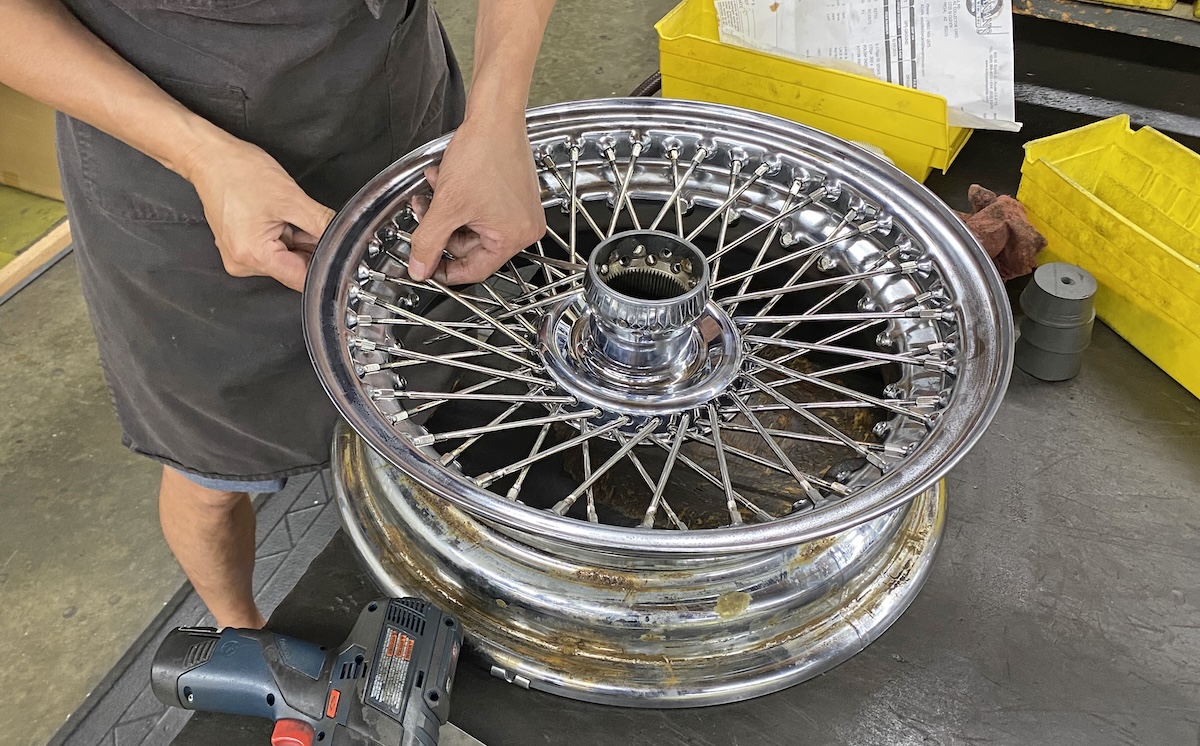
“The process of restoring wire wheels begins with consultation with the customer and an inspection,” says Ken Buchanan. “We assess the condition of all the wheels before work begins. We’re looking for loose, rusty or broken spokes as well as inspecting the condition of the hub and the rim.”
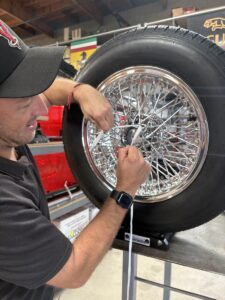
Decisions also have to be made concerning the desired finish for the hub, rim and spokes.
“Are they to be powder-coated or plated or is it a combination of finishes?” he asks. “Buchanan’s does not offer either service in-house, but we can, of course, get the finish outsourced and typically customers direct us to their preferred finisher. Attention must also given to the spoke pattern as there many layout variations, and for important restorations they must match the factory pattern.”
Sometimes customers try to save some money by disassembling their own wheels and getting the hubs and rims finished before contacting Buchanan’s.
“Unfortunately, this can prove to be a costly mistake, because they invariably do not examine the rims for straightness before having them finished—only to find that the rim was not straight,” Buchanan explains. “It’s better if we remove the spokes—typically with a bolt cutter—and check the hub and rim for straightness before we begin the build process.”
After taking careful measurements, the shop assembles the necessary nipples and stainless steel spokes, cut to the correct length and threaded at the nipple end.
“Most of these components we have in stock, but occasionally we have to outsource special spokes and nipples,” he reveals. “There is no norm and each wheel can have anywhere from 40 to 150 spokes.”
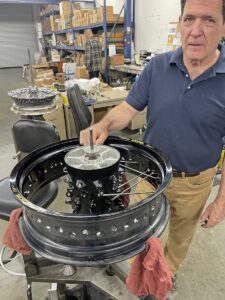
When all of the components have been finished and assembled, the build process of mounting the spokes into the hub on a bench begins.
“After all the spokes have been installed into the hub, the rim is positioned and the spokes are threaded through the rim,” Buchanan says. “Anti-seize is applied to the threaded ends of the spokes before the nipples are installed.”
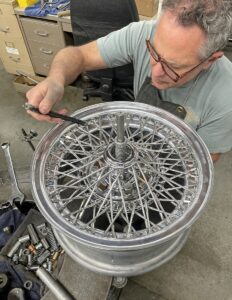
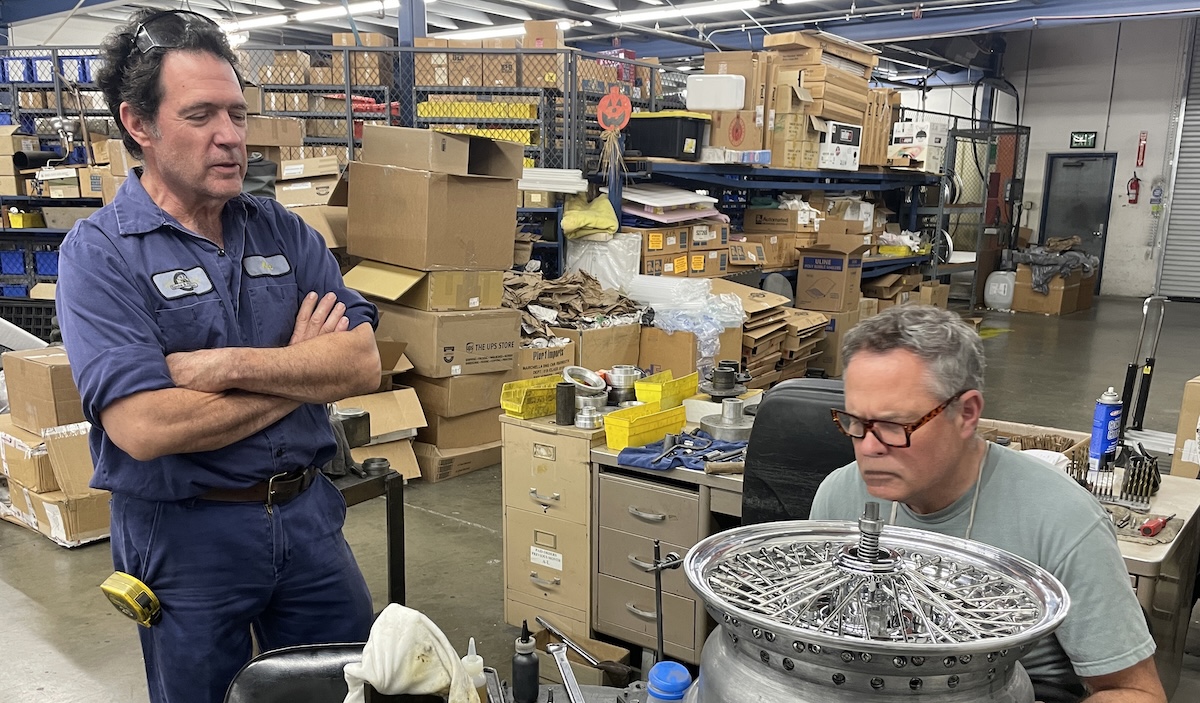
With everything loosely assembled, the wheel is installed on a rotating fixture and the process of gradually tightening the spokes is started using a spoke wrench while constantly checking the wheel’s trueness with a dial indicator and adjusting accordingly—a time-consuming process called “truing.”
“After all the spokes are tight and the rim is deemed to be true, a final check of all the spokes is taken, as occasionally a spoke can be missed or come loose,” he continues. “If all goes well, a typical wheel (if there is such a thing) takes about two hours to assemble. Something most customers don’t realize is that spoke wheels need to be rechecked for trueness after 200 miles of driving. If you’re racing, then they should be checked much more regularly.”
As more enthusiasts take to the track and the street in vintage or classic automobiles, the need for experienced wire wheel builders and restorers increases, and companies such as Buchanan’s can thrive in the world of AI.