KPI – December 2025: State of Business – Automotive Industry
Sponsored by Holley Performance Brands
- KPI – December 2025: The Brief
- KPI – December 2025: State of Manufacturing
- KPI – December 2025: Consumer Trends
- KPI – December 2025: State of the Economy
- KPI – December 2025: Recent Vehicle Recalls
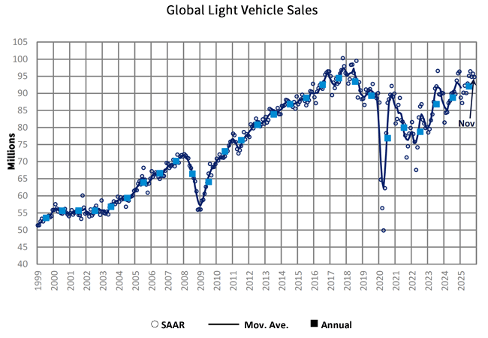
Global Light Vehicle Sales
In November 2025, the Global Light Vehicle (LV) selling rate remained strong at 95 million units per year. While the overall market dipped 2% year-over-year, year-to-date sales are up 4% with 83.6 million vehicles sold.
Key markets recorded mixed results. In the U.S., sales fell for a second consecutive month year-over-year due to EV tax credit cuts and economic headwinds. Sales remained “broadly flat” in Western Europe, but the outlook is more positive heading into 2026. While Chinese sales declined year-over-year, the selling rate continues to post strong results.
U.S. New Vehicle Market
Editor’s note: New-vehicle sales data for December 2025 was not released by this article’s publication date. The following new-car data is from November 2025.
Total new-vehicle sales for November 2025, including retail and non-retail transactions, were projected to reach 1,255,900 – a 5.2% decrease year-over-year, according to a joint forecast from J.D. Power and GlobalData.
“November’s results reflect another notable – yet anticipated – decline in the new vehicle sales pace, driven largely by the pull-ahead of electric vehicle (EV) purchases prior to the expiration of federal EV tax credits on Sept. 30. That expiration prompted many shoppers to accelerate buying decisions, resulting in a surge in EV sales that temporarily inflated the overall industry sales pace,” says Thomas King, president of the data and analytics division at J.D. Power.
Two months later, King says the industry continues to feel the effects of accelerated purchases. EVs were expected to account for just 6% of new vehicle retail sales in November, which was consistent with the month prior but well below the 12.9% recorded in September.
As a result, “Automakers are recalibrating pricing strategies following the expiration of EV tax credits, tariff dynamics and evolving fuel economy requirements, along with the transition to the new model year,” he says, noting these factors create some distortions in typical seasonal discount patterns.
For example, discounts on EVs are expected to average $11,869 in November, up $260 year-over-year but down $928 compared to October 2025. Discounts on non-EVs are estimated at $2,960, an increase of $161 from a year ago.
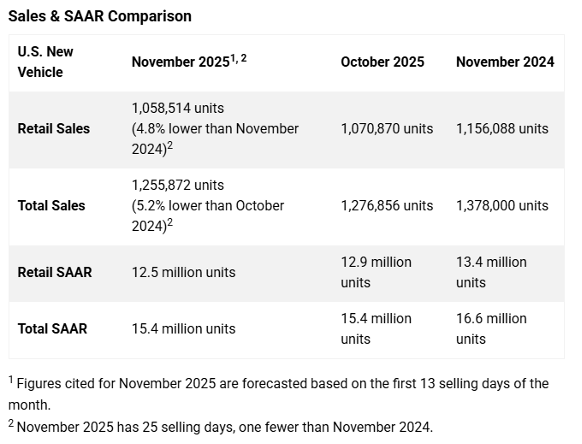
Key takeaways, courtesy of J.D. Power:
- Retail buyers are on pace to spend $46.8 billion on new vehicles, down $3.2 billion year-over-year.
- Internal combustion engine (ICE) vehicles are expected to account for 77.5% of new vehicle retail sales, an increase of 2.3 percentage points from a year ago. Plug-in hybrid vehicles (PHEV), electric vehicles (EVs) and hybrid electric vehicles (HEV) are estimated at 1.1%, 6% and 14.5% of new vehicle retail sales, respectively.
- Trucks/SUVs are on pace to account for 82.6% of new vehicle retail sales, up one percentage point year-over-year.
- Leasing was expected to account for 20.5% of sales in November, down 2.7 percentage points from a year ago.
- The average new vehicle retail transaction price in November is estimated at $46,029, up $722 year-over-year.
- Average monthly finance payments are on pace to hit $760, up $19 from a year ago. The average interest rate for new-vehicle loans is 6.05%, down 0.27 percentage points year-over-year.
- Total retailer profit per unit – which includes vehicle gross plus finance and insurance income – is expected to be $2,161, up $6 year-over-year but down $54 compared to last month.
- Fleet sales should total 197,358 units in November, down 7.5% year-over-year. Fleet volume is expected to account for 15.7% of total light-vehicle sales, down 0.4 percentage points from a year ago.
Looking ahead: “The industry enters the holiday sales season facing a mix of affordability challenges, evolving incentive strategies and lingering effects from the EV pull-ahead earlier this year. While interest rates have eased and used-vehicle values remain strong – providing some support for trade-in equity – the number of leases set to expire in December is projected to be more than 15% lower than the same period a year ago and 50% lower than in 2023, thus limiting the typical year-end boost,” King says. “Automakers are expected to maintain disciplined pricing and restrained incentives, particularly in non-EV segments, as they balance profitability with the need to stimulate demand. How aggressively manufacturers choose to adjust discounting and promotional activity during December will be critical in shaping the close of 2025.”
U.S. Used Market
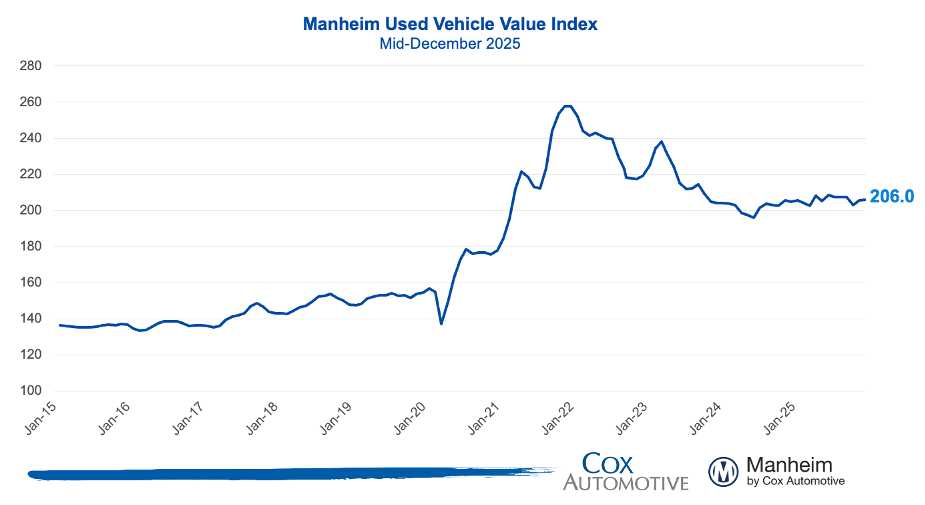
The Manheim Used Vehicle Value Index (MUVVI) increased to 206.0 – a 0.3% increase in wholesale used-vehicle prices (adjusted for mix, mileage and seasonality) during the first 15 days of December, and a 0.6% increase compared to December 2024. Seasonally adjusted wholesale values typically show no change over the full month on average.
“As we wind down the year, the wholesale market is showing fairly seasonal patterns of price movement—a welcome effect following a volatile year,” says Jeremy Robb, interim chief economist at Cox Automotive. “The seasonal adjustment factor was weaker than usual, causing the overall index to rise more than typically seen this month. With two weeks left in the year and many people shifting focus to the holidays, we are likely to see activity at Manheim slow down slightly – which is normal. Last week, the Fed cut rates for the third time this year, which appears to be the right move in hindsight as the employment picture continues to soften marginally. It takes time for auto loan APRs to see the impact from those cuts, but we would expect to see a bit of an impact on consumer financing soon. When you couple lower interest rates with higher credit availability and an expectation of a stronger tax refund season, the auto market could have a little wind in its sails as we embark on 2026.”
Click here to view results by segment.