
- KPI – March 2026: The Brief
- KPI – March 2026: State of Manufacturing
- KPI – March 2026: State of the Economy
- KPI – March 2026: Consumer Trends
- KPI – March 2026: Recent Vehicle Recalls
Global Light Vehicle Sales
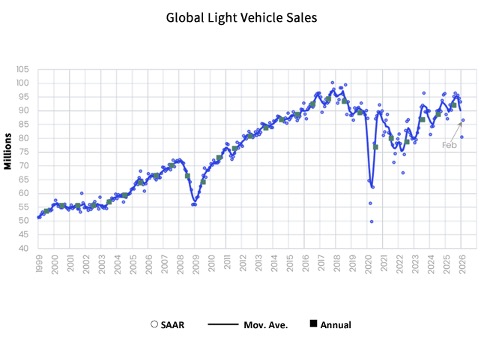
In February, the Global Light Vehicle (LV) selling rate improved modestly to 86.6 million units per year, following a weak start to 2026. The market declined 8.5% year-over-year due to a sharp contraction in the Chinese PV market for the second consecutive month; sales totaled six million units globally.
While Western Europe posted promising totals, China’s steep contraction remains a key drag on global sales volumes, as consumers feel the effects of less policy support. Likewise, weak EV sales and affordability concerns are weighing on LV demand in the U.S.
According to GlobalData, recent developments in the Middle East and the ensuing shock to energy prices and supply chains present the global LV market with serious headwinds to sales this year, keeping the outlook tilted to the downside in the near term.
“Our forecast for total global sales in 2026 stands at 93.5 million units, up 1.9% year-over-year. Our Chinese sales outlook has been revised down by around 300k units on the back of weaker momentum in the new year. Although China should still see some growth in 2026, developing markets such as India will also contribute significantly to the global expansion in light-vehicle sales this year, while most mature markets are expected to see a flat outcome or only modest gains,” says David Oakley, manager of Americas vehicle sales forecasts at GlobalData.

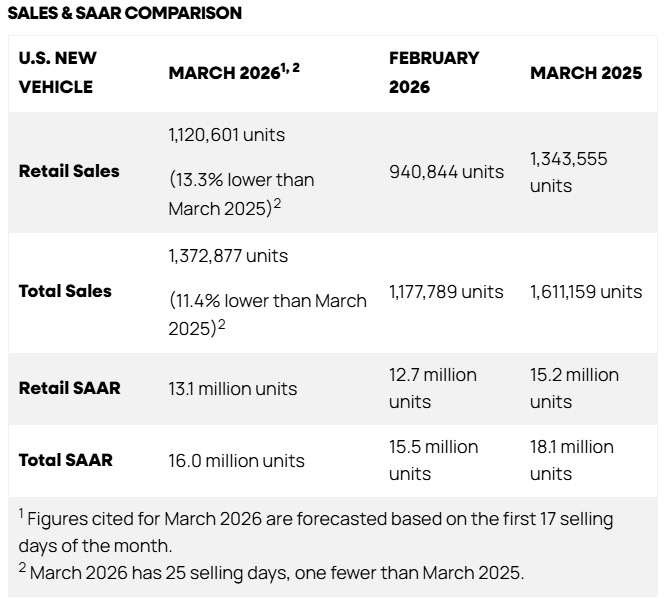
Total new-vehicle sales for March 2026, including retail and non-retail transactions, are projected to reach 1,372,877, a 11.4% decrease year-over-year, and a 11.9% increase from February 2026, according to a joint forecast from JD Power and GlobalData.
In March, vehicle sales are on pace to deliver the best monthly performance of the year, with total sales expected to reach 16 million units on an annualized basis. However, year-over-year data presents a far less positive picture, with total sales down 11.4% and retail sales down 13.3%. According to JD Power, the apparent contradiction is really a technical anomaly.
“March 2025 sales were inflated by consumers who rushed to showrooms in anticipation of a big increase in vehicle prices due to tariffs. In fact, the rush to showrooms last March resulted in a total annualized sales pace of 18.1 million, the highest of any month in 2025 and well above the full-year sales pace of 16.3 million. Said differently, the usual focus on year-over-year sales changes is not helpful in understanding the underlying health of consumer demand for new vehicles this month,” says Thomas King, president of the data and analytics division at JD Power.
“Putting aside last year’s results, March 2026 shows continued strong demand for new vehicles, despite concerns around fuel prices and economic uncertainty. In fact, March results would have been even stronger were it not for unusually low availability of one of the industry’s best-selling vehicles,” he says.
Furthermore, King points to the elimination of Federal Electric Vehicle credits as a challenge the industry continues to face. Now, consumers interested in EV purchases inevitably face higher prices.

Key Takeaways, Courtesy of JD Power:
- Retail buyers are on pace to spend $49.4 billion on new vehicles, down $8 billion year-over-year.
- Leasing is expected to account for 22.9% of sales this month, down 0.5 percentage points from a year ago.
- The average new vehicle retail transaction price is expected to reach $45,859, up $1,102 year-over-year.
- Average monthly finance payments are on pace to be $805, up $38 from a year ago.
- For retailers, profit per unit—which includes vehicle gross plus finance and insurance income—is expected to be $2,452, up $26 year-over-year and up $80 from a month prior. Total aggregate retailer profit from new-vehicle sales for this month is projected to be $2.6 billion, down 15.1% from last year, with decline driven by last year’s inflated sales pace.
- Fleet sales are expected to total 252,276 units in March, down 2% year-over-year. Fleet volume is expected to account for 18.4% of total light-vehicle sales, up 1.8 percentage points from a year ago.
“Looking ahead, interpreting year-over-year results will remain unusually challenging for most of the year, as the industry continues to work through the after-effects of two major pull-ahead events in 2025. The first was the tariff-driven rush to showrooms in March and April, when approximately 173,000 additional purchases were pulled forward, followed by a payback period that weighed on subsequent months. The second was the EV pull-ahead ahead of the Sept. 30 expiration of federal EV tax credits, which temporarily inflated EV demand in late summer before shifting to a payback dynamic that persisted into the fall,” King says.
“As a result, simple year-over-year comparisons will remain inherently noisy—reflecting the timing of these events more than underlying demand—until the industry fully laps both events. In practical terms, it will most likely be late in the year before comparisons return to a more normalized pattern and provide a clearer read on market momentum,” he continues.
U.S. Used Market
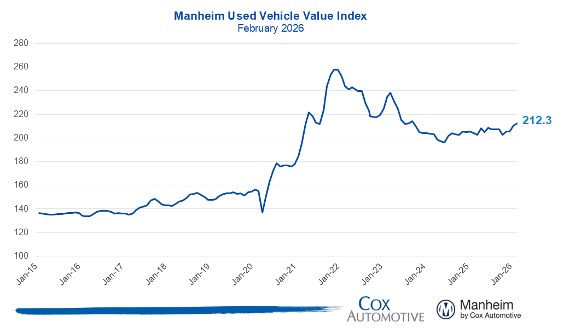
The Manheim Used Vehicle Value Index (MUVVI) increased to 212.3, reflecting a 4% increase for wholesale used-vehicle prices (adjusted for mix, mileage and seasonality) compared to February 2025. The index is up 0.8% month-over-month. Non-adjusted wholesale vehicle prices are now up 4.2% year over year, and up 3% against January 2026. The long-term average monthly move in non-adjusted values is an increase of 0.9% in February.
“Since the start of 2026, we’ve seen mostly solid demand at Manheim with higher sales conversion rates indicating an appetite from dealers to buy. As we progressed through February, we saw prices move higher than usual, especially in the back half of the month. The last week of January and early February threw some winter weather at dealer groups, which they indicated slowed down traffic,” says Jeremy Robb, chief economist at Cox Automotive.
“Now that we are officially in March, with warmer weather ahead across much of the U.S., we have seen retail demand increasing in our most recent data points—for both new and used sales. The average tax refund is running 10% higher this year, as we hit some of the strongest weeks for consumer filing, and we are expecting to see that translate to more traffic at dealerships in March,” he continues.
In addition, Robb cautions that recent geopolitical events introduce new risks to the economy, which may put a damper on consumer appetite in the short run as people digest the news in the Middle East.
“This could slow the building pace we see on the back of tax refund season, particularly as gas prices rise. All in, the impact may be more acutely felt early in the month, with a pickup in demand building as we move through March,” he says.

Click here to view results by segment.