
KPI – March 2026: The Brief
KPI – March 2026: State of Manufacturing
KPI – March 2026: State of Business – Automotive Industry
KPI – March 2026: State of the Economy
KPI – March 2026: Recent Vehicle Recalls
Below is a synopsis of consumer sentiment, confidence, demand and income/spending trends.
Sentiment
The University of Michigan Survey of Consumers—a survey consisting of approximately 50 core questions covering consumers’ assessments of their personal financial situation, buying attitudes and overall economic conditions—registered 56.6 in February and posted a preliminary reading of 55.5 in March.
In addition, national data shows a decline of 7.5% in personal finance expectations across various consumer groups, including income, age and political affiliation.
“Consumer sentiment dipped approximately 2%, reaching its lowest reading of the year. Interviews completed prior to the military action in Iran showed an improvement in sentiment from last month, but lower readings seen during the nine days thereafter completely erased those initial gains. Gasoline prices have exerted the most immediate impact felt by consumers, though the magnitude of passthrough to other prices remains highly uncertain,” says Joanne Hsu, director of Survey of Consumers.
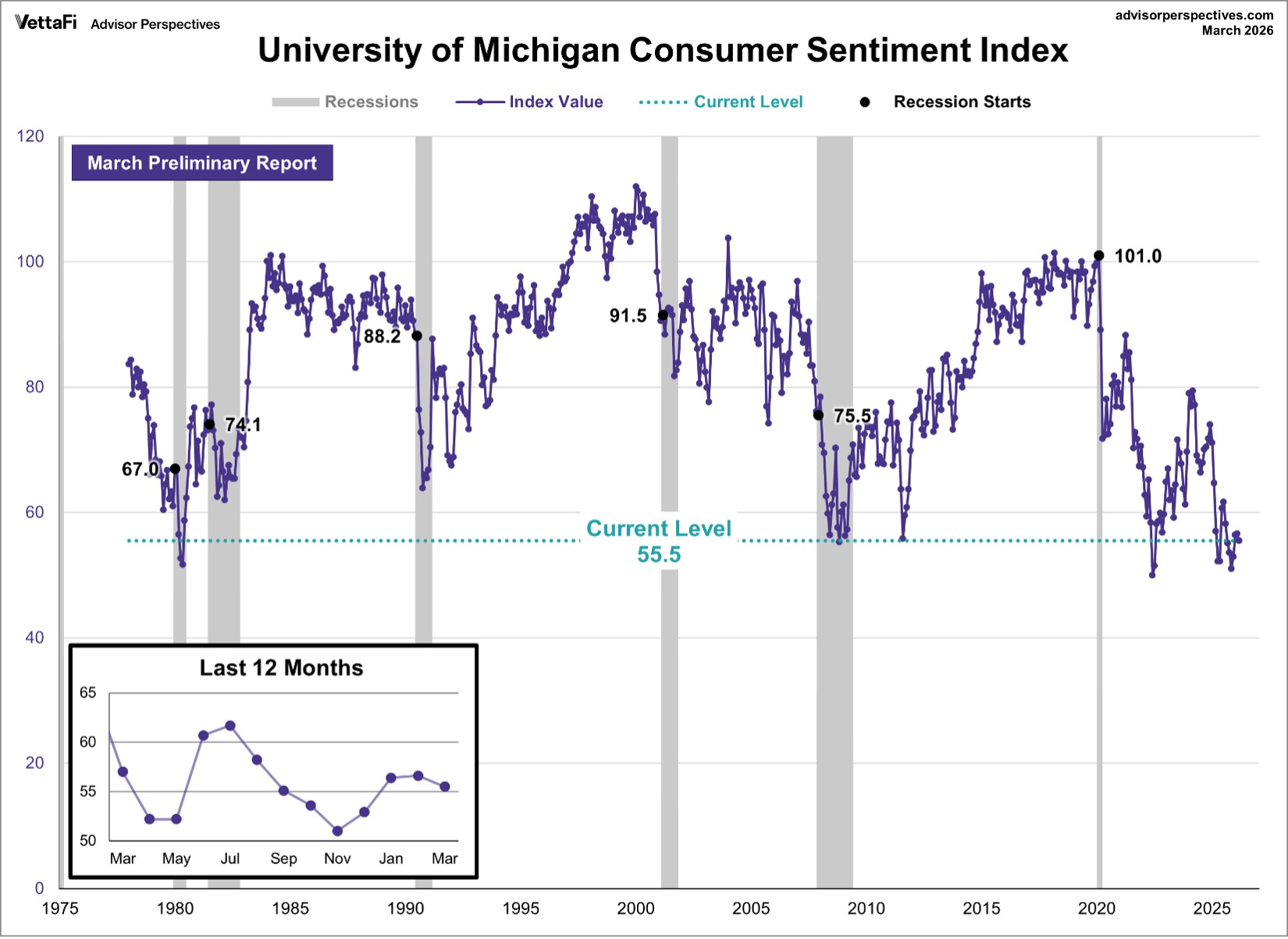

Caption: To put today’s report in historical context, consumer sentiment is currently 33.9% below its average reading of 84.0 (arithmetic mean) and 33% below its geometric mean of 82.8, based on data dating back to 1978.
Key Takeaways, Courtesy of Survey of Consumers:
- This month, year-ahead inflation expectations ended six months of consecutive declines, stalling at 3.4%. The current reading exceeds those seen in 2024 and remains well above the 2.3%-3% range seen in the two years pre-pandemic.
- Long-run inflation expectations inched down to 3.2%. In 2024, readings ranged between 2.8% and 3.2%, while in 2019 and 2020, they were consistently below 2.8%.
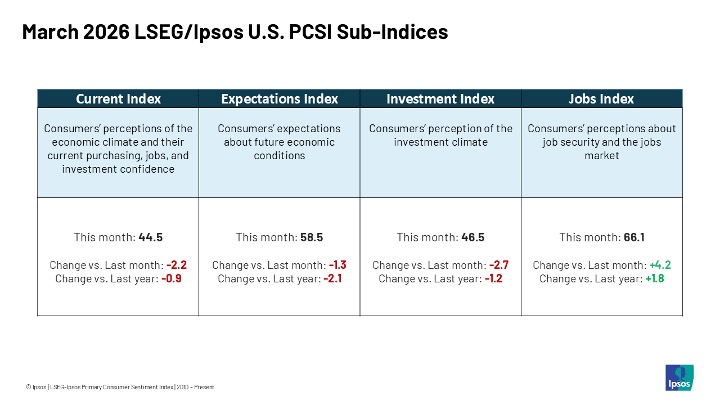

Caption: The LSEG/Ipsos Primary Consumer Sentiment Index for March 2026 is at 53.3. Fielded from February 20-23, 2026, the Index is down 0.5 points from last month.
Confidence
The Conference Board Consumer Confidence Index increased from 91.0 in February to 91.8 in March. The Present Situation Index—based on consumers’ assessment of current business and labor market conditions—increased by 4.6 points to 123.3. Meanwhile, the Expectations Index—based on consumers’ short-term outlook for income, business and labor market conditions—declined by 1.7 points to 70.9.
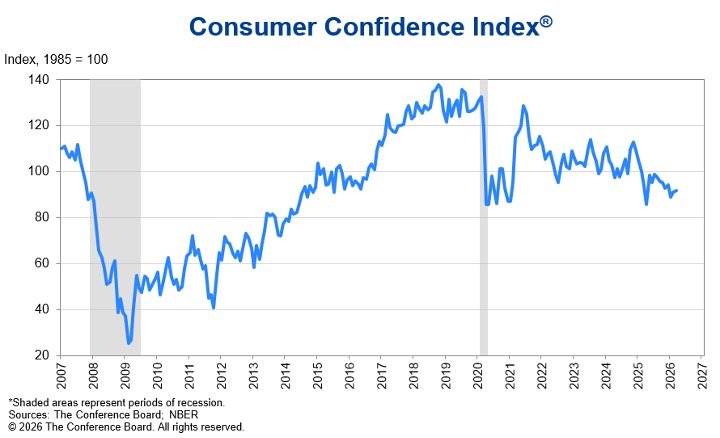

“Consumer confidence ticked up again in March, as a modest improvement in consumers’ views of current conditions outweighed a slight downshift in expectations for the future,” says Dana M. Peterson, chief economist at The Conference Board.
While three of five components “firmed” in March and overall confidence improved modestly for a second month, she says the Index has been on a general downward trend since 2021.
On a six-month moving average basis, confidence continued to moderate for consumers under age 35 and 55-plus. However, it remained virtually unchanged for those aged 35 to 54, following a multi-month decline. Respondents under 35 were the most optimistic, and those 55 and over the least. By income, confidence on a six-month moving average basis continued to dip in six of eight groups. Only consumers earning $25,000-$34,999 and $125,000-plus were somewhat more optimistic. Consumer confidence by political affiliation was relatively unchanged. Republicans remained the most optimistic, while confidence was substantially lower among Independents and Democrats.
“Unsurprisingly, given the Iran war oil shock, consumers’ average and median 12-month inflation expectations surged in March to levels last seen in August 2025, when U.S. consumers awaited more tariff announcements from the U.S. federal government. Consequently, the percentage of consumers stating that interest rates over the next 12 months will be higher on net skyrocketed from 34.9% to 42.4%. Expectations for higher stock prices a year from now plunged,” Peterson says.
Key Takeaways, Courtesy of The Conference Board:
- Consumers’ views of their Family’s Current Financial Situation improved slightly after a February retreat. Expectations for their Family’s Future Financial Situation continued to be less optimistic.
- The share of consumers who said a U.S. recession over the next 12 months is “very likely” rose, while those saying “somewhat likely” or “not likely” fell. The cohort believing the U.S. is already in a recession was virtually unchanged.
- Consumers’ plans to buy big-ticket items over the next six months shifted from “yes” and “maybe” in February to “no” in March. Nonetheless, the proportion saying “yes” remained well above the other responses. Used cars, furniture, TVs and smartphones remained the most popular items within respective categories for future purchases. Among all expensive items, furniture persists as the top expected purchase.
- Buying plans for autos continued rising on a six-month moving average basis in March, with used cars remaining the clear preference over new cars. Homebuying expectations were somewhat lower on a six-month rolling basis for both existing and new units, with consumers continuing to prefer existing homes to newly built ones. Purchase plans for all types of home furnishings, white goods and electronics on a six-month moving average basis improved in March.
- Consumers planning to spend more on services over the next six months also shifted from “yes” and “maybe” to “no.” Consumer spending trends in 2026 remain focused on “cheap thrills” and necessary services, and away from expensive and highly discretionary activities.
“Consumers’ write-in responses on factors affecting the economy continued to skew towards pessimism. Comments about prices and the cost of goods suggest that the cost of living remained at the top of consumers’ minds. As the war in Iran overlapped significantly with the survey sample period, comments about oil/gas and war/conflict spiked, while specific mentions of trade and tariffs decreased notably,” Peterson says.
Consumer Income & Spending
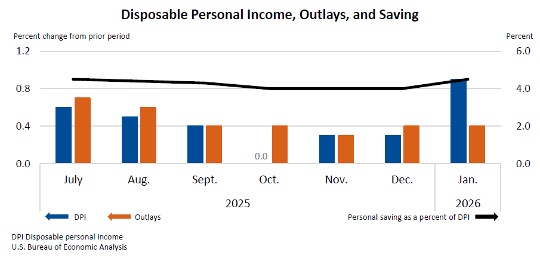
In January, personal income increased $113.8 billion (0.4% at a monthly rate), according to the U.S. Bureau of Economic Analysis (BEA). Disposable personal income (DPI)—personal income less personal current taxes—jumped $219.9 billion (0.9%) and personal consumption expenditures (PCE) increased $81.1 billion (0.4%).
Personal outlays—the sum of PCE, personal interest payments and personal current transfer payments—increased $85.8 billion in January. Personal saving was $1.05 trillion, while the personal saving rate (personal saving as a percentage of DPI) registered 4.5%.
The $81.1 billion increase in current-dollar PCE reflected an increase of $105.7 billion in spending on services, which was partly offset by a decrease of $24.6 billion in spending on goods.

Key Takeaways, Courtesy of the U.S. Bureau of Economic Analysis:
- In January, real PCE increased $17 billion (0.1% at a monthly rate).
- The PCE price index increased 0.3% month-over-month. Excluding food and energy, the PCE price index increased 0.4%.
- The PCE price index increased 2.8% year-over-year. Excluding food and energy, the PCE price index increased 3.1% from one year ago.