

GAZOO Racing (GR) has unveiled the 2026 GRMN Corolla, the ultimate in GR Corolla performance, according to a company press release. This track-oriented compact hatchback was developed under GR’s philosophy of “making better cars starting from motorsport,” along with the desire of Master Driver Akio Toyoda, also known as Morizo, “to bring back a Corolla that captivates customers.”
The 2026 GRMN Corolla will be built at Toyota Motor Corporation’s Motomachi plant in Japan, primarily for North America, Japan and Australia. More information on the full model specifications and MSRP will be provided later, noted the release.
The GR team developed the GRMN Corolla through intensive Nürburgring testing. The Nürburgring exposes inputs and surface changes that do not appear on ordinary test tracks and brings a car’s weaknesses to light, the company said. The team tuned the car so that, from low speeds to full racing speeds and even on rough surfaces, it should respond more in line with the driver’s intentions.
The development of the GRMN Corolla also included participation in Japan’s Super Taikyu endurance racing series and extensive verification using the latest driving simulators. By pushing the vehicle to its limits, the GR team said it was able to address unexpected issues and pursue a high level of vehicle-driver harmony.
The insights gained during GRMN Corolla development have also been applied to the evolution of the base GR Corolla. For example, the GR Corolla, announced in September 2025, extended the application of structural adhesive on the body by 45.6 feet to a total of 107.2 feet to strengthen the body structure, and it was equipped with a cool air duct to reduce intake air temperature under high-load driving — both measures born from Nürburgring learnings.

Key Features of the GRMN Corolla
Aerodynamics
The GRMN Corolla features exclusively developed aerodynamic performance parts for enhanced road holding. Its hood duct, fender ducts, front side spoilers and rear wing incorporate knowledge gained from racing, tested on the hydrogen engine-powered GR Corolla that competes in the Super Taikyu Series.
Based on all-inclusive Super Taikyu Series trial and error, fine-tuning came at the Nürburgring. This effort included adjusting the rear wing angle, which features a five-step adjustment mechanism, in 1-degree increments during driving tests with professional drivers to verify effectiveness and determine the optimal specification.
Dedicated Tuned Suspension
The GRMN Corolla’s suspension employs exclusive front and rear monotube shock absorbers with rebound springs for improved inner-wheel traction during cornering and for enhanced high-speed cornering performance.
The Nürburgring road surface includes environments that induce significant vertical suspension travel beyond that experienced on typical circuits. To ensure high stability for confident driving even in such conditions, extensive Nürburgring test runs facilitated optimization of bump-stop characteristics, the company said. The exclusive shock absorbers were developed by adjusting their stroke down to a millimeter at the front and rear for optimal balance.
To improve cornering stability and braking performance, high-grip Michelin Pilot Sport Cup 2 tires were added.
The EPS (electric power steering) control program was also adjusted to generate the required amount of assistance torque even during cornering under high g-forces. The exclusively tuned 4WD control system provides optimal rear torque distribution during straight-line driving and enhanced stability at the onset of steering input at extremely high speeds.
Internal Combustion Advancements Informed by the Hydrogen GR Corolla
GR says that it has been gaining valuable lessons for the evolution of the internal combustion engine (ICE) by competing in the Super Taikyu Series with a hydrogen engine-powered GR Corolla, as extended, high-load endurance racing helps heighten not only the potential of hydrogen technology but also that of fundamental ICE components.
Based on insights from Super Taikyu, the GRMN Corolla’s peak engine torque was increased to 302 pound-feet. The development team optimized the GRMN Corolla’s engine characteristics by analyzing the range of engine use during circuit driving, focusing on increasing torque in the 4,000-4,600 rpm mid-speed range, which is crucial for accelerating out of corners.
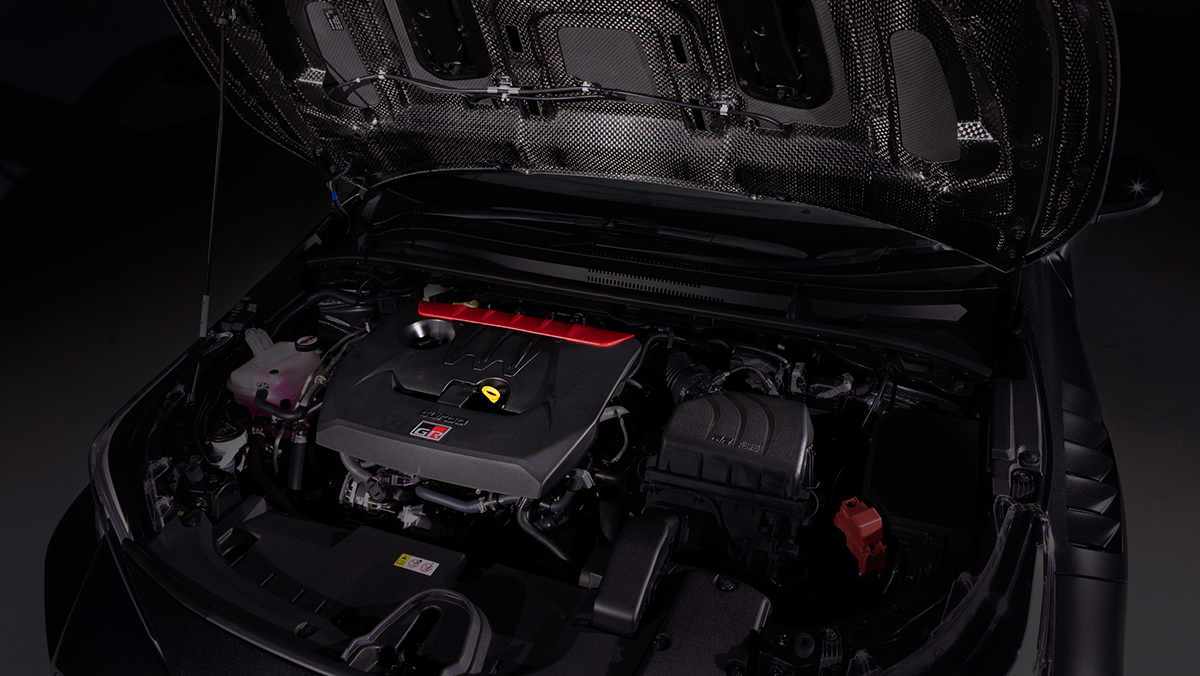
The GRMN Corolla includes an intercooler spray system to help maintain stable engine output during continuous full-throttle driving, along with the cool-air duct added to the 2026 GR Corolla.
The GRMN Corolla has no rear seats as part of an effort to achieve thorough weight reduction. The power-to-weight ratio has been improved by reducing weight by 66 pounds compared to the base vehicle.
Cockpit Designed for Higher Performance
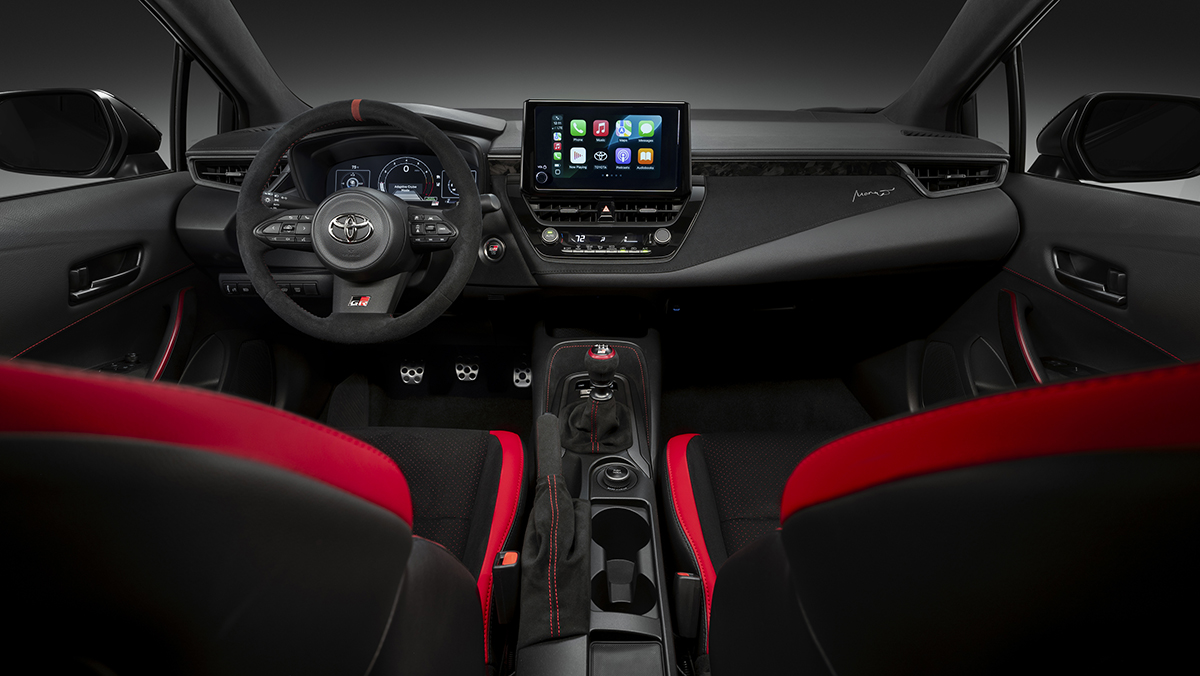
Beyond driving performance, the seats and the instrument panel were upgraded in the cockpit.
The GRMN Corolla features semi-bucket sport seats upholstered in black and red Brin Naub suede and synthetic leather, combining premium materials with purposeful lateral support for performance driving. Accented with distinctive GR detailing, the seats reinforce the model’s motorsport-inspired character while delivering a focused, driver-oriented cockpit experience.
The cockpit is focused on enabling driver concentration, featuring a dedicated flocked instrument panel and front pillar trim. A carbon ornament manufactured by Toyota Motor Corporation’s Motomachi Plant carbon division is installed on the passenger-side instrument panel, and a dash pad bearing Morizo’s signature is included. Door trim and the shift knob are accented with Alumite red, and a GRMN-exclusive serial number plate is fitted.
Key Specifications of the 2026 GRMN Corolla (Preliminary Specifications)
| Overall Length | 173.6 inches |
| Overall Width | 72.8 inches |
| Overall Height | 58 inches |
| Wheelbase | 103.9 inches |
| Track (front/rear) | 62.5/63.7 inches |
| Curb Weight | 3,218.7 pounds |
| Seating | 2 |
| Engine | G16E-GTS 1.6L, 3-cylinder port-injected turbo, 12-valve DOHC |
| Bore x Stroke | 87.5 x 89.7 mm |
| Displacement | 1618 cm³ |
| Compression Ratio | 10.5:1 |
| Maximum Horsepower | 300 hp @ 6,500 RPM |
| Maximum Torque | 302 pound-feet @ 3,250–4,600 RPM |
| Driveline | GR-FOUR All-Wheel Drive |
| Transmission | 6-speed intelligent Manual Transmission (iMT) with rev-matching |
| Gear Ratios — 1st | 3.214 |
| 2nd | 2.238 |
| 3rd | 1.592 |
| 4th | 1.162 |
| 5th | 1.081 |
| 6th | 0.902 |
| Reverse | 3.557 |
| Front Suspension | MacPherson-type strut (with inverted monotube shock absorbers) |
| Rear Suspension | Double wishbone type multilink (with monotube shock absorbers) |
| Front Shock Absorbers | Inverted monotubes (with internal rebound springs) |
| Rear Shock Absorbers | Upright monotubes (with internal rebound springs) |
| Front Brakes | 14-in. x 1.1-in. ventilated disc, 4-piston caliper |
| Rear Brakes | 11.7-in. x 0.7-in. ventilated disc, 2-piston caliper |
| Wheels | 18-in. matte-bronze 10-spoke forged aluminum with TOYOTA GAZOO Racing logo |
| Tires | 245/40ZR18 Michelin Pilot Sport Cup 2 |