
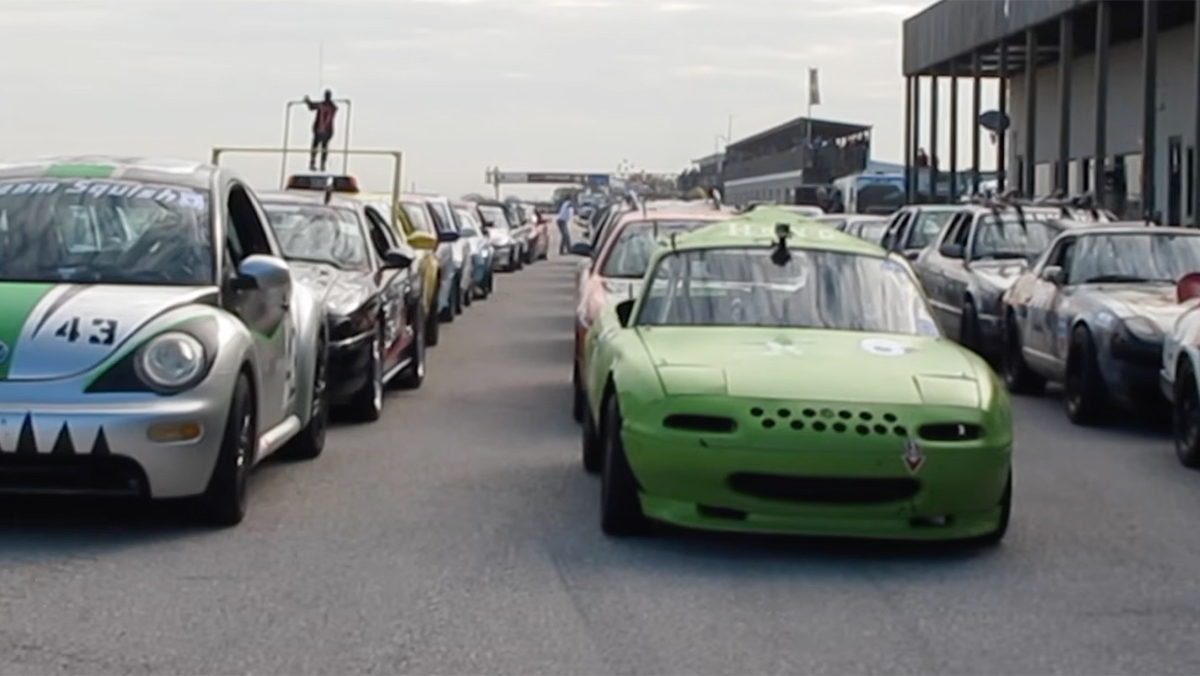
The 24 Hours of Lemons will mark 20 years of cheap-car endurance racing with “Twenty Ridiculous Years,” a one-day, seven-hour race featuring 45 teams at WeatherTech Raceway Laguna Seca on Monday, Oct. 12. This will be the first time the series has raced at this circuit.
The premise has not changed since 2006: Buy an inexpensive car, prepare it to a serious safety standard, and race it wheel-to-wheel against a full field on a real road course, with real flags, rules and penalties. What has changed is the scale: more than 40,000 people have now raced in Lemons, covering nearly 18 million official race miles, according to a press release.
“Back in 2006, I was just throwing a one-time fun thing for myself and some car-whacko friends—it wasn’t supposed to be anything more. And my real expectation was, we’d attempt to race 24 hours, all of our cars would blow up by about hour three, and we’d all spend the rest of the weekend in a bar,” said Jay Lamm, chief perpetrator and chief executive officer of the 24 Hours of Lemons.
Survey Shows Cost Is the Top Barrier to Grassroots Racing
Most of the racers have never raced wheel-to-wheel before. In a 2026 survey of its racers, the series found that 8 out of 10 said Lemons was the first place they had ever done so. The same survey asked what had kept people out of racing before starting with 24 Hours of Lemons. Of the 735 racers who answered that question, 63% said cost, 41% did not have a car, 40% did not have a team, 36% did not know how to start and 35% did not know that accessible options existed at all.
“Racing never needed to feel as exclusive and unapproachable as it did—it’s like skiing or golf, not like going to Mars,” Lamm added. “While it’s incredibly hard to be great, it’s actually not all that hard just to go out and be safe and have fun.”
Budget, Safety & Penalty Rules for 24 Hours of Lemons
A team can spend a maximum of $500 to buy a car, but safety equipment does not count toward the cost. Neither do wheels, tires, brakes, wheel bearings, ball joints, windshields and wipers, exhaust downstream of the header, or most fuel-system components.
At tech inspection, a panel reviews what each team spent, and teams over the spending limit have electronic penalty laps deducted from their score rather than sitting in a penalty box. Teams can spend whatever they need to on safety; what the rules discourage is spending on speed, noted the release.
Safety standards are not negotiable. Every car goes through technical inspection before every race. The series requires a fully welded roll cage, an onboard fire suppression system certified to SFI 17.1 or an FIA equivalent and serviced every two years, a five- or six-point harness with an anti-submarine belt, a one-piece racing seat, a collapsible steering column, a sealed engine firewall, a bulkhead separating the fuel system from the cockpit, and a master electrical kill switch operable by the belted-in driver and from outside the car. Airbags come out.
Drivers wear a full-face Snell SA2015 or newer helmet, an SFI 38.1 or FIA 8858 head-and-neck restraint, and a fire-retardant suit, gloves, shoes and socks. First-timers sit in on a rookie meeting on top of the mandatory drivers’ meeting, and full fire, rescue and ambulance crews are on site at every event, covered by the entry fee.
Black flags are issued for contact of any kind, for putting wheels off the pavement, for ignoring a flag, for speeding in the pits, for overly aggressive driving and for unsportsmanlike conduct. Multiple penalties escalate through a stern conversation, a time-consuming public penalty, a mandatory one-hour penalty, a mandatory three-hour penalty, and, finally, ejection of the entire team. Anyone who rolls a car is out of racing for 12 months. Penalties are handed down in the paddock, where spectators can watch them happen.
Why Laguna Seca Is a First for the 24 Hours of Lemons
Laguna Seca caps every race at 45 cars, and that cap is the reason the 24 Hours of Lemons has never raced there before: The series is usually known for large fields, including the Guinness World Record for “Most Participants in a Car Race” set in 2014.
“As a driver, Laguna is my favorite track,” Lamm said. “But they also have a max-45 car limit, so it never made sense for a low-cost/high-volume series like Lemons. Throwing ourselves a party just means we don’t have to care. It’ll cost us a pile of money, but I’ll be able to race my favorite track in a hooptie from my favorite series with a lot of my favorite people. Once every couple of decades, I think I just get to do that.”