
- KPI – October 2026: The Brief
- KPI – October 2026: State of Manufacturing
- KPI – October 2026: State of Business – Automotive Industry
- KPI – October 2026: State of the Economy
- KPI – October 2026: Recent Vehicle Recalls
Below is a synopsis of consumer sentiment, confidence, demand and income/spending trends.
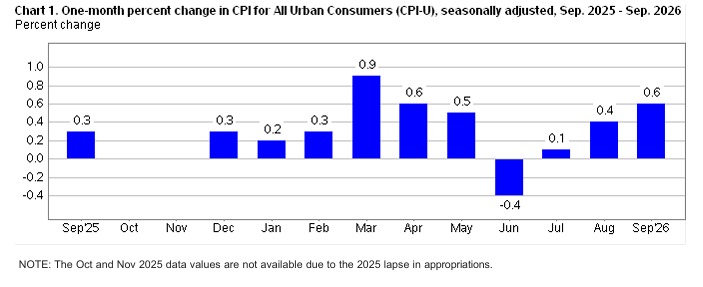
In September, the Consumer Price Index for All Urban Consumers (CPI-U) increased 0.6% on a seasonally-adjusted basis after rising 0.4% in August, according to the U.S. Bureau of Labor Statistics. Over the last 12 months, the all-items index increased 3.7% before seasonal adjustment—higher than the 3.4% increase reported last month.
Data show the index for gasoline rose 9.1% in September, accounting for over half of the monthly all-items increase. The energy index increased 5.2% month-over-month following a 2.1% increase in August, while the shelter index rose 0.4% after rising 0.3% a month prior. The index for food was unchanged in September, as the index for food-away-from-home increased 0.2% and the index for food-at-home fell 0.1%.
The index for all-items-less-food-and-energy rose 0.3% in September, as it did in August. Indexes on the rise include recreation, used cars and trucks, education, airline fares, medical care and apparel. Conversely, the index for communication was among the small number of major indexes to decrease in September.
Overall, the all-items-less-food-and-energy index rose 2.6% year-over-year, following a 2.4% increase a month ago. The energy index increased 20.4%, while the food index increased 2.5% year-over-year.
Sentiment
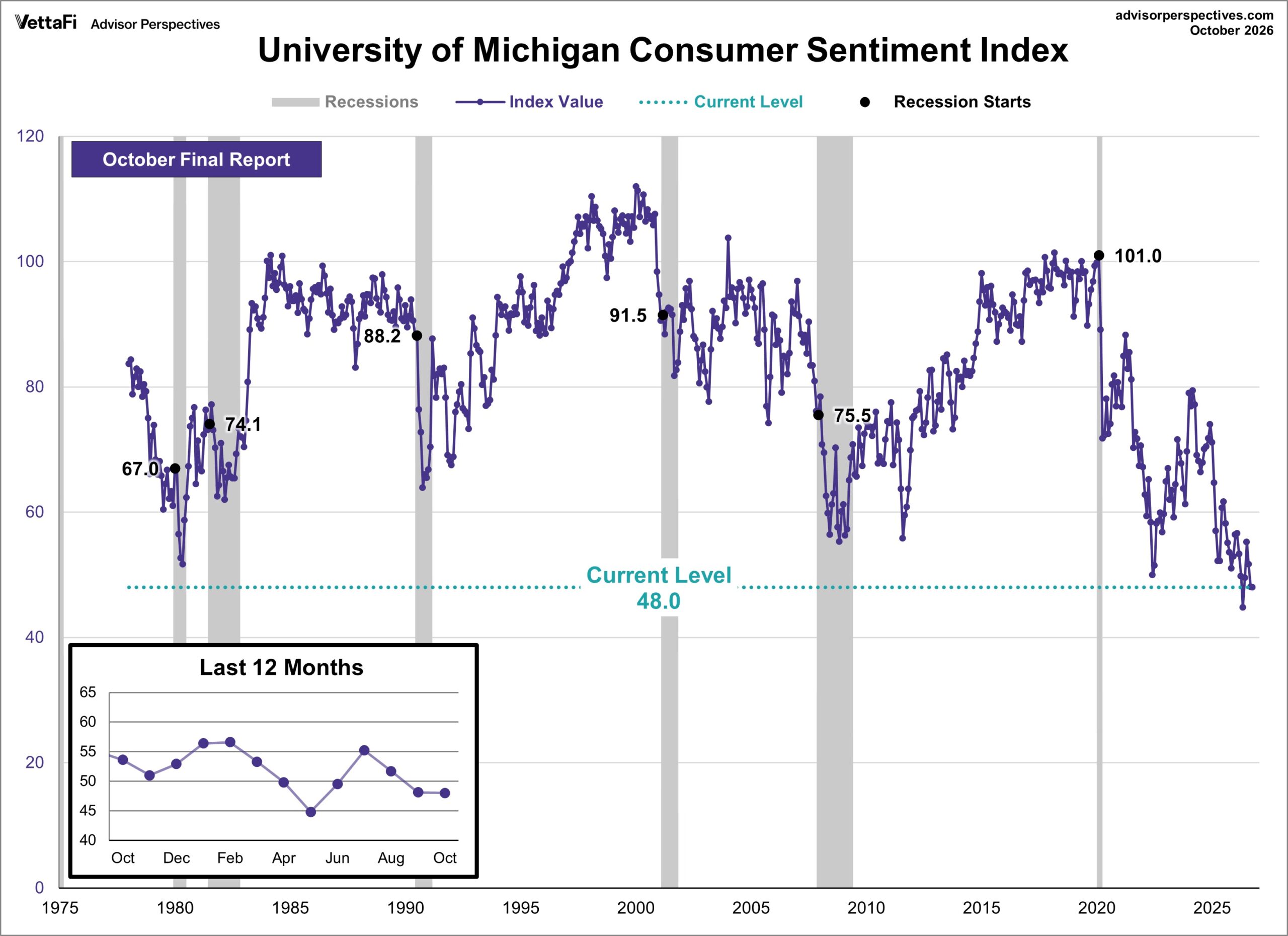
The University of Michigan Survey of Consumers—a survey consisting of approximately 50 core questions covering consumers’ assessments of their personal financial situation, buying attitudes and overall economic conditions—registered 48.1 in September and posted a preliminary reading of 48.0 in October.
According to Joanne Hsu, director at Survey of Consumers, consumer sentiment held steady this month, “registering a scant one-tenth of an index point below September.”
Increases in sentiment among Republicans and Democrats were balanced by declines among independents. While year-ahead business conditions improved approximately 14%, the figures remain down 16% year-over-year.
“This month’s decline in the Current Conditions sub-index was driven entirely by buying conditions for durables, which plunged 18% on the basis of higher interest rates and rising concerns about the affordability of such purchases. Purchasing power continues to dominate consumer views of the economy,” Hsu says, noting sentiment is 10% below a year ago and 15% less than February, just prior to the Iran conflict.
Key Takeaways, Courtesy of Survey of Consumers:
- Year-ahead inflation expectations ticked up from 4.6% last month to 4.7% this month. The current reading substantially exceeds the 3.4% seen in February before the Iran conflict began, along with all 2024 readings.
- Long-run inflation expectations also stepped up from 3.4% in September to 3.5%, notably higher than their 2024 range of 2.8% to 3.2%. Inflation expectations over both time horizons increased for the second straight month to their highest readings since May.
Confidence
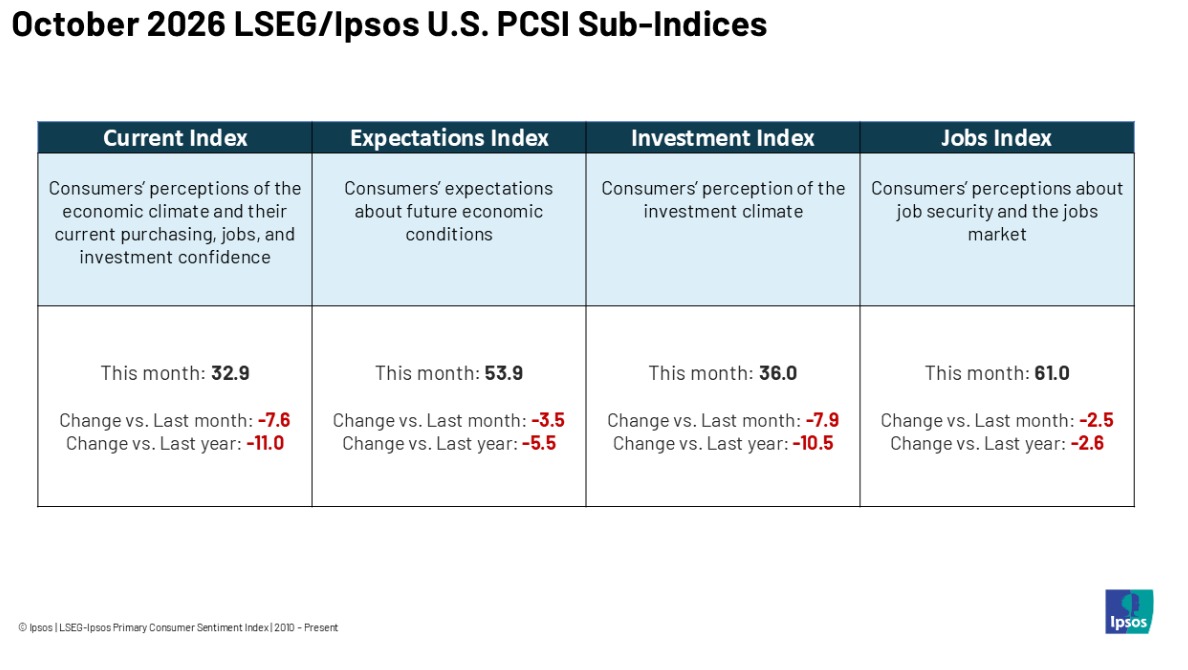
The Conference Board Consumer Confidence Index rose by 7.5 points, registering 91.7 (1985=100) in October, up from 84.2 in September (a slight upward revision). The Present Situation Index—based on consumers’ assessment of current business and labor market conditions—increased by 8.6 points to 120.4. The Expectations Index—based on consumers’ short-term outlook for income, business and labor market conditions—recovered by 6.9 points to 72.6, only partially reversing three consecutive monthly declines.
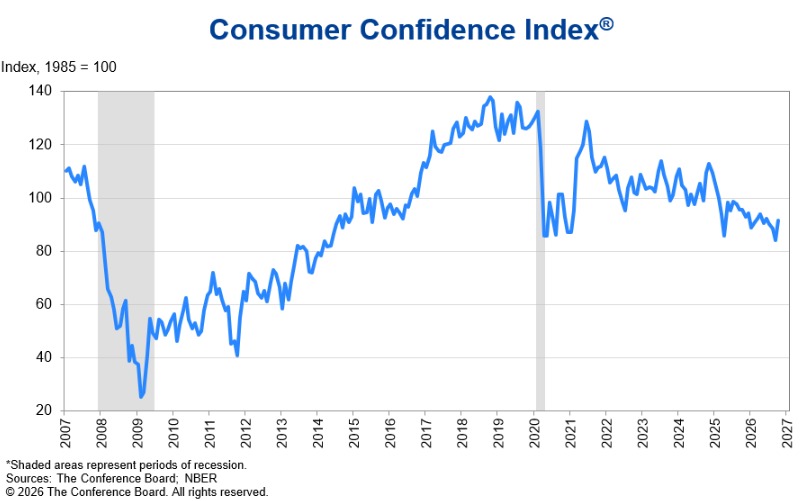
Consumer confidence advanced in October, driven primarily by improved perceptions of current and expected business conditions.
“The recovery was in line with retail gasoline prices easing from September to October. Yet, despite the increase in October, consumer confidence remained on the long-term downward trend that’s persisted over the past few years,” says Fergus McCormick, senior economist of global indicators at The Conference Board.
While consumer confidence improved across all political affiliations, data show only consumers under age 35 and those with a household income of $100,000 or more expressed an increase in confidence. McCormick notes confidence among Gen X, baby boomers and the Silent Generation continued to trail significantly behind Gen Z and millennials, “widening a sharp generational divide that has emerged over the past two years.”
Key Takeaways, Courtesy of The Conference Board:
- Perceptions of current employment conditions were moderately more favorable, with the labor market differential—the share of consumers saying jobs are “plentiful” minus the share saying jobs are “hard to get”—improving by 2.4 percentage points to +5.3%.
- Consumers felt better about their Family’s Current Financial Situation in October after two weak months. Views of their Family’s Future Financial Situation over the next six months remained optimistic.
- Asked to assess the likelihood of a U.S. recession over the next 12 months, “somewhat likely” remained consumers’ most cited answer.
- Consumers’ average 12-month inflation expectations declined in October but remained elevated at 5.8%. Consumers still expected higher interest rates over the next 12 months.
- Overall, more consumers in October expected stock prices to increase rather than decrease in the next 12 months.
- Consumers planned less spending on services and durable goods over the next six months. This likely reflected higher price levels and persistent inflation, which eroded consumers’ purchasing power.
- On a six-month moving average basis, plans to purchase autos and homes both declined slightly in October. Planned spending on durable goods in the month dropped across the board, with expected purchases of electronics such as smartphones, personal computers, laptops and tablets pulling back by over 1%.
- Expected spending on services over the next six months was generally lower, except for movies, theater, live entertainment and sporting events. The top five spending plans included restaurants, bars and take-out; streaming, internet and mobile services; utilities; health care; as well as beauty and personal care.
- Anticipated spending on hotels and airfare for personal travel moderated. Likewise, vacation plans dipped, with 43.3% of consumers planning a vacation in the next six months, down 0.9 percentage points from an upwardly revised 44.2% in September. More consumers planned domestic trips and fewer planned visits to foreign countries.
“Among write-in responses in October, consumers continued to express frustration with rising costs. References to prices, the high cost of food and groceries, as well as oil and diesel prices rose. Comments about war and conflict eased for a second straight month but remained elevated. Mentions of jobs and employment as an area of concern also ticked up, though to a lesser extent,” McCormick says.
Consumer Income & Spending
According to the U.S. Bureau of Economic Analysis (BEA), personal income, disposable income (DPI) and personal consumption expenditures (PCE) increased $54.5 billion (0.2% at a monthly rate), $52.7 billion (0.2% at a monthly rate) and $113.1 billion (0.5% at a monthly rate), respectively.
Personal outlays—the sum of PCE, personal interest payments and personal current transfer payments—increased $113 billion in September. Personal saving was $911.1 billion, while the personal saving rate, calculated by personal saving as a percentage of DPI, registered 3.8%.
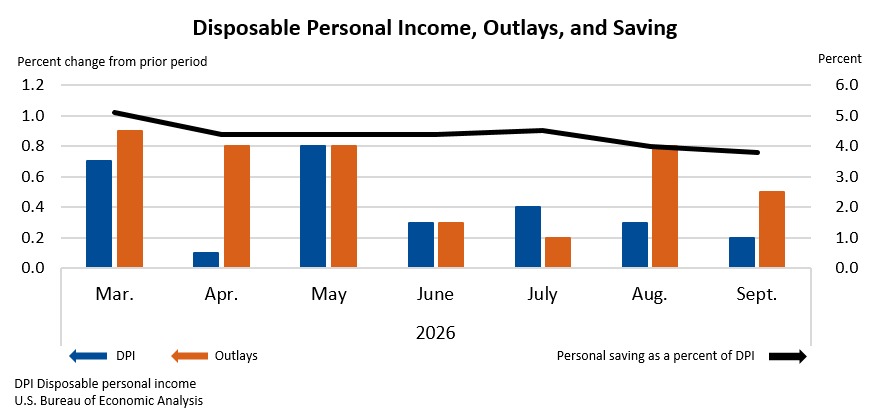
Key Takeaways, Courtesy of the U.S. Bureau of Economic Analysis:
- In September, the $113.1 billion increase in current-dollar PCE reflected increases of $35.1 billion in spending on goods and $78.1 billion in spending on services.
- Real PCE increased $2.6 billion (less than 0.1% at a monthly rate).
- From the preceding month, the PCE price index increased 0.5%. Excluding food and energy, the PCE price index increased 0.3%.
- The PCE price index increased 3.6% year-over-year. Excluding food and energy, the PCE price index increased 3.1% from one year ago.