- KPI – November 2026: State of Manufacturing
- KPI – November 2026: State of Business – Automotive Industry
- KPI – November 2026: State of the Economy
- KPI – November 2026: Consumer Trends
- KPI – November 2026: Recent Vehicle Recalls
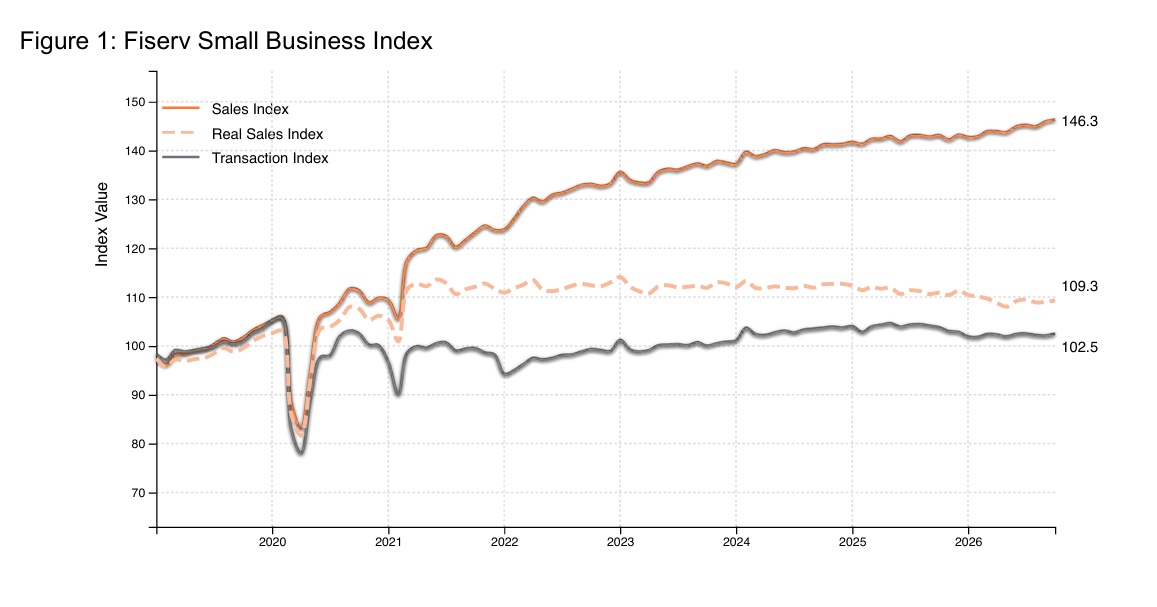
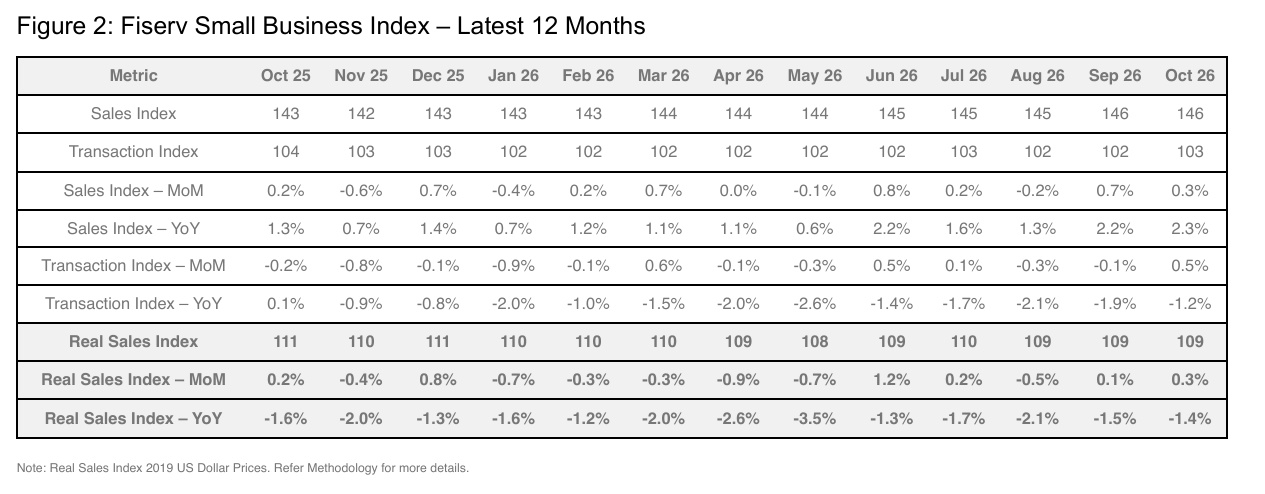
In October, the national Fiserv Small Business Index and Fiserv Small Business Transaction Index reflected “mixed momentum.” The Fiserv Small Business Index, which tracks small business sales, reached 146.3 — growing 2.3% year-over-year and 0.3% month-over-month.
Meanwhile, the Fiserv Small Business Transaction Index recorded 102.5, declining by 1.2% year-over-year but improving 0.5% month-over-month. Data shows this split points to changing consumer spending behavior across small business sectors. The Real Fiserv Small Business Index, adjusted for inflation, reached 109.3 in October 2026, with a 1.4% year-over-year decline and 0.3% month-over-month incline.
“Small businesses are entering the holiday season with encouraging momentum on both spending and customer activity,” says Prasanna Dhore, chief data officer at Fiserv. “October’s monthly sales gains come from more purchases, not larger tickets. Sustaining that momentum as holiday shopping accelerates will be the next signal to watch.”
Key Takeaways, Courtesy of the Fiserv Small Business Index
- Restaurants steadied but continue to lag: Food services and drinking places sales slipped 0.5% year-over-year but rose 0.2% month-over-month, driven by 0.8% monthly growth at limited-service restaurants. Transactions fell 2.7% since last year, an improvement from September’s 3.9% decline; however, average tickets rose 2.2%. Limited-service restaurants remained down 2.2% year-over-year, as transactions fell 4%. Full-service restaurants and drinking places edged up 0.5% and 3.7%, respectively.
- Gas station sales climbed and grocery stalled: Gasoline station sales moved up 23.2% year-over-year, their fastest growth pace in 2026. This was driven by a 22.3% rise in average tickets. By contrast, grocery sales were flat year-over-year. Transactions grew 1% year-over-year, but average tickets fell 1.1%.
- Retail kept its traffic gains, but many big-ticket categories lagged: Total retail sales rose 1.9% year-over-year on 2.2% transaction growth, while average tickets slipped 0.3%. The biggest contributions to this increase came from gas stations (+23.2%), sporting goods, hobby, music and bookstores (+4.3%) and motor vehicle and parts dealers (+3%). Furniture, home furnishings, electronics and appliances sales fell 2.5% year-over-year.
- Essential spending expanded as services regained footing: Essentials grew 2.7% year-over-year, widening their lead over discretionary spending (+2.0%). Professional services sales grew 4.6%, led by tax preparation services (+18.6%). Services (+2.3% year-over-year growth) edged past goods (+2.2% growth). Services foot traffic fell 2.4%, still an improvement from September, while average tickets rose 4.8%. Goods growth came from foot traffic: transactions rose 2.1% while average tickets were essentially flat at 0.2%.
The NFIB Small Business Optimism Index registered 97.8 in October, down 0.1 point from a month prior and slightly below the 53-year average of 98.0. The Uncertainty Index fell six points to 84, the lowest level since December 2025.
“There was little change in optimism among small businesses in October as owners navigated enduring challenges, though there were some encouraging developments,” says Bill Dunkelberg, chief economist at NFIB. “Even with inflation pressures continuing to strain operations, more Main Street owners reported their businesses in good or excellent health and actual sales improved. Looking ahead, continued strength in consumer spending will support economic growth, while persistent inflation, labor shortages and policy risks will weigh on the small business outlook.”
Important Takeaways, Courtesy of NFIB
- The percentage of small business owners reporting the quality or availability of labor as their top operating problem decreased 1 point to 25%, making it the top reported issue for the fourth consecutive month. The current reading is 13 points above the historical average of 12%.
- The second top issue in October was taxes, which rose notably from September. Twenty-one percent of small business owners reported taxes as their single most important problem, up 10 points from September and the highest level since May 2021.
- Small business owners’ self-evaluation of the health of their business shifted positively, with more reporting their business as excellent and good rather than fair. When asked to evaluate the overall health of their business, 15% rated it as excellent (up 2 points), 54% as good (up 6 points), 26% as fair (down 9 points) and 4% as poor (unchanged).
- In October, expectations for better business conditions improved, after two months of deterioration. A net 8% (seasonally adjusted) of owners expect better business conditions over the next six months, up 2 points from September and still above its average.
- Eleven percent (seasonally adjusted) reported that it is a good time to expand their business, up 4 points.
- A seasonally adjusted 36% of all owners reported job openings they could not fill in the current period, up 4 points from September and 12 points above the historical average.
- The two inventory components of the Optimism Index both downshifted, with the net percent with inventory “too low” falling 3 points to a net -3% and planned inventory investments sliding 3 points as well to a net -1%.
- Inflation pressures grew in October as both price measures increased. A seasonally adjusted net 33% of owners reported raising average selling prices (up 2 points) and a net 37% plan to increase prices, up 6 points — and the highest level since July 2022.
- In October, a net 13% of owners reported paying a higher interest rate on their most recent loan, up 5 points from September. This is the highest level since August 2024.
Key Performance Indicator Report Overview
Professionals in the automotive, RV and powersports industries remain steadfast in their efforts to evolve their business models and grow their brands in the face of adversity. As such, the monthly Key Performance Indicator Report serves as an objective wellness check on the overall health of our nation, from the state of manufacturing and vehicle sales to current economic conditions and consumer trends. Below are a few key data points explained in further detail throughout the report.
Key Takeaways
- In October, economic activity in the manufacturing sector expanded for the 10th consecutive month, say the nation’s supply executives in the latest ISM Manufacturing PMI Report. The Manufacturing PMI registered 55.5% in October, 1 percentage point above the September figure of 54.5%. The overall economy expanded for the 24th month in a row.
- Total new-vehicle sales for November 2026, including retail and non-retail transactions, are projected to reach 1,200,100 — a 1.2% year-over-year increase, according to a joint forecast from J.D. Power and GlobalData.
- During the first 15 days of November, the Manheim Used Vehicle Value Index was unchanged at 206.8 as wholesale used-vehicle prices (adjusted for mix, mileage and seasonality) remained steady.
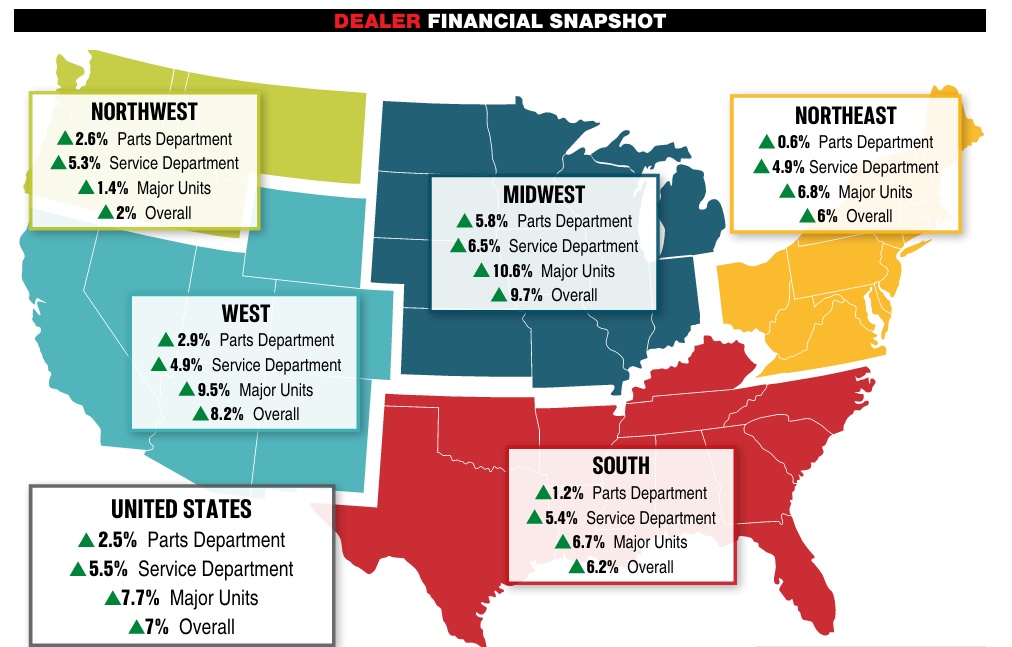
- Powersports Business says dealers across the country reported an incline of 7% in combined same-store sales compared with the same month last year, according to composite data from more than 1,700 dealerships in the U.S. that utilize CDK Lightspeed DMS. On average, dealerships were up 7.7% in major units, 2.5% in the parts department and 5.5% in service.