- KPI – November 2026: The Brief
- KPI – November 2026: State of Manufacturing
- KPI – November 2026: State of the Economy
- KPI – November 2026: Consumer Trends
- KPI – November 2026: Recent Vehicle Recalls
U.S. New Vehicle Market
Total new-vehicle sales for November 2026, including retail and non-retail transactions, are projected to reach 1,200,100 — a 1.2% year-over-year increase, according to a joint forecast from J.D. Power and GlobalData.
“November results demonstrate the ongoing tension between vehicle affordability and sales volumes as the industry navigates elevated interest rates and fuel prices. Transaction prices are up 1.2% from October and 2.2% from a year ago, to a new record high of $47,154 for the month of November. Monthly finance payments are up 0.6% from October and 4.2% from a year ago for a November record of $840 per month. In contrast, retail sales are on pace to rise 1.6% on a selling-day-adjusted basis and decline 6.6% without the selling-day adjustment,” says Thomas King, president of OEM solutions at J.D. Power.
“All these dynamics are playing out as inventory on dealer lots is increasing, albeit by a modest amount,” he adds.

Key Takeaways, Courtesy of J.D. Power
- The seasonally adjusted annualized rate for total new-vehicle sales is expected to be 15.7 million units, down 0.2 million units from November 2025.
- Transaction prices are up 1.2% from October and 2.2% from a year ago, reaching a new record high of $47,154 for the month of November.
- Compared with a year ago, the average interest rate on new-vehicle loans is 6.71%, up 61 basis points and the highest November level since 2023.
- Monthly finance payments are up 0.6% from October and 4.2% from a year ago for a November record of $840 per month.
- Average incentive spending per vehicle is trending toward $3,589, a 5.6% increase from a year ago and $235 more than in October. Incentives as a percentage of manufacturer’s suggested retail price are expected to increase to 6.7%, up 0.2 percentage point from November 2025.
- Buyers continue to shift toward hybrids, with hybrid share of retail sales expected to reach 18.3%, up 3 percentage points from last year, due to elevated fuel prices and increased availability of hybrid vehicles.
U.S. Used Market
During the first 15 days of November, the Manheim Used Vehicle Value Index was unchanged at 206.8 as wholesale used-vehicle prices (adjusted for mix, mileage and seasonality) remained steady.
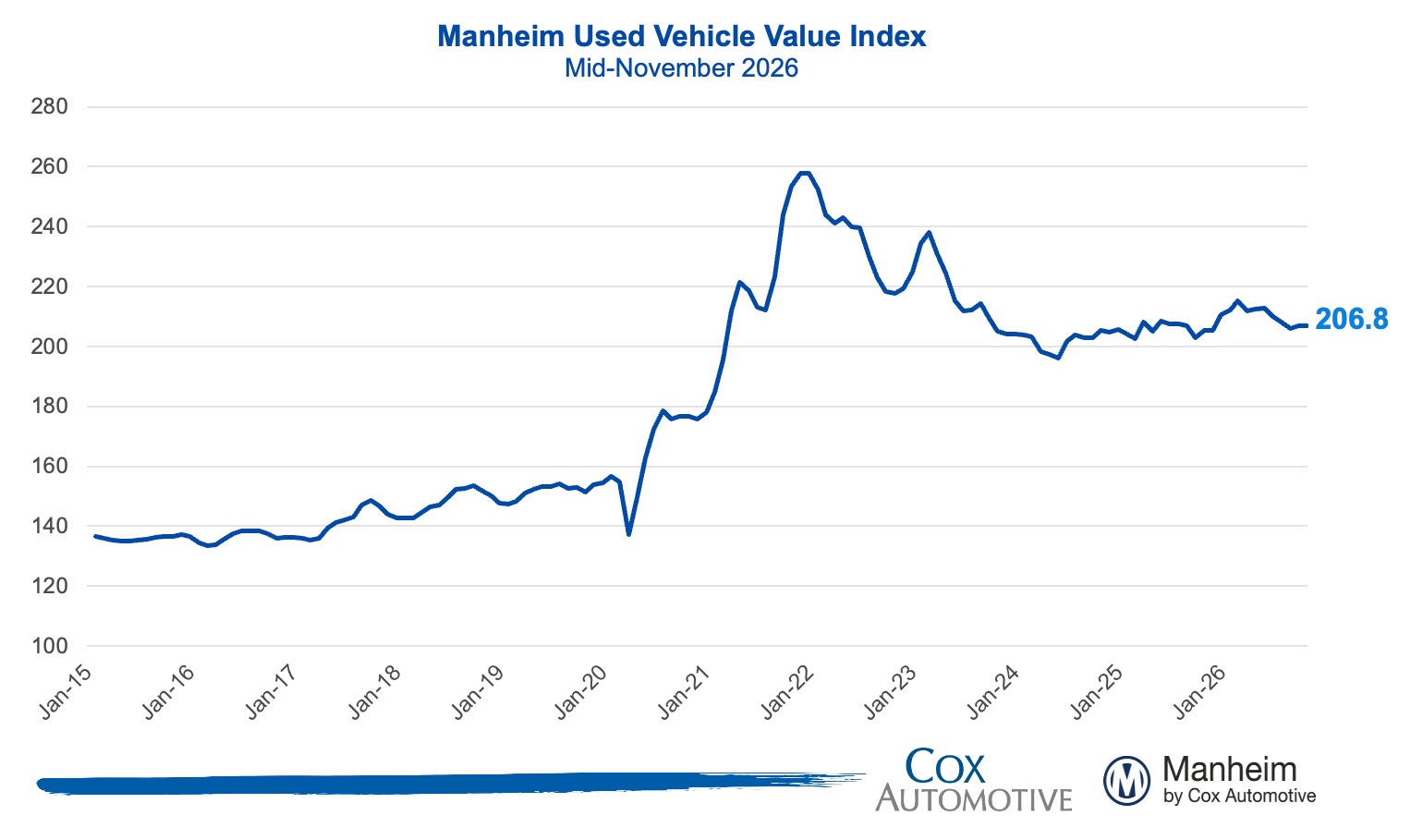
The Manheim Used Vehicle Value Index held, while non-adjusted values fell 0.7% — steeper than the last two years. The seasonally adjusted index appeared flat largely due to recent November numbers being weak. The year-over-year gain narrowed to 0.7% from 2% in October, which is mostly arithmetic, according to Jonathan Gregory, senior director at Cox Automotive.
“October’s weakness flattened the comparison and values rebounded in November 2025, so that cushion is gone. Units sold were running roughly 6% above last year through mid-month and sales conversion was about 1.5 percentage points higher, while retention held near 99% (flat with last year),” Gregory says.
“Vehicles are clearing, but sellers are meeting the market on price rather than buyers chasing inventory. Fuel costs are still shaping where values hold up. With gas roughly 90 cents above last year, compact cars are up 10% year-over-year, while luxury, SUVs and pickups remain below last year,” he continues.
EVs are the exception: Their year-over-year gain has narrowed to 3.4% from 6.6% in October as more off-lease units reach the lanes.
“The financing backdrop won’t make the rest of the quarter any easier. The 10-year Treasury is back above 5%, and markets are pricing in a high probability of a Fed rate hike in December, a direct headwind for financed buyers heading into tax season. Prices are holding for now, but depreciation is running faster than normal, and the second half of the month will tell us whether this stability holds,” Gregory says.
Global Light Vehicle Sales
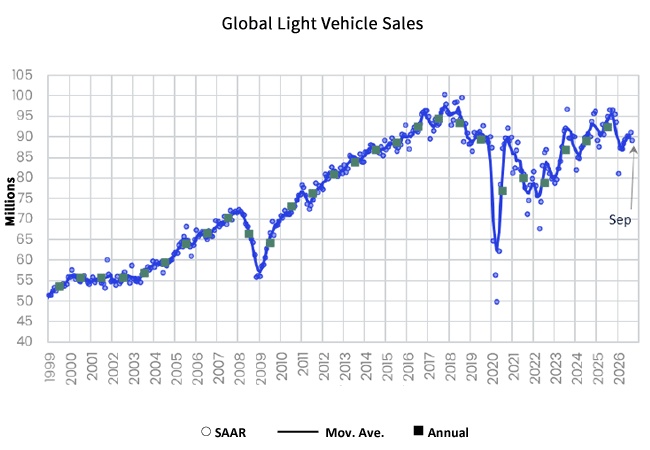
Editor’s note: The Global Light Vehicle sales report for November, which covers October data, was not available at the time of publication. The information below is from last month’s report and reflects September data.
In September, the global light-vehicle selling rate fell to 89 million units per year — bringing the year-to-date average selling rate to 88 million units per year in 2026, 4.4% lower than the full-year 2025 result.
“As has been the case for much of the year, sales declined sharply year-over-year in China, dragging down the global market despite some bright spots elsewhere,” says David Oakley, manager of Americas vehicle sales forecasts at GlobalData.
According to the report, “weak economic fundamentals and lack of policy support” in China pose significant headwinds. By contrast, the U.S. returned to year-over-year growth, although the selling rate eased and rising fuel costs are steering buyers toward hybrids. Western Europe continues to be supported by the electrification momentum, while India remains the key driver in Asia.
With one quarter of sales remaining, data shows it looks very likely that the market will not improve upon last year. Year-to-date sales stand at 65 million units, down 4.3% compared with the first nine months of 2025.
“Our forecast for total global sales in 2026 now stands at 87.9 million units, compared to 88.3 million units a month ago. This forecast would represent a 4.8% year-over-year decrease, with the Chinese market expected to drag on sales until 2027,” Oakley says.